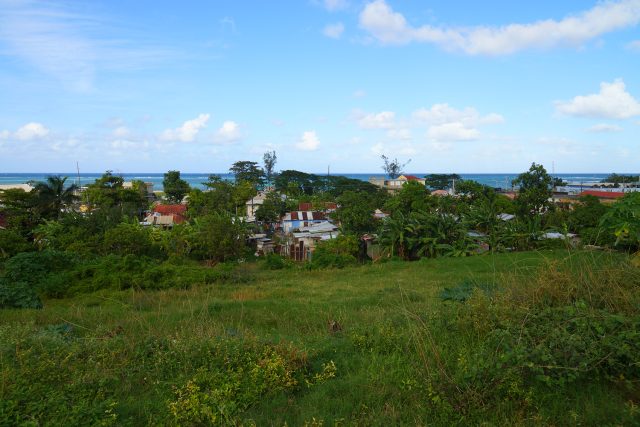
Saint Anne’s Bay is a quiet coastal town where the past feels closer than it does in Jamaica’s more tourist-heavy spots. It’s the kind of place where history isn’t just remembered—it’s still alive in the slow rhythm of daily life, the way the sea breeze carries the scent of salt and ripe fruit, and in the unassuming square where Marcus Garvey’s memorial stands. Garvey was born here in 1887, and though his life took him across oceans, this small town remains the heart of his legacy. The memorial isn’t grand or imposing, but it carries the weight of ideas that reshaped how millions of people saw themselves and their place in the world.
The monument itself is simple: a bronze bust of Garvey mounted on a stone pedestal, surrounded by low walls lined with plaques that tell his story. The sculpture captures him mid-speech, his expression intense, as if he’s still addressing the crowds that once filled Harlem’s streets or Kingston’s squares. The plaques quote his words—some fiery, some measured—but all of them carry the same core message: that Black people had the right to dignity, self-determination, and a future unshackled from colonial rule. The memorial isn’t just a tribute; it’s a reminder of how one man’s vision could ripple across continents.
Garvey’s ideas weren’t born in a vacuum. He grew up in a Jamaica still under British rule, where racial hierarchies were rigid and opportunities for Black people were limited. His early years in Saint Anne’s Bay were shaped by the same landscapes that visitors see today—rolling green hills, the turquoise sweep of the Caribbean, and the quiet resilience of a community that had long learned to make do with little. As a young man, he left for Kingston, then London, and finally the United States, where he founded the Universal Negro Improvement Association (UNIA). At its peak, the UNIA was the largest Black-led organization in history, with chapters from New York to Cape Town. Garvey’s call for a return to Africa wasn’t about abandoning the diaspora but about reclaiming a homeland that had been stolen.
The memorial sits in the center of town, surrounded by pastel-colored buildings with wooden shutters and overhanging balconies—a reminder of Jamaica’s colonial past. The square is small, but it feels intimate, shaded by trees that dapple the sunlight onto the flowers below. On any given day, you might see schoolchildren gathered for a history lesson, their teacher pointing to the plaques as they try to imagine what it was like to hear Garvey speak. Locals stop by too, some to pay their respects, others simply to sit on the benches and watch the world go by. There’s no fanfare here, just a quiet acknowledgment of how deeply Garvey’s ideas are woven into Jamaica’s identity.
After Jamaica gained independence in 1962, Garvey was officially recognized as a national hero, and his influence became part of the country’s foundation. The memorial was renovated in the 1980s, but its purpose never changed: to keep his legacy alive for new generations. On Emancipation Day or Independence Day, the square comes alive with music, speeches, and the rhythmic beat of drums. It’s easy to imagine Garvey’s spirit lingering in those moments, not as a distant historical figure but as someone whose words still resonate. His famous declaration—*"A people without the knowledge of their past history, origin, and culture is like a tree without roots"*—is etched into one of the plaques, a sentiment that feels especially poignant here.
Saint Anne’s Bay isn’t the kind of place that draws crowds. There are no all-inclusive resorts or flashy nightclubs, just a handful of guesthouses, a few beachside shacks serving jerk chicken, and the kind of slow, unhurried pace that makes you forget about time. The town is surrounded by lush hills, and the beaches nearby are some of the island’s most beautiful—soft white sand, water so clear it looks like glass. But it’s the memorial that gives the town its soul. It’s a place where visitors can step away from the postcard-perfect image of Jamaica and see something deeper: the roots of a nation’s struggle for freedom.
Garvey’s ideas didn’t just shape Jamaica; they echoed across the Black world. His emphasis on economic empowerment, cultural pride, and political self-determination influenced movements from the Civil Rights era in the U.S. to anti-apartheid struggles in South Africa. Reggae musicians like Bob Marley later carried his messages into global consciousness, turning his words into anthems. Standing in front of the memorial, it’s impossible not to feel the weight of that legacy. The plaques don’t just tell Garvey’s story—they connect it to a larger narrative of resistance and resilience.
For many Jamaicans, the memorial is more than a stop on a tour. It’s a place of reflection, a spot where the past and present intersect. Teachers bring their students here to talk about colonialism, independence, and what it means to fight for justice. Elders come to remember the struggles they lived through. Tourists, too, find something here—a sense of history that’s personal, not just academic. The memorial doesn’t offer easy answers, but it asks the right questions: What does freedom really mean? How do we honor the past while building the future?
Saint Anne’s Bay might be small, but its connection to Garvey makes it feel larger than itself. The town is a reminder that great ideas don’t always come from capital cities or centers of power. Sometimes, they begin in quiet places, in the minds of people who refuse to accept the world as it is. The memorial doesn’t just commemorate Garvey; it invites visitors to think about their own place in history. And in a world where the fight for equality is far from over, that might be the most powerful tribute of all.