Saint Anne’s Church in Saint Ann’s Bay is one of those places in Jamaica where history isn’t just remembered—it lingers in the air, in the worn stone steps, in the way the light falls through the windows. Perched on a hill overlooking the bay, the church has stood here since the mid-1700s, a quiet witness to the island’s transformations. Its whitewashed walls, bleached by sun and salt, carry the weight of centuries, from the days when Jamaica was a jewel of the British Empire to the slow, uneven march toward independence. The town below was once a bustling port, a stop for ships laden with sugar, rum, and human cargo, and the church watched it all, its presence as steady as the tides.
The building itself is a study in practical elegance, a blend of English colonial design and the realities of a tropical climate. Thick limestone walls, quarried locally, keep the interior cool even when the Caribbean sun blazes outside. High arched windows let in breezes along with light, while the heavy wooden roof, though unassuming, has held firm through hurricanes and time. The bell tower, modest compared to the soaring spires of European cathedrals, still cuts a distinct silhouette against the sky. In earlier days, its chime would have marked not just the hours but the rhythms of community life—calling people to prayer, announcing news, or tolling for the dead.
Inside, the church feels intimate, almost domestic in its simplicity. The wooden pews, smoothed by generations of hands, lead toward a plain altar adorned with delicate carvings. The stained glass, though not as vivid as the grand windows of European churches, casts a soft, diffused glow, turning the space into a refuge from the outside world. The organ, installed in the 19th century, is one of the few of its kind still in use on the island. Its sound is warm and slightly uneven, a reminder of the craftsmanship of another era. On Sundays, when the congregation gathers, the music swells with voices that carry the cadences of Jamaica—English hymns woven with African rhythms, a quiet testament to the island’s layered identity.
The church’s history is inseparable from Jamaica’s own. In the 18th century, it was more than a place of worship; it was a hub of social life, where births, marriages, and deaths were recorded, where disputes were settled, and where the community gathered to make sense of the world. For enslaved Africans, it was one of the few spaces where they might find a moment of solace, though the faith they were offered was not their own. After emancipation in 1838, the church became a symbol of new beginnings for many, a place where freed people could redefine themselves beyond the brutality of slavery. The walls, though silent, hold these stories—the whispered prayers, the quiet defiance, the fragile hope.
Today, Saint Anne’s Church remains a living part of Saint Ann’s Bay. It welcomes both locals and visitors, though there’s no grand welcome, no tourist spectacle. The services are still conducted in English, but the music and the spirit of the congregation reflect Jamaica’s cultural mosaic. On feast days, the church is decorated with flowers, and the bell rings out as it has for centuries, its sound carrying over the rooftops and down to the sea. The rituals may have evolved, but the sense of continuity is palpable.
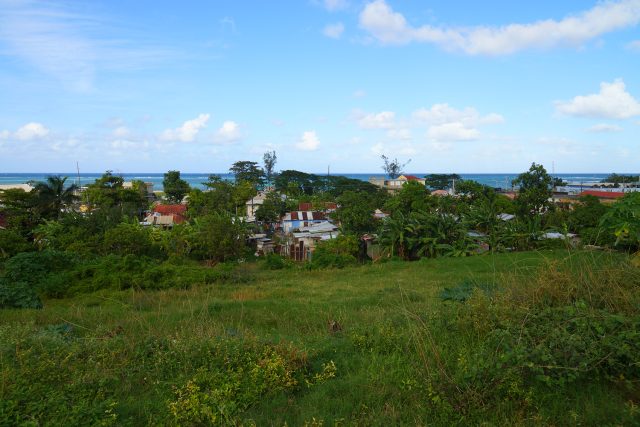
Beyond the church, a small garden sprawls across the hillside, filled with mango trees, bougainvillea, and the occasional hummingbird darting between blossoms. It’s a place to sit in the shade, listen to the waves below, and let the quiet settle over you. The garden feels like an extension of the church itself—less a manicured space than a natural one, where history isn’t preserved in glass cases but grows wild in the soil. The trees, the stones, the very air seem to hold memories, as if the past isn’t something that happened long ago but something that still lingers, just beneath the surface.
For those who visit, the church offers different things. Some come for the history, tracing the lines of the building’s architecture or imagining the lives of those who once filled the pews. Others come for the atmosphere—a rare stillness in a world that often feels too loud. There’s no guided tour, no gift shop, no scripted experience. Just the church, the garden, the sound of the wind through the trees, and the distant murmur of the sea. It’s the kind of place where time doesn’t so much stand still as move at its own pace, unhurried and unforced.
Saint Anne’s Church isn’t a monument frozen in time. It’s a place that breathes, that changes with the seasons and the people who pass through its doors. For some, it’s a connection to Jamaica’s colonial past; for others, it’s a reminder of resilience and faith. But for everyone who steps inside, it offers something simple and enduring: a moment of quiet, a sense of belonging to something larger than themselves. In a world that often feels fragmented, that’s no small thing.