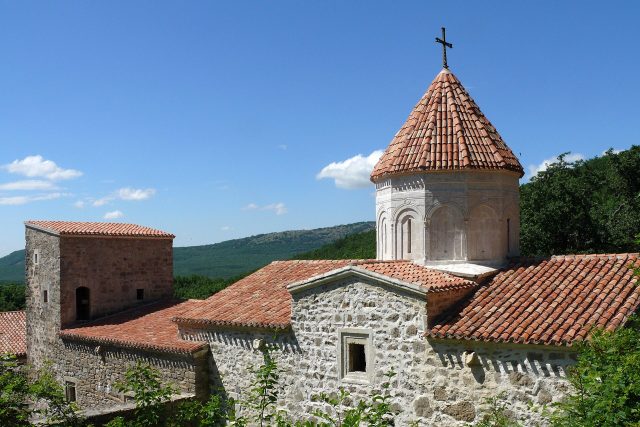
Old Crimea is one of those places where history lingers in the air, not as something distant and abstract, but as a living presence. The town sits quietly in the foothills of the Crimean Mountains, its streets lined with low houses and overgrown gardens, where the past seems to breathe through the cracks in the old stone walls. Among its many layers—Genoese, Tatar, Ottoman—one of the most enduring is the legacy of the Golden Horde, and nowhere is that legacy more tangible than in the Khan Uzbek Mosque.
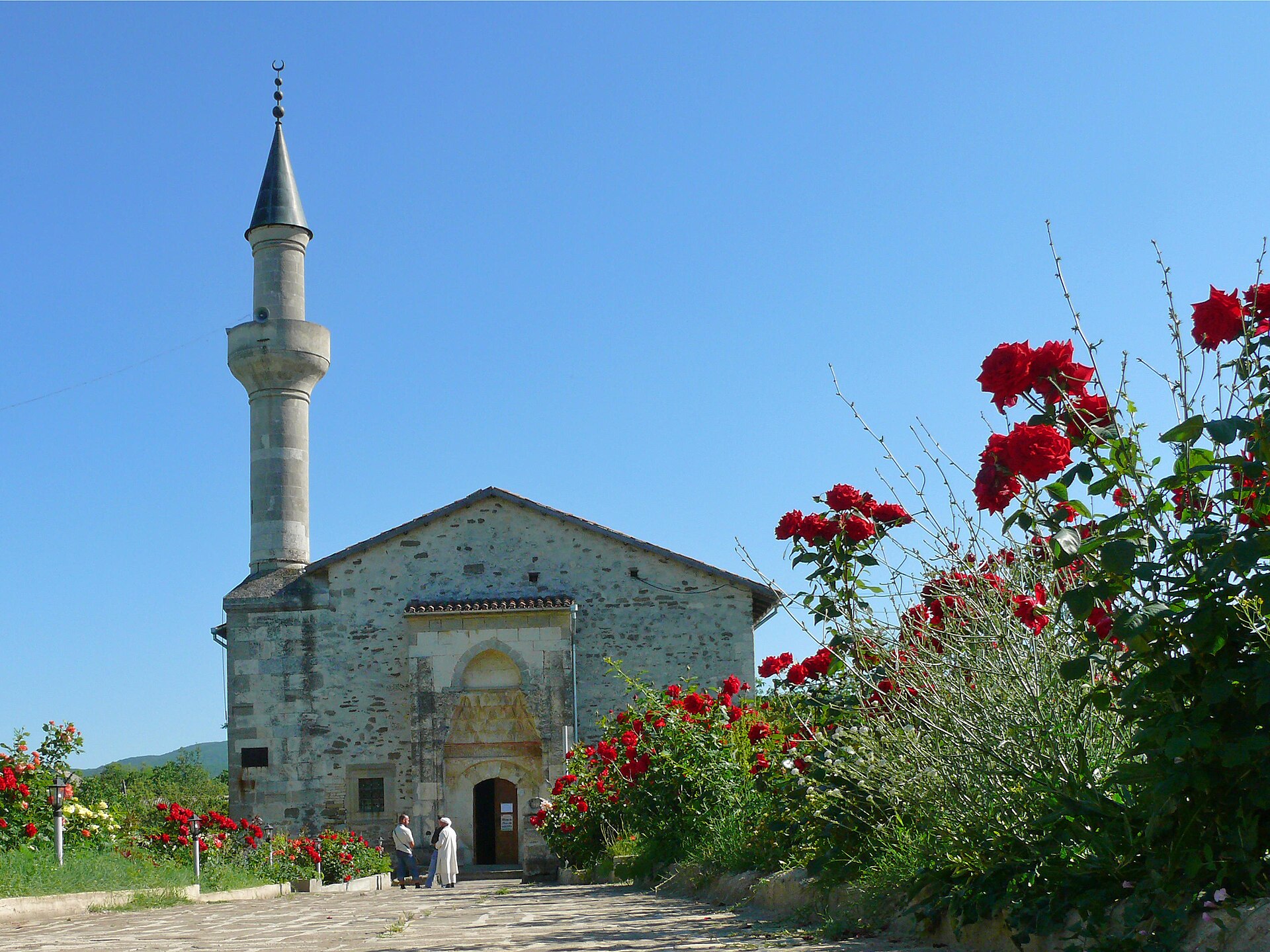
Built in the early 14th century, the mosque is one of the oldest surviving Islamic structures in Crimea. It was commissioned by Khan Uzbek, a ruler who not only expanded the Golden Horde’s territory but also played a key role in the spread of Islam across the steppe. The mosque’s architecture reflects the simplicity and functionality of early Islamic design in the region, with thick stone walls, a flat roof supported by wooden beams, and a modest minaret that rises just enough to call the faithful to prayer. Unlike the grand mosques of Istanbul or Cairo, this one feels intimate, almost domestic, as if it grew organically from the earth rather than being imposed upon it.
The building itself is unassuming, almost austere. There are no intricate mosaics or soaring domes, just a rectangular prayer hall with a small courtyard. The entrance is marked by a simple arched doorway, above which the original Arabic inscription still faintly traces the name of the khan and the date of construction. Inside, the space is divided by rows of columns, their stone bases worn smooth by centuries of use. The mihrab, the niche indicating the direction of Mecca, is carved directly into the wall, its lines clean and unadorned. Light filters in through narrow windows, casting shifting patterns on the floor, where the shadows of the past seem to mingle with the present.
What makes the Khan Uzbek Mosque remarkable is not its size or ornamentation, but its endurance. Over the centuries, Crimea has been a crossroads of empires—Mongol, Genoese, Ottoman, Russian—and each left its mark, often erasing what came before. Yet this mosque survived, not as a relic behind glass, but as a place of worship. It weathered the rise and fall of khanates, the shifting borders of empires, and the slow ebb and flow of populations. Even during the Soviet era, when religious buildings across the region were repurposed or destroyed, the mosque remained standing, though its purpose was often obscured.
Today, the mosque is still active, though its congregation is small. The call to prayer no longer rings out from the minaret, but on Fridays, a handful of worshippers gather inside, their voices low and measured. The surrounding neighborhood has changed little over the decades—narrow streets, fruit trees heavy with apricots in summer, the occasional stray dog dozing in the shade. The mosque is not a tourist attraction in the conventional sense; there are no guided tours or souvenir stalls outside. Instead, it exists as part of the town’s quiet rhythm, a place where history is not performed for visitors but simply is.
For those who take the time to visit, the mosque offers more than just a glimpse into the past. It is a reminder of how faith and identity can persist through upheaval. The Golden Horde may be long gone, but its legacy lives on in this small stone building, in the way the light falls through its windows, in the way the air feels heavier with the weight of centuries. Old Crimea itself is a place where time moves differently, where the past is not something to be visited but something that surrounds you, like the scent of wild thyme on the mountain breeze.
If you wander beyond the mosque, the town unfolds in layers. The ruins of Genoese fortresses loom on the hills, their stones scattered like the bones of a forgotten giant. Further out, the steppe stretches endlessly, the same windswept expanse that once carried Mongol horsemen across the continent. The mosque stands as a quiet counterpoint to all of this—a place of stillness in a landscape shaped by movement. It does not demand attention, but for those who listen, it tells a story of resilience, of a faith that outlasted empires, and of a town that has learned to carry its history lightly.