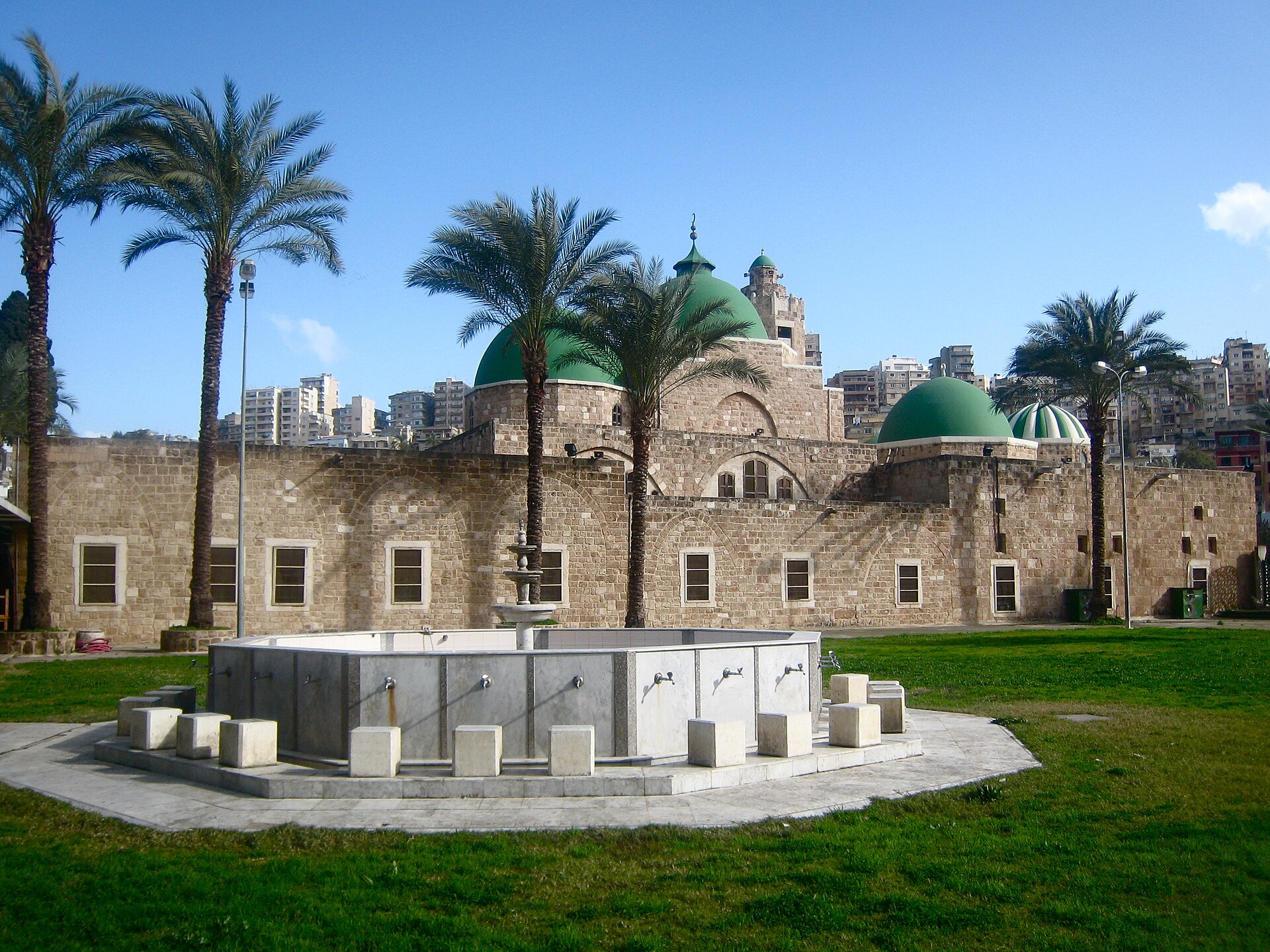
Taynal Mosque in Tripoli is one of those rare places where history isn’t just preserved in stone but feels alive, shifting with the city around it. Built in the 14th century under the Mamluk sultan Qalawun, it was originally part of a larger religious complex that included a madrasa, a hospital, and a library. Today, only the mosque remains, yet it still stands as a quiet witness to an era when Tripoli was a thriving center of the Islamic world, and the Mamluks constructed buildings that balanced military strength with refined beauty.
From the outside, the mosque appears unassuming, especially when compared to the grander Ottoman structures that came later. But that modesty is part of its charm. The entrance is marked by an intricately carved portal, where geometric patterns and Arabic calligraphy intertwine—a hallmark of Mamluk design. Inside, a spacious courtyard with a fountain for ablutions is framed by arcades supported by dark basalt columns. These columns, like many other details here, were repurposed from older Roman and Byzantine ruins, a common practice in the Levant, where each new era didn’t so much erase the past as reinterpret it.
The main prayer hall is striking in its simplicity and balance. The high mihrab, pointing toward Mecca, is adorned with marble and Quranic inscriptions. Wooden beams support the ceiling, while light filters through lattice windows, casting gentle shadows across the space. Unlike the lavish mosques of Istanbul or Cairo, there’s no gilding or tilework here, just a sense of authenticity, as if time has paused and you’re standing in the same place where merchants, scholars, and warriors once prayed centuries ago.
Tripoli has always been a city of trade routes, and Taynal Mosque is deeply tied to that history. In the Middle Ages, it stood near the harbor, where ships from Venice, Genoa, and Egypt docked. Pilgrims on their way to Mecca and merchants dealing in spices, silk, and glass would gather here. The mosque wasn’t just a place of worship but a hub of daily life—people met in its courtyard to exchange news, strike deals, or rest in the shade. Though the harbor has long since been built over and the port moved elsewhere, the connection to that past remains palpable.
Over the centuries, the mosque has undergone several restorations, yet its core features endure. When the Ottomans took control of Tripoli in the 16th century, they added a minaret in their signature style—tall and slender, with a balcony for the muezzin. In the 20th century, the building suffered damage from earthquakes and conflict, but each time it was carefully restored, preserving its original character. Today, Taynal Mosque remains an active place of worship, and while it doesn’t draw crowds of tourists, locals treat it with quiet reverence, as a living part of their city.
The surrounding neighborhood is just as compelling. Old Tripoli is a maze of narrow streets, where layers of history reveal themselves at every turn. Nearby is the famous Khan al-Saboun, a market still selling handmade soap, and a short walk away stands the Crusader fortress, looming over the city. Getting lost here is part of the experience—you might stumble upon a forgotten fountain, a house with ornate wooden balconies, or a tiny café serving the best mana’eesh in town.
Visiting Taynal Mosque isn’t just about seeing a historic site; it’s about stepping into the rhythm of a city that effortlessly blends different eras. There are no tourist crowds, no souvenir stalls, no pushy guides—just the quiet of the inner courtyard, the rustle of leaves overhead, and the sense that life within these walls continues much as it has for centuries. If you’re lucky, you’ll hear the call to prayer echoing over the rooftops of Tripoli, and in that moment, it becomes clear why this place matters—not just as an architectural landmark, but as a living piece of the city’s soul.