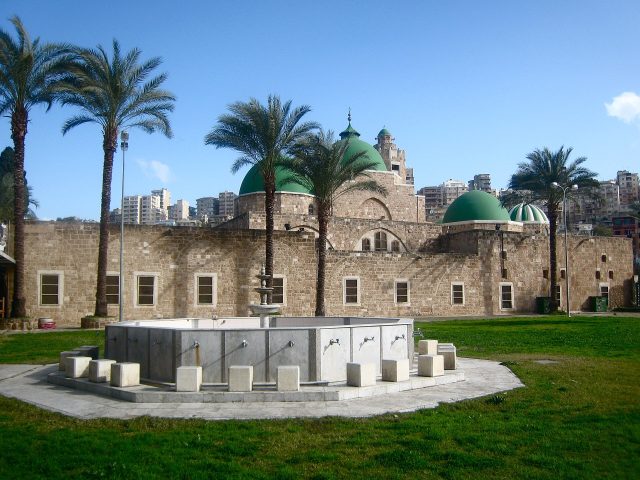
The Great Mansouri Mosque in Tripoli is one of those rare places where history isn’t just preserved in stone—it breathes, shifts, and endures alongside the city itself. Built in the early 14th century, it stands at the crossroads of eras, cultures, and architectural traditions, a silent witness to the layers of time that have shaped this corner of the Levant. Its origins trace back to the Mamluk sultan Al-Mansur Qalawun, who sought to cement his legacy not only through military conquest but through grand construction. Tripoli, then a thriving hub of trade and politics, needed a monument that would reflect its importance, and the mosque became just that—a symbol of power, stability, and the intricate blend of influences that defined the region.
The architecture of the mosque reflects the austere elegance of Mamluk design, where geometric precision meets delicate craftsmanship. The main entrance is framed by an intricately carved portal, its patterns weaving together calligraphic inscriptions and symmetrical motifs. Inside, a spacious courtyard is bordered by arcades supported by columns salvaged from older structures—some Roman, some Byzantine—a common practice in Lebanon, where every stone seems to carry echoes of past civilizations. The minaret, rising above the city’s skyline, once served a dual purpose: calling the faithful to prayer while also acting as a watchtower, scanning the horizon for approaching caravans or potential threats.
What makes the mosque particularly fascinating is its location. It was built atop the ruins of an earlier Crusader church, which itself may have stood on the site of a Roman temple. This kind of layering is typical of the Middle East, where borders between cultures and faiths have always been fluid. Today, fragments of those earlier structures are embedded in the mosque’s walls, subtle reminders of how closely intertwined the histories of different peoples have been here. The interior is understated, with a mihrab adorned in simple stucco work and a floor of stone slabs worn smooth by centuries of footsteps. There’s a quiet dignity to the space, as if the years have polished away anything unnecessary.
Tripoli is a city where Muslim and Christian neighborhoods have coexisted for centuries, and the Great Mansouri Mosque sits at the heart of this coexistence. It occupies a central place in the old city, surrounded by narrow streets where the scent of spices and freshly baked bread lingers in the air. The area around the mosque is always alive with activity—vendors selling sweets and coffee, children playing in the square, elders gathered on benches exchanging stories. Time here moves at its own pace, untouched by the rush of the modern world. The mosque isn’t just a religious site; it’s a part of the city’s daily rhythm, a place where life unfolds in its most ordinary and yet profound moments.
Despite its historical significance, the mosque hasn’t been reduced to a museum piece. It remains an active place of worship, drawing not only locals but also pilgrims from across the region. On Fridays, the courtyard fills with worshippers, and during Ramadan, the mosque becomes a focal point of community life. After sunset, iftar meals are shared here, bringing people together in a tradition that has endured for generations. For visitors, this offers a rare glimpse into how religious practices are woven into the fabric of everyday existence.
Tripoli has seen its share of turmoil in recent decades, and the mosque has not been spared. During the civil war, it suffered damage from shelling, though it was later restored. The scars of those years remain visible in places, though they’re rarely spoken of openly. For the people of Tripoli, the mosque is more than just a building—it’s a repository of memory, a link to their past. Even those who aren’t particularly religious often come here to reconnect with that history, to feel the weight of the centuries that have shaped their city.
Visiting the Great Mansouri Mosque is a reminder that some places are more than just landmarks. There are no rigid rules for tourists, no signs dictating behavior, but a quiet expectation of respect—for the space, for those who come to pray, for the history that resides within its walls. Women are advised to cover their shoulders and hair, and men to avoid shorts, but beyond that, the mosque asks only for mindfulness. Inside, the atmosphere is one of hushed reverence, where even the sound of footsteps seems amplified. It’s a place to pause, to step away from the noise of the city, and to simply stand in the quiet, watching how the light plays across the ancient stones.
Tripoli is a city of contrasts—where crumbling buildings stand beside grand mansions, where centuries-old mosques share the streets with modern cafes. The Great Mansouri Mosque is one of those anchors that help make sense of its character. It doesn’t demand attention or dazzle with opulence; its strength lies in its unassuming presence. Here, history isn’t put on display—it’s lived, breathed, and carried forward by the people who pass through its doors. That, perhaps, is why the mosque continues to draw visitors—not just as a monument to the past, but as a place where the past and present intersect in the most ordinary and extraordinary ways.