The Sultan Abdul Hamid Mosque sits quietly on the edge of Jericho, where the city’s modern streets give way to the gentle slopes of the desert. Built in the early 1900s, it was named after the Ottoman sultan Abdul Hamid II, a ruler whose empire was already fading but still left its mark across the Middle East. The mosque is modest in size, a small but enduring piece of that legacy, blending into the landscape without demanding attention.
Its architecture is unmistakably Ottoman, with a slender minaret tapering toward the sky and an entrance framed by a simple arched portal. Inside, light filters through tall windows, casting soft patterns on the walls, which are adorned with understated geometric designs. There is no grand ornamentation here—no gilded domes or polished marble—just a sense of stillness, as if the past century has barely touched the place.
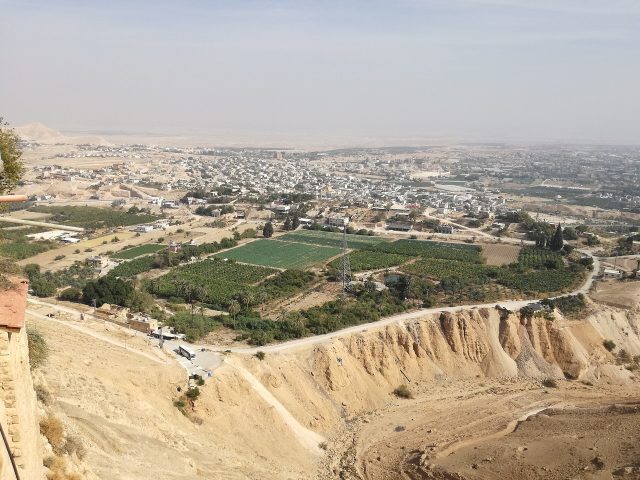
Jericho is one of the oldest continuously inhabited cities in the world, and this mosque arrived relatively late in its long history. By the time it was built, Palestine had been part of the Ottoman Empire for centuries, and the mosque settled naturally into the surroundings. The city itself is a patchwork of eras—palm groves and gardens stretch out in every direction, while biblical stories linger in the air, from the fall of Jericho’s walls to the encounter between Jesus and Zacchaeus. The mosque doesn’t compete with these ancient narratives; it simply exists alongside them.
Unlike the crowded holy sites of Jerusalem or Bethlehem, the Sultan Abdul Hamid Mosque sees few visitors. Those who do come can take their time, moving through the space without hurry. The courtyard, enclosed by a low wall, is usually quiet, the only sounds the rustling of palm fronds and the distant murmur of life from nearby homes. It’s a place where the present feels suspended, where the weight of history is palpable but not overwhelming.
Jericho has a unique status in the region, and visitors to the mosque are expected to respect local customs. Women typically cover their shoulders and knees, while men avoid wearing shorts. Inside, voices are kept low, and photography is discouraged during prayer times. These aren’t strict rules so much as a quiet understanding—a way of acknowledging that the mosque remains a living part of the community, not just a relic.
This isn’t the kind of place that draws crowds or makes it onto every tourist itinerary. It doesn’t need to. The mosque serves its purpose without fanfare, a quiet presence in a city where history is measured in millennia rather than centuries. It’s a reminder that the past isn’t just found in ruins or grand monuments but in the everyday rhythms of life—how people gather, how they pray, how they carry on traditions that have endured for generations.
If you find yourself in Jericho, it’s worth stopping by. Sit in the courtyard for a while, listen to the silence, and let the layers of time settle around you. The mosque won’t offer dramatic revelations or sweeping views, but it will give you something rarer: a moment of stillness in a place where the past and present are always close at hand.