Shiraz has long been known as Iran’s city of poets, gardens, and wine, but among its many treasures, one building stands out for its quiet magic. The Nasir al-Molk Mosque, often called the Pink Mosque, is a place where light and color come together in a way that feels almost unreal. Built in the late 19th century during the Qajar era, it was commissioned by Mirza Hasan Ali Nasir al-Molk, a nobleman from one of Shiraz’s most prominent families. The mosque was never meant to be just another place of worship—it was an experiment in beauty, a space where architecture and art could elevate the act of prayer into something transcendent.
What makes the mosque unforgettable is its stained glass. The windows along the southern wall are filled with intricate patterns in shades of pink, purple, blue, and gold, and when the morning sun shines through them, the entire prayer hall is bathed in a kaleidoscope of light. The effect is fleeting—it lasts only a few hours after sunrise—but in that time, the mosque becomes a living painting. The floors, covered in Persian carpets, glow with shifting hues, and the vaulted ceilings seem to dissolve into the colors above. It’s easy to see why visitors often linger here, even those who don’t come for prayer. The space feels more like a sanctuary of light than a traditional mosque.
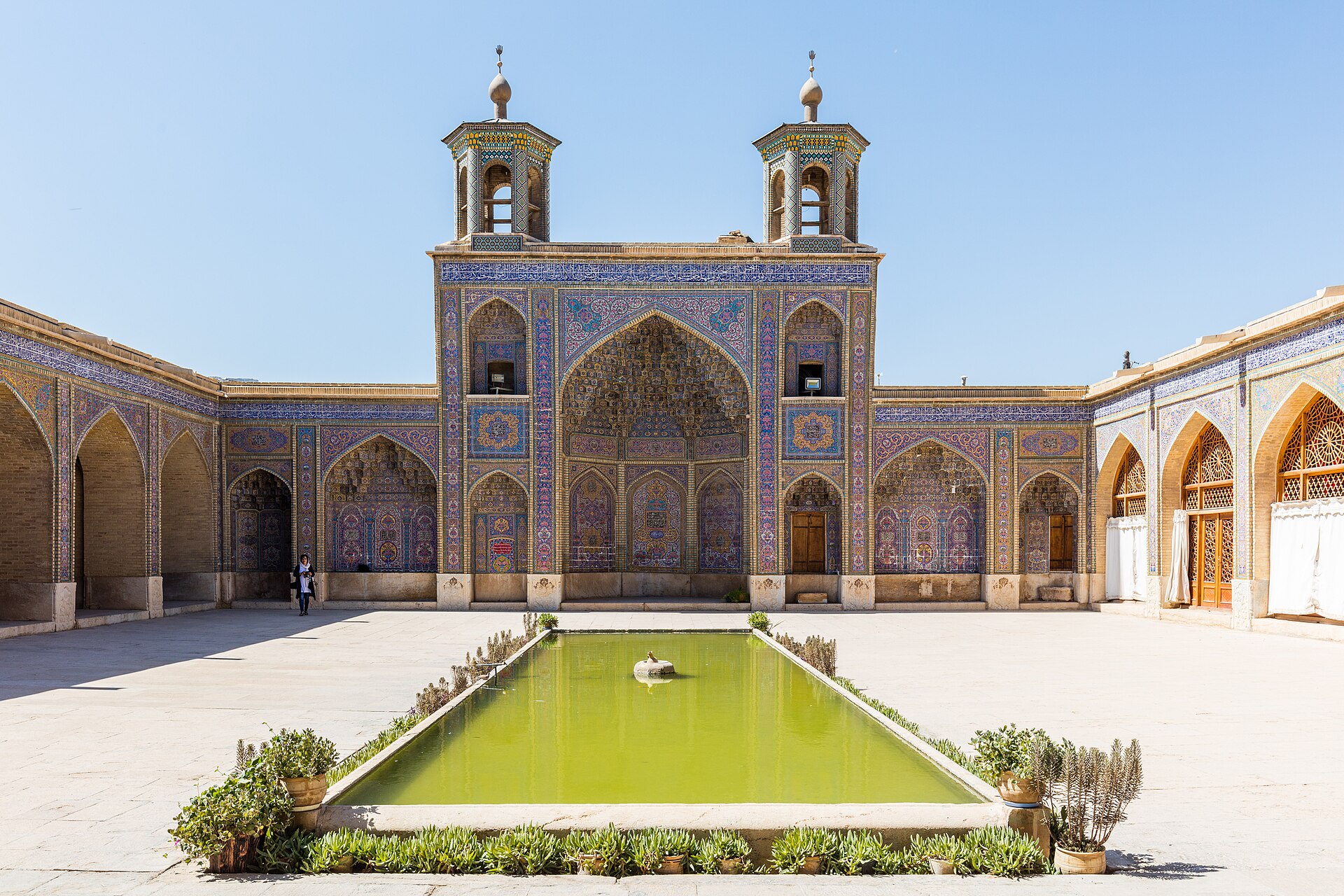
The architecture itself is a blend of Persian and Islamic styles, with influences that stretch back centuries. The mosque follows the classic four-iwan layout, a design that became standard in Iranian religious buildings after the Seljuk period. The iwans—vaulted halls open on one side—frame the central courtyard, creating a sense of symmetry and balance. The southern iwan, where the mihrab (the niche indicating the direction of Mecca) is located, is the most elaborate, adorned with intricate tilework and calligraphy. The tiles are a mix of geometric patterns and floral motifs, a hallmark of Qajar-era design, and they cover nearly every surface, from the walls to the minarets.
One of the most striking features is the mosque’s use of color. Unlike many Iranian mosques, which favor deep blues and turquoise, Nasir al-Molk embraces warmer tones. The exterior is clad in pinkish tiles, which give the building its nickname, while the interior plays with a broader palette. The stained glass is just one part of this; the walls and ceilings are also decorated with painted floral designs, their soft pinks and greens creating a gentle contrast with the bold geometry of the tiles. Even the courtyard, with its reflecting pool, is designed to enhance the play of light and color. The water mirrors the sky, and the surrounding arcades cast delicate shadows that shift as the day progresses.
The mosque’s history is intertwined with the broader story of Shiraz. The Qajar era, when it was built, was a time of relative stability for the city, which had long been a center of culture and learning. Shiraz was already famous for its poets, like Hafez and Saadi, and its gardens, which were celebrated in Persian literature. The Nasir al-Molk Mosque was part of this tradition—an attempt to create a space that was both spiritually meaningful and aesthetically refined. The family that commissioned it was deeply involved in the city’s intellectual life, and the mosque reflects their taste for beauty and innovation.
Today, the mosque remains a working place of worship, but it’s also one of Shiraz’s most visited landmarks. The best time to see it is in the early morning, when the light is soft and the colors are at their most vivid. By midday, the effect fades, and the mosque takes on a more subdued appearance. It’s a reminder that beauty, in this place, is fleeting—something to be appreciated in the moment. The caretakers are used to visitors, and while the mosque is still a sacred space, they allow people to wander quietly, as long as they’re respectful.
Beyond its visual splendor, the mosque offers a glimpse into the way Iranians have long thought about architecture and spirituality. In Persian culture, beauty is not just decoration—it’s a way of connecting with the divine. The Nasir al-Molk Mosque embodies this idea. The careful balance of light, color, and form isn’t just about aesthetics; it’s about creating an atmosphere that lifts the spirit. Even the act of walking through the courtyard, with its cool shade and the sound of water, feels like a small ritual.
For those who visit Shiraz, the mosque is often a highlight, but it’s also a place that rewards patience. The crowds can be thick in the morning, especially during peak tourist seasons, but if you wait a little, the space empties out, and you’re left with the quiet hum of the city outside. It’s a reminder that Shiraz, for all its history and grandeur, is still a living place, where the past and present coexist. The Nasir al-Molk Mosque isn’t just a relic of the Qajar era—it’s a part of the city’s daily life, a place where people still come to pray, to reflect, or simply to stand in awe of something beautiful.