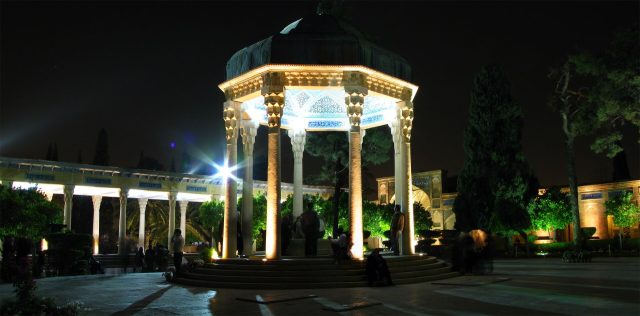
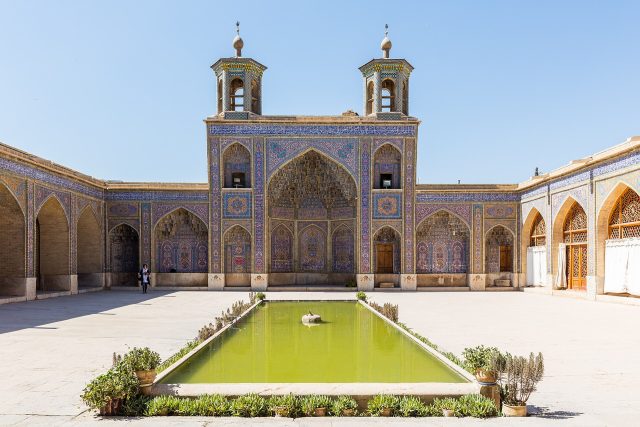
Eram Garden in Shiraz is one of those rare places where time seems to slow down, allowing you to step into a world that feels both ancient and timeless. Nestled along the banks of a quiet river in the northwest of the city, it has stood for centuries as a testament to the harmony between human craftsmanship and the natural world. Though its origins trace back to the Seljuk era, the garden took on its current form much later, during the 18th and 19th centuries, when local Qajar rulers commissioned its redesign. It was then that the iconic pavilion was built, a structure that still rises above the greenery, its presence a quiet reminder of the elegance of a bygone era.
The pavilion itself is a striking blend of Persian architectural traditions and European influences, a hallmark of the late Qajar period. Low and elongated, its facade is adorned with intricate tilework and carved patterns, while the towering columns of the portico are clad in colorful tiles depicting floral motifs. Inside, the halls feature painted ceilings and delicate stained glass, though access is limited—part of the building now serves as a university space. Still, even from the outside, the pavilion exudes a sense of refined beauty, its details hinting at the craftsmanship of those who built it.
Yet the true heart of Eram lies not in the pavilion but in the garden itself. Designed according to the principles of Persian garden design, it is a masterful fusion of water, greenery, and architecture. A central pathway leads from the entrance toward the pavilion, flanked by rectangular pools that mirror the surrounding trees. Cypresses, plane trees, and citrus groves line the walkways, their leaves rustling softly in the breeze. In spring, the garden bursts into color with roses and tulips, their fragrances mingling in the air. The cypresses, in particular, are legendary—some so old their gnarled trunks seem to whisper stories of the past.
For much of its history, Eram was a private retreat, accessible only to a select few. In the 20th century, it came under the care of Shiraz University, which still manages it today. While the garden now serves as a site for botanical research and student studies, for most visitors, it remains a place of quiet reflection rather than academic pursuit. Locals often come in the early hours to sip tea beneath the trees, while tourists arrive later in the day, drawn by the garden’s reputation as one of Iran’s most beautiful spaces. Despite its fame, Eram never feels crowded; its atmosphere is one of serene stillness, as if the outside world barely touches it.
The garden’s mood shifts with the seasons. In spring, it is alive with birdsong and the scent of blossoms, while summer brings a welcome respite from the heat beneath the shade of ancient trees. Autumn paints the leaves in hues of gold and crimson, and even winter has its own stark beauty, especially when a light frost dusts the branches. No matter the time of year, Eram retains a sense of tranquility, a place where the rush of modern life fades into the background. Perhaps that’s why it feels less like a tourist attraction and more like a sanctuary—somewhere to sit on a bench, listen to the murmur of water in the channels, and simply be.
Eram is often called the jewel of Shiraz, and the title is well-deserved. Alongside eight other Persian gardens, it holds a place on UNESCO’s World Heritage list, recognized as one of the finest examples of this unique landscape tradition. Persian gardens were never merely decorative; they were philosophical spaces, designed to evoke a sense of connection between humanity, nature, and the cosmos. Eram embodies this idea with particular grace. Its layout is precise, almost mathematical, yet it feels effortlessly natural, a place where every element exists in perfect balance.
The garden is deeply intertwined with Shiraz’s cultural and literary legacy. The city has long been a center of poetry and learning, and many of Persia’s greatest poets, including Hafez and Saadi, found inspiration in its gardens. It’s easy to imagine them walking these same paths, their verses shaped by the play of light on water or the scent of roses in the air. Today, you might still encounter students reciting poetry beneath the trees or artists sketching the pavilion’s intricate tilework. Eram feels like a living piece of history, a place where the past and present coexist seamlessly.
Visiting Eram isn’t about ticking off a sightseeing checklist. There are no crowds, no loud announcements, no rows of souvenir stalls—just the quiet rustle of leaves, the scent of earth and greenery, and the occasional ripple of water in the pools. You could spend hours wandering the pathways, admiring the patterns on the pavilion’s tiles, or simply sitting by the water, watching the sunlight shift across the garden. That’s the magic of Eram: it doesn’t demand anything of you except the willingness to pause, to look around, and to let the stillness settle in. In a world that moves too fast, it offers something rare—a moment of quiet, a breath of timeless beauty.