Standing in the heart of Shiraz, Karim Khan Fortress is a quiet witness to Iran’s turbulent past. Built in the mid-18th century under the orders of Karim Khan Zand, the founder of the Zand dynasty, it was more than just a military stronghold—it was the ruler’s personal residence and the political center of a nation in the making. At the time, Shiraz served as the capital of Iran, and the fortress became a symbol of authority and stability, shaping the city’s growth during an era when the country was fragmented into warring khanates. Karim Khan’s vision was to unite Persia under his rule, and the fortress stood as a tangible representation of that ambition.
The architecture of the fortress blends the austerity of a military structure with the elegance of Persian design. Its four corner towers, once part of a defensive system, now rise over the city as more decorative than functional elements. The thick walls, built from large bricks, bear the marks of time, while the entrance is adorned with traditional tilework featuring geometric patterns—a hallmark of Iranian architecture from that period. Inside, the courtyards, pools, and living quarters offer a glimpse into the daily life of the Zand court. The grand hall, with its high ceilings and recessed niches, likely once held royal decrees or works of art, though much of its original splendor has faded.
Karim Khan’s choice of Shiraz for his capital was no accident. The city had long been a center of culture and learning, home to some of Persia’s greatest poets, philosophers, and scholars. Under the Zand dynasty, Shiraz flourished—madrasas, libraries, and bustling bazaars sprang up around the fortress, which became the hub of decision-making for the entire region. After the fall of the Zands, the fortress took on different roles: it served as barracks, a prison, and later, in the 20th century, a museum. Each chapter of its history left its mark on the stone and plaster, layers that can still be seen if you look closely enough.
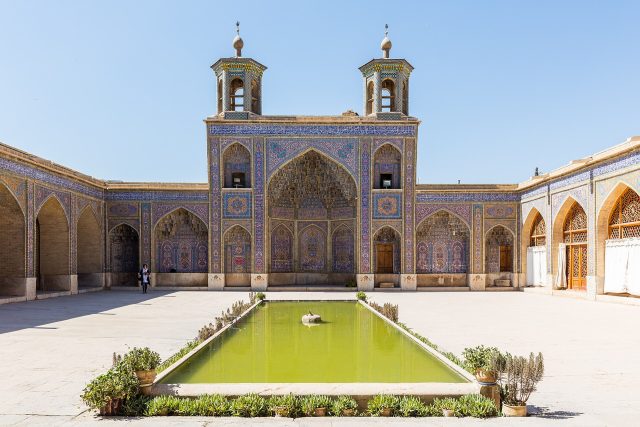
Today, the fortress is open to visitors, and though some of its interiors have been lost to time, the atmosphere of the past lingers. Walking through the inner courtyard, it’s easy to imagine the scene centuries ago—official receptions, the sound of music, the rustle of silk robes as courtiers moved across the marble floors. In one corner, a small pool surrounded by orange trees remains, a classic feature of Persian gardens meant to evoke the idea of paradise on earth. On hot days, the water reflects the fortress walls, creating a sense of timelessness, while in the evening, the shadows of the towers stretch across the ground in intricate patterns.
Karim Khan Fortress is more than just an architectural monument; it’s a place where Iran’s history feels alive and almost tangible. Unlike later structures adorned with elaborate decorations, this fortress retains a sense of authenticity and simplicity that makes it all the more compelling. It hasn’t been polished into a tourist attraction, and that’s part of its charm. There’s no attempt to romanticize the past here—just the raw, unfiltered presence of history in its stones, its scents, and its silence.
Shiraz has always been a city of poets, and the fortress seems to carry on that tradition. Within its walls, the verses of Hafez or Saadi feel almost audible, a reminder that true power lies not in weapons but in culture and memory. The fortress offers an escape from the modern world’s hustle, inviting visitors to step into the unhurried rhythm of life that once defined Persian cities. Even the noise of the streets outside fades into the background, replaced by the scent of blooming trees and the dry earth that has inspired artists and thinkers for centuries.
If you find yourself in Shiraz, the fortress is worth visiting not just for the photographs but for the chance to sit on one of its benches and imagine life here over two hundred years ago. History isn’t just recounted here—it’s felt in the cool touch of the old walls, heard in the rustle of leaves, and sensed in the stillness of the air. That’s why Karim Khan Fortress remains one of the most memorable places in the city, where the past and present coexist so naturally it’s as if there’s no boundary between them at all.