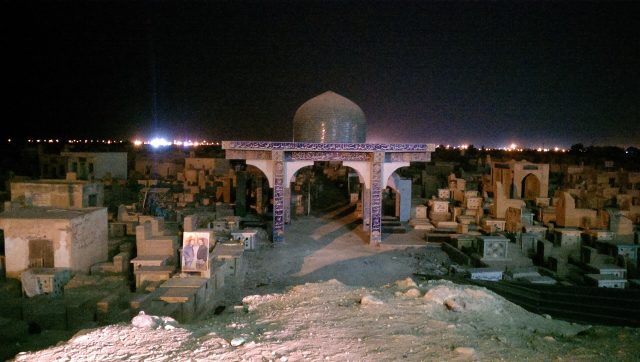
Kufa Mosque stands on the edge of what was once the ancient city of Kufa, now absorbed into the sprawl of Najaf. Its origins trace back to the seventh century, when these lands were still taking shape as the heart of a new faith. According to tradition, this was where Ali ibn Abi Talib, the son-in-law of the Prophet Muhammad and a central figure in Shia Islam, once stayed. For millions of believers, the mosque is not just a building but a living connection to the earliest days of Islam, when Kufa was one of the first Muslim cities beyond the Arabian Peninsula.
The mosque itself is unassuming compared to the grander structures of later Iraqi architecture. There are no gilded domes or intricate mosaics here—what matters is the sense of history embedded in its walls. The original structure was built from clay and palm trunks, like many buildings of its time, but it has been rebuilt and reinforced over the centuries. Today, it is a rectangular complex with an inner courtyard surrounded by arcades and a single minaret rising above the flat roof. Inside, the walls bear simple Quranic inscriptions, and the floors are covered with carpets worn smooth by generations of pilgrims.
Kufa was more than just a city in the early centuries of Islam—it was an intellectual hub where scholars, theologians, and poets gathered. The mosque played a key role in this, serving as a place for debates, lectures, and important decisions. It is said that Ali delivered some of his most influential sermons here, which later became foundational to Shia theology. For Shia Muslims, Kufa Mosque is one of the four holiest sites after Mecca, Medina, and the Imam Ali Mosque in Najaf, and visiting it at least once in a lifetime is considered a spiritual obligation.
The area around the mosque has changed little over the centuries. Narrow streets wind toward its walls, passing shops selling prayer beads, incense, and old manuscripts. The air feels thick with history, carrying the scent of spices and the weight of time. Under the shade of the arcades, elderly men often gather to discuss religious matters or rest after prayers. In the summer, the heat is relentless, and visitors tend to come early in the morning or as the sun sets. In winter, the mosque hums with quiet voices, as if time moves differently here.
The architecture of Kufa Mosque reflects the many transformations the city has undergone. The original structure was destroyed by fires and wars, but each time it was rebuilt, preserving its essence. During the Abbasid era, brick arches and domes were added, and under the Seljuks, the building took on a more monumental form. Later, Ottoman renovations introduced elements of Turkish design. Today, the mosque is a layered record of history, with every stone bearing the memory of those who prayed, studied, or simply passed through.
For locals, the mosque is more than a place of worship—it is woven into daily life. Weddings, religious festivals, and memorial gatherings all take place here. During the mourning period for Imam Hussein, the grandson of the Prophet Muhammad, the mosque becomes the center of processions and rituals. Thousands arrive to honor his memory, turning the streets of Kufa into a sea of black clothing and solemn chants. On ordinary days, the mosque has a quieter rhythm: Quranic recitations, lessons for children, and elders sharing stories of the past.
Despite its significance, Kufa Mosque remains free of ostentatious luxury. There are no golden gates or crystal chandeliers—just whitewashed walls, wooden beams, and carpets walked upon barefoot. This simplicity is part of what makes it special. It does not seek to impress but simply endures, a witness to a time when faith mattered more than outward splendor.
Today, the mosque is both a religious and historical landmark, drawing scholars and pilgrims from around the world. Walking through its courtyards, one can sense the spirit of early Islam, when Kufa was a center of the Muslim world. Nearby ruins hint at the city’s past as the capital of a caliphate. The mosque invites reflection on the countless lives that have passed through its walls and the prayers offered under its roof.
Kufa Mosque is a place where history is not just preserved in stone but lives on in the people who visit. Here, anyone can touch the past and feel a connection to those who worshipped centuries ago. That enduring presence is why it remains so meaningful to millions, for whom Kufa is not just a location but a part of their spiritual journey.