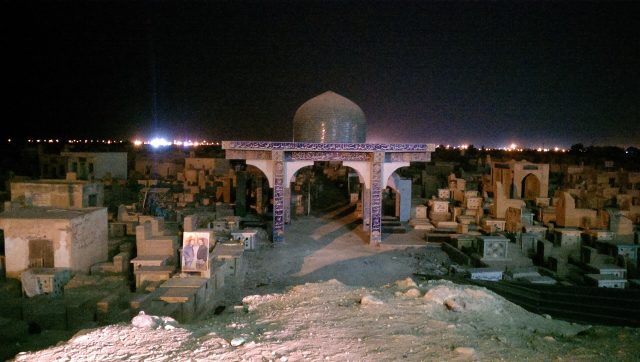
Al-Indiya Mosque in Najaf is one of those rare places where time seems to pause, allowing history and faith to intertwine in a quiet, almost tangible way. Najaf itself holds deep significance for Shia Muslims as the resting place of Imam Ali, the cousin and son-in-law of the Prophet Muhammad and a central figure in Islam. While the city’s most revered sites draw crowds of pilgrims, Al-Indiya stands slightly apart, offering something different—a blend of spiritual solace and architectural beauty that feels both intimate and grand.
Built in the early 20th century, the mosque doesn’t carry the weight of centuries like other landmarks in Najaf, yet its importance is no less profound. Its name, Al-Indiya—or the Indian Mosque—reflects its origins, funded by Indian Muslims who wished to honor Imam Ali. At the time, British India was home to millions of Shia Muslims, and their contributions to religious architecture across the Middle East left a lasting mark. The mosque became a symbol of unity, a reminder that faith transcends borders, languages, and cultures.
The architecture of Al-Indiya is a harmonious fusion of traditional Islamic design and elements borrowed from Indian craftsmanship of the era. The main dome, crowned with a golden crescent, rises gracefully above the city, while its slender minarets reach toward the sky with an almost delicate elegance. Inside, the mosque reveals a world of intricate detail: walls adorned with geometric tilework, marble surfaces polished to a soft sheen, and gilded accents that catch the light. The mihrab, the niche indicating the direction of Mecca, is particularly striking, crafted with precision and care. There’s no ostentatious luxury here, just a quiet reverence in every line and curve.
Najaf is a city where religion shapes daily life, and Al-Indiya fits naturally into this rhythm. Unlike the bustling shrine of Imam Ali, where pilgrims from across the globe gather in vast numbers, this mosque retains a more subdued atmosphere. Locals come for daily prayers, students of religious schools linger in quiet discussion, and travelers wander through, absorbing the city’s spiritual pulse. During prayer times, the air fills with the murmur of devotion, while at other hours, the space settles into a peaceful stillness, broken only by the occasional footsteps of visitors.
The mosque is nestled in Najaf’s old quarter, where narrow streets and low-slung clay houses evoke a sense of stepping back in time. Modernity feels distant here, replaced by the unhurried pace of life governed by prayer calls and tradition. Al-Indiya doesn’t dominate the skyline like some of the city’s larger structures, but its refined beauty makes it stand out. It blends seamlessly into the surroundings, yet its presence is unmistakable—a quiet testament to the craftsmanship and faith that brought it into being.
For many who visit, the mosque offers more than just a place of worship. It provides a different perspective on Najaf, one removed from the crowds and commerce of the city center. There’s no hustle here, no vendors calling out to passersby. Instead, Al-Indiya invites reflection, a moment to pause and consider the layers of history and culture that define this place. It’s why those who come to Iraq not just for pilgrimage but for a deeper understanding of its heritage often find themselves drawn to its doors.
Najaf, like much of Iraq, has endured its share of hardship. Wars and conflict have left scars on the city, yet Al-Indiya, like many of its sacred sites, has endured. It has witnessed the upheavals of the past century, standing as a silent observer to the changes that have shaped the region. For the people of Najaf, the mosque is more than just a building—it’s a part of their identity, a place of comfort and continuity in a world that has often been uncertain.
Visiting Al-Indiya is more than just admiring a beautiful structure; it’s an opportunity to connect with a story that spans continents and generations. The Indian Muslims who funded its construction over a century ago could scarcely have imagined how their gift would become woven into the fabric of another nation’s life. Yet that’s the nature of sacred spaces—they bind people together, even across vast distances. Today, the mosque remains a living bridge between past and present, a place where the echoes of devotion still resonate.