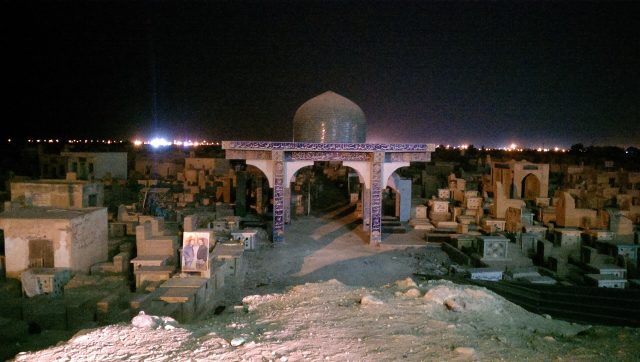
The Imam Ali Mosque in Najaf stands as one of the most revered sites in the Islamic world, particularly for Shia Muslims. It is believed to house the tomb of Ali ibn Abi Talib, the cousin and son-in-law of the Prophet Muhammad, who holds a central place in Shia tradition as the first Imam and is also recognized in Sunni Islam as the fourth Rightly Guided Caliph. For millions of believers, this mosque is not just a place of worship but a spiritual anchor, a pilgrimage destination that connects modern Iraq to the earliest days of Islam. The weight of history here is palpable, as if the very ground carries the echoes of centuries of devotion.
The mosque’s architecture is a testament to both grandeur and resilience. Over the centuries, it has been rebuilt and restored countless times, its current form shaped largely in the 19th and 20th centuries. The most striking feature is its golden dome, gilded with sheets of gold leaf, which rises nearly forty meters into the sky and gleams under the Iraqi sun. Flanking the dome are towering minarets, their silhouettes defining Najaf’s skyline. Inside, the space is a masterpiece of Islamic artistry—walls adorned with intricate mosaics, calligraphic verses from the Quran, and geometric patterns so precise they seem almost alive. The craftsmanship speaks to a tradition of devotion that transcends mere aesthetics, turning stone and gold into vessels of faith.
Najaf itself owes its existence to this mosque. The city grew around the shrine of Ali, and for centuries, its fate has been intertwined with the sacred site. During the medieval period, Najaf became one of the most important centers of Shia scholarship, drawing theologians, students, and pilgrims from across the Muslim world. It was here that Shia jurisprudence, theology, and philosophy flourished, shaping the intellectual foundations of the faith. Even today, Najaf remains a spiritual capital for Shia Islam, a place where critical religious and communal decisions are made. The mosque is not just a building but a living institution, its influence radiating far beyond its walls.
The atmosphere around the mosque is unlike anywhere else. The vast plaza in front of the entrance is always alive with movement—worshippers kneeling in prayer, groups of men engaged in quiet conversation, and vendors selling prayer beads, religious texts, and incense. The scent of frankincense and freshly brewed coffee lingers in the air, mingling with the calls to prayer that echo from the minarets. For locals, the mosque is woven into the fabric of daily life. People come not only to pray but to meet friends, discuss business, or simply sit in the shade of the ancient walls. It is a place where the sacred and the ordinary coexist, where the weight of history feels as natural as the rhythm of the city.
The mosque’s history mirrors the turbulent past of Iraq itself. It has survived invasions, wars, and destruction, each time rising again as a symbol of endurance. In the 13th century, the Mongol invasion under Hulagu Khan left the shrine in ruins, yet within decades, it was rebuilt. In more recent times, the mosque has faced damage from conflicts and uprisings, but the Shia community has always rallied to restore it. These cycles of destruction and renewal are not just part of its story—they are a testament to the unshakable faith of those who see the mosque as a beacon of hope. Today, it stands as both a religious sanctuary and a historical monument, a reminder of how belief can unite people even in the darkest times.
For pilgrims, visiting the Imam Ali Mosque is a deeply personal experience. Many travel great distances to spend days in prayer and reflection at the shrine. Inside, the space is dimly lit, the air thick with the murmur of prayers and the flicker of candlelight. The tomb itself is enclosed by a silver grille, and worshippers often press their hands against it, as if seeking a connection to the sacred. There is no rush here, no sense of urgency—only a quiet intensity, a focus that feels almost meditative. For those who come seeking solace or answers, the mosque offers a rare stillness in a world that often feels too loud.
Najaf and its mosque are not just for Shia Muslims. The city has long been a place of convergence, where people of different faiths and backgrounds have crossed paths. While access for non-Muslims can sometimes be restricted, those who do visit often leave with a lasting impression. The mosque’s significance extends beyond religion—it is a window into the culture, history, and traditions of the region. For outsiders, it can be a place of reflection on how faith shapes cities, how architecture becomes a language of belief, and how history binds generations together. Even in its quiet moments, the mosque speaks volumes.
More than just a structure, the Imam Ali Mosque is a living entity, evolving alongside the city and its people. Every stone carries the memory of those who have walked its halls, every prayer whispered within its walls adds to its legacy. It is a place where the past and present coexist, where the sacred and the everyday intertwine. For first-time visitors, it may appear as a stunning architectural marvel, but for those who understand its significance, it is something far greater—a meeting point of history and faith, a bridge between what was and what will be. In Najaf, the mosque is not just a destination; it is a journey.