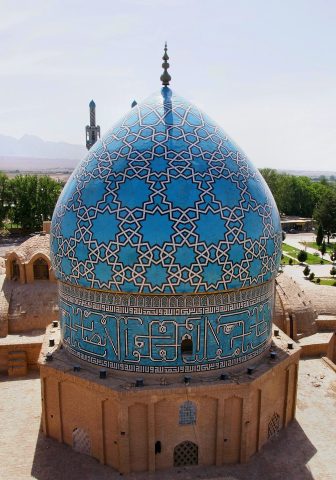
Mahan is one of those quiet Iranian towns that rarely makes it onto the usual tourist trails. Tucked away in the southeast of the country, it lacks the bustling bazaars and crowds of visitors found in more famous cities. Instead, it offers something far more understated: a sense of stillness, the embrace of mountains, and one of the most intriguing mosques in Iran—the Jameh Mosque of Mahan. Standing on the edge of town, almost at the foot of the mountain range, it feels like a natural extension of the landscape itself. Its domes and minarets don’t soar above the earth so much as rise from it, as if they’ve always been there, rooted in the same soil as the surrounding hills.
The mosque’s construction began in the late 19th century, a time when Mahan had long since faded as a major trading hub but still held its place as a spiritual and cultural center. By then, the town was already known for the shrine of Shah Nematollah Vali, a revered Sufi saint, and the new mosque was meant to become another symbol of the region’s religious life. Yet the building process stretched over decades, with the final touches only coming together by the mid-20th century. This slow evolution gave the mosque its unique character—a blend of late Qajar traditions and more modern influences, a quiet dialogue between different eras of Islamic architecture.
What makes the Jameh Mosque of Mahan truly distinctive is its courtyard, enclosed by an arcade of tall, pointed arches. These arches aren’t just decorative; they’re part of a carefully designed system that keeps the space cool even in the peak of summer. In the warmer months, the courtyard remains shaded, while in winter, sunlight filters through the lattice windows, casting a soft, diffused glow. At the center lies a small pool, reflecting the sky and the minarets above, surrounded by a garden of low shrubs and flowers tended with obvious care by the locals. The whole setting feels less like a place of worship and more like a sanctuary, somewhere to sit, listen to the water, and let the mind wander.
Inside, the mosque is far more modest than its grand exterior might suggest. There are no gilded mosaics or intricate tilework like those found in Isfahan or Shiraz. Instead, the prayer hall is spacious and airy, with a high dome supported by sturdy columns. The walls are adorned with geometric patterns and Quranic calligraphy in black ink against a white background—simple, yet deliberate. These inscriptions aren’t mere decoration; they serve as a reminder of the mosque’s true purpose, a place for reflection and prayer. The floors are covered in carpets, replaced every few years, and depending on the time of day, the hall can be nearly empty or filled with worshippers.
The mosque’s two minarets tell their own story. They’re strikingly different from one another—one tall and slender, with a balcony for the muezzin, the other short and squat, more like a watchtower. The asymmetry isn’t accidental. Some say the second minaret was never fully completed; others believe it was left that way intentionally, to give the mosque its own distinct identity. Whatever the reason, the pair create a memorable silhouette, visible from afar when approaching Mahan from the direction of Kerman.
Unlike Iran’s more famous mosques, the Jameh Mosque of Mahan isn’t overrun with tourists. There are no long lines, no jostling for the perfect photo, no sense of being hurried along. On weekdays, it’s often nearly empty, allowing visitors to wander the courtyard at their own pace, noticing details that might otherwise go unnoticed. On Fridays, when the main prayers take place, the mosque fills with people, but even then, the atmosphere remains calm, as if time moves a little slower here than in the rest of the world.
Mahan itself is worth a visit, even if just for a day. Nestled in a valley surrounded by mountains, the air is cleaner than in nearby Kerman, just a half-hour drive away. Summers are hot, with the heat lingering until evening, while winters are cool but rarely snowy. The old quarters around the mosque are a maze of narrow streets and clay houses, easy to get lost in but pleasant to explore without any particular destination in mind. From a nearby hill, the entire town unfolds below—the mosque’s domes, the shrine of Shah Nematollah Vali, the gardens, and the mountains stretching into the distance.
The Jameh Mosque of Mahan doesn’t try to impress with grandeur or opulence. It simply exists, woven into the fabric of the town’s daily life, and that’s what makes it special. Here, you can sense the rhythm of provincial Iran, where religion and everyday existence are so closely intertwined that one cannot be separated from the other. The mosque doesn’t tell stories of conquerors or rulers; instead, it holds the quiet narratives of the people who have prayed here for decades, who tend to its garden, who come simply to find a moment of peace. That’s why it lingers in the memory—not for its architecture alone, but for the atmosphere that can’t quite be put into words, the kind that can only be felt when you stand in its courtyard, even if just for an hour.