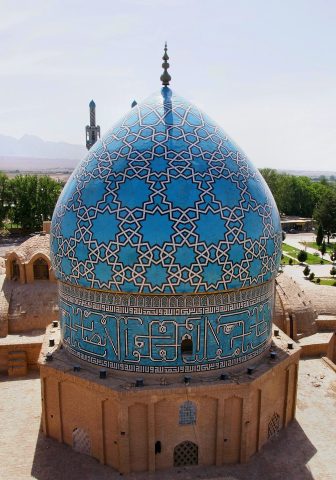
Mahan is one of those quiet Iranian towns where time seems to move at its own unhurried pace. Tucked away in Kerman Province, it feels far removed from the bustle of modern cities, with its narrow lanes, earthen houses, and gardens crisscrossed by the gentle murmur of irrigation channels. Among its unassuming streets, the tomb of Mirza Agha Khan Nuri stands as a subtle yet meaningful landmark, a place where history lingers in the shade of old trees.
Mirza Agha Khan Nuri, known during his lifetime as Sadr-e Azam, was one of the most influential political figures in 19th-century Iran. Serving as prime minister under Naser al-Din Shah Qajar from 1851 to 1858, he navigated a turbulent era when Persia grappled with internal reforms and external pressures. His policies, aimed at modernizing the country while preserving its traditions, met resistance from both conservative factions and foreign powers vying for influence. After his dismissal, he retreated to Mahan, where he spent his final years. His tomb, though modest in size, carries the weight of that complex period—a time when Iran stood at a crossroads between old ways and new ideas.
The architecture of the tomb reflects the Qajar era’s distinctive style, blending Persian traditions with European influences. Built from brick, the structure is small but carefully crafted, its facade adorned with delicate tilework and stucco patterns. The entrance, framed by a semicircular arch, features geometric and floral motifs that catch the light in shifting ways throughout the day. Inside, the space is simple: whitewashed walls, wooden beams supporting the ceiling, and a marble tombstone enclosed by a low railing. There are no grand decorations, no elaborate inscriptions—just a quiet dignity that suits the man it commemorates.
Unlike the more famous historical sites in Iran, this tomb rarely draws crowds. Visitors can wander through its rooms without the distraction of tour groups, taking in the details at their own pace. Locals treat the place with respect, but without the formality that often surrounds major shrines. Occasionally, someone might stop by to pay their respects, but more often, it’s just a peaceful corner where the past feels close enough to touch. The lack of signage or explanations inside means that those who come without prior knowledge might miss some of its significance, but even then, the atmosphere speaks for itself.
Mahan itself is worth exploring beyond the tomb. The town is best known for the Shahzadeh Garden, one of Iran’s most beautiful Persian gardens, but its other attractions are equally rewarding. Old mosques, traditional teahouses, and artisan workshops line the streets, offering glimpses into a way of life that has changed little over the centuries. The tomb of Mirza Agha Khan Nuri is just one piece of this larger tapestry, yet it serves as a reminder that history isn’t confined to grand capitals or monumental landmarks. Sometimes, the most telling stories are found in quiet places like this.
There’s no need for special arrangements to visit. The tomb is open to the public, and there’s no entry fee. The best times to go are early morning or late afternoon, when the heat eases and the light softens, casting long shadows over the brickwork. Inside, the absence of informational plaques means that a little background reading beforehand can help appreciate the site’s context. But even without it, the place has a way of making history feel tangible—less like a distant narrative and more like something that still lingers in the air.
This isn’t a tourist attraction in the conventional sense. There are no gift shops, no guided tours, no grand ceremonies. Instead, it’s a place where the past is preserved in its simplest form: a small building, a name, and the quiet weight of memory. In an age where history is often reduced to dates and headlines, such places offer a different perspective. They remind us that behind every political shift or social change, there were real people—flawed, ambitious, and human. Visiting the tomb in Mahan isn’t just about seeing a historical site; it’s about stepping into a moment where that humanity is still palpable.