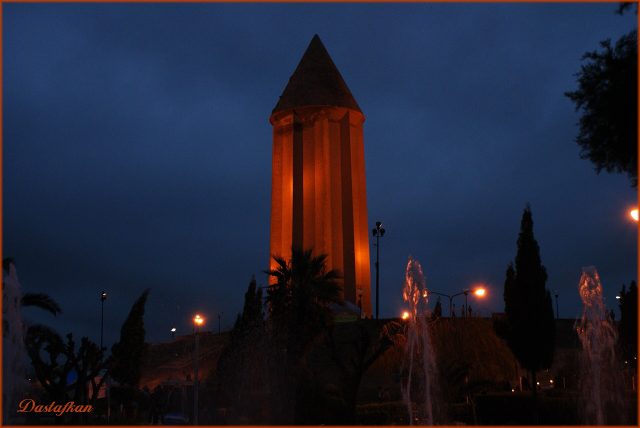
Gonbad-e Kavus is a city that moves at its own pace, far from the well-trodden paths of Iran’s more famous destinations. Here, the past lingers in quiet corners, and the Jameh Mosque stands as a testament to the unassuming beauty of everyday faith. Unlike the grand mosques of Isfahan or Shiraz, with their towering minarets and intricate tilework, this one doesn’t demand attention. It simply exists, woven into the fabric of the old city, where narrow streets wind between low-slung houses and the rhythm of life unfolds without hurry.
The mosque’s walls, built from the same sun-baked brick that has shaped northern Iran for centuries, carry the weight of time. There’s a quiet dignity in their simplicity—no elaborate carvings or gilded domes, just the clean lines of geometric patterns that echo the region’s architectural traditions. The brickwork isn’t ornate, but it doesn’t need to be. The harmony lies in its restraint, a reflection of the land itself, where the landscape is more about subtle shifts in color than dramatic vistas.
Inside, the space feels intimate, almost domestic. The ceiling is low, supported by sturdy columns that divide the prayer hall into smaller sections. Light filters through narrow windows, casting soft shadows on the plastered walls. There are no grand chandeliers or gilded calligraphy here—just the essentials for prayer and reflection. This is a place meant for daily use, not spectacle, and that practicality gives it a warmth that grander mosques sometimes lack.
The history of the Jameh Mosque is as layered as the city around it. Gonbad-e Kavus, once known as Gorgan, was a crossroads on the Silk Road, a place where merchants, scholars, and travelers from distant lands converged. The mosque has likely stood in some form for centuries, though its exact origins are lost to time. What remains today bears the marks of different eras—the sturdy brickwork of the medieval period, the refinements of the Safavid and Qajar dynasties—each leaving its imprint without erasing what came before.
Unlike the tourist hubs of Iran, Gonbad-e Kavus doesn’t put on a show for visitors. The Jameh Mosque is very much a living part of the city, not a relic preserved for outsiders. In the early mornings, the elderly arrive for the first prayers, their movements unhurried. Women in traditional dress walk through the courtyard, children dart between the columns, and the air fills with the murmur of conversation. On Fridays, the mosque swells with worshippers for the weekly communal prayer, and afterward, the courtyard becomes a place of gathering—men sipping tea, neighbors catching up, the occasional laughter of children playing nearby.
The mosque is also home to a madrasa, where students still study theology and Arabic grammar. If you’re lucky, you might hear the low hum of discussion drifting from the classrooms, a reminder that this place is as much about learning as it is about worship. For travelers, it’s a rare glimpse into the rhythms of Iranian life, unfiltered by the expectations of tourism.
Beyond the mosque, the old quarter of Gonbad-e Kavus offers its own quiet charms. The streets twist and turn in a maze of close-packed houses, their walls bearing the marks of generations. Some doors are still carved with intricate wooden patterns, a nod to a craftsmanship that’s slowly fading. In the courtyards, ancient wells stand as silent witnesses to the city’s past, and the occasional donkey laden with goods plods by, a reminder of how little some things have changed.
Nearby, the bazaar hums with activity, though without the urgency of larger cities. Here, vendors sell spices in paper cones, their colors vivid against the muted tones of the brick stalls. Handwoven carpets are displayed with quiet pride, and the scent of freshly brewed tea mingles with the earthy aroma of saffron and dried herbs. There’s no hard sell, no rush—just the easy back-and-forth of a community that knows its own pace.
What makes the Jameh Mosque special isn’t its grandeur, but its authenticity. It doesn’t try to impress; it simply endures, a quiet anchor in a city that has seen empires rise and fall. For those willing to look beyond Iran’s more famous landmarks, this place offers something far more valuable: a sense of connection to the everyday lives of the people who call it home. The beauty here isn’t in the spectacle, but in the small moments—the way the light falls across the courtyard in the late afternoon, the sound of a call to prayer echoing over the rooftops, the warmth of a shared cup of tea. It’s a reminder that sometimes, the most meaningful experiences are the ones that unfold without fanfare.