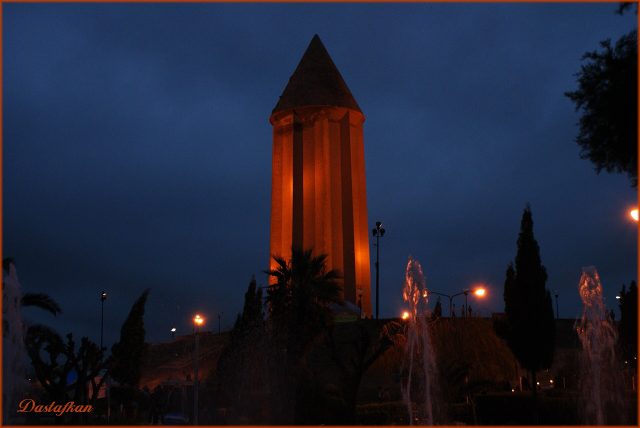
Gonbad-e Qabus is a city where time seems to stand still. The modern world barely brushes against its ancient streets, and history lingers in every stone. Here, in Iran’s northern Golestan province, one of the most unusual monuments of Islamic architecture rises—the mausoleum of Khalil ibn Ahmad. Unlike typical tourist attractions, it doesn’t demand attention with flashy signs or crowds. Instead, it stands quietly, its presence speaking volumes to those who approach, offering a sense of grandeur and mystery.
The mausoleum was built in the 11th century to honor Khalil ibn Ahmad, a distinguished linguist and scholar who lived in the 8th century. He is best known for creating the first Arabic grammar and laying the foundations of Arabic lexicography. His work became essential to the study of the language, and his name is still revered among scholars. Yet the mausoleum itself appeared three centuries after his death, when descendants sought to immortalize his legacy. The location was no accident—Gonbad-e Qabus was once a vital cultural and commercial hub along the Silk Road, where ideas, goods, and people from across the known world converged.
The architecture of the mausoleum is striking in its simplicity and monumentality. A tall cylindrical structure made of fired brick, it culminates in a conical dome that seems to reach toward the sky. The exterior walls are adorned with geometric patterns, also crafted from brick—subtle yet elegant, casting shifting shadows as the light changes throughout the day. The entrance is unassuming, a modest portal leading into a spacious hall with a soaring vault. Inside, there are no lavish decorations, only a few Arabic inscriptions reminding visitors of the man to whom this place is dedicated.
What makes this mausoleum unique is how unlike traditional Islamic tombs it is. There are no ornate minarets, marble slabs, or gilded inscriptions. Instead, its austere forms and restrained details emphasize a spiritual rather than material significance. Perhaps that’s why it blends so seamlessly into the landscape—it doesn’t compete with nature but complements it, becoming part of this ancient land.
Gonbad-e Qabus itself is a city steeped in history. Founded in the 10th century as the capital of the Ziyarid dynasty, it flourished before the Seljuk conquest. Known then as Gorgan, it was renowned for its scholars, poets, and artisans, and its libraries were among the finest in the Islamic world. Today, little remains of its former glory—just the ruins of old structures and a handful of monuments, among which the mausoleum of Khalil ibn Ahmad holds a special place.
Visiting the mausoleum is more than just admiring an architectural landmark; it’s an immersion in the past. Stepping inside, you feel the coolness of the ancient walls and the silence, broken only by the echo of your own footsteps. Time seems to slow, allowing space for reflection on things often overlooked in the rush of daily life. For locals, the mausoleum is more than a historical site—it’s a place of reverence, where they can honor their ancestors and connect with their cultural heritage.
The mausoleum also stands as a testament to how architecture can reflect the ideas and values of its time. Built in the 11th century, when the Islamic world was experiencing a golden age of science and art, it embodies the era’s intellectual curiosity. Scholars were producing groundbreaking works in medicine, astronomy, mathematics, and philosophy, while architects experimented with new forms. The mausoleum, with its clean, harmonious lines, captures this spirit of innovation. It doesn’t aim to dazzle with opulence but invites contemplation and introspection.
Today, the mausoleum remains one of the few surviving monuments from that era in the region. It has endured wars, earthquakes, and the rise and fall of empires, yet it still stands, a reminder that true greatness lies not in extravagance but in the depth of thought and strength of spirit. For travelers who venture to Gonbad-e Qabus, it’s an unexpected discovery. There are no crowds, no souvenir stalls, no guided tours—just silence, history, and the chance to be alone with the past.
Gonbad-e Qabus and its mausoleum serve as a reminder that Iran’s treasures extend beyond its famous landmarks. This is a place for those who seek quiet walks through old streets, who want to understand how people lived and thought centuries ago. The mausoleum of Khalil ibn Ahmad is more than an architectural monument—it’s a living page of history, still speaking to those willing to listen.