Lake Kum, often simply called Qom, is a city where the past and present coexist in quiet intensity. It’s a place where theology and daily life intertwine, where the scent of saffron from the bazaars mixes with the murmur of prayers rising from centuries-old seminaries. At the heart of this spiritual landscape stands the Azam Mosque, a structure that embodies both the devotion and the architectural ambition of modern Iran.
The mosque wasn’t built to compete with the ancient shrines that have drawn pilgrims to Qom for generations, but rather to complement them. Construction began in the mid-20th century, a time when the city was already firmly established as the intellectual center of Shia Islam. The architects of Azam Mosque faced a unique challenge: how to create a space that could accommodate the growing number of worshippers during major religious gatherings while respecting the traditions that had shaped Qom for centuries. The result is a building that feels both timeless and distinctly contemporary.
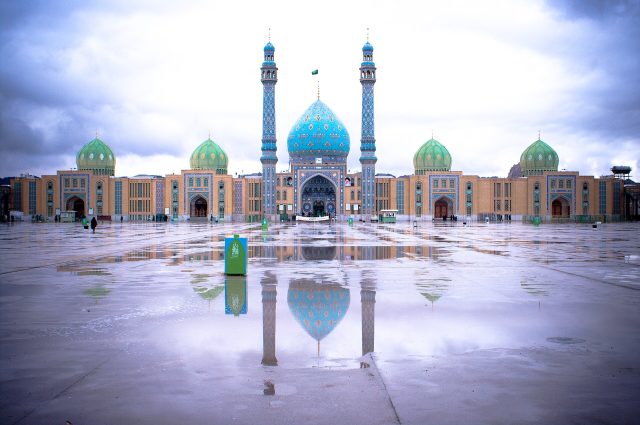
From the outside, the mosque’s most striking feature is its grand turquoise dome, a color that has long been associated with Islamic architecture in Iran. The tiles catch the sunlight at different angles throughout the day, shifting from deep blue to shimmering green. The dome is flanked by two towering minarets, their slender forms reaching toward the sky. The entrance is framed by intricate tilework, a nod to the geometric patterns that have adorned Persian mosques for centuries. Yet there’s something undeniably modern about the scale of the structure—its vast courtyards and expansive prayer halls were designed with functionality in mind, a necessity for a mosque that serves as a gathering place for thousands.
Inside, the space is both vast and intimate. The prayer hall is dominated by a high, arched ceiling, its surface covered in elaborate calligraphy. The verses from the Quran and the names of revered figures in Shia Islam are rendered in flowing script, their curves and lines creating a rhythm that draws the eye upward. The walls are clad in smooth marble, cool to the touch, while the floors are covered in thick carpets that are changed seasonally, their patterns shifting from deep reds in winter to lighter hues in summer. The mihrab, the niche indicating the direction of Mecca, is a masterpiece of precision, its details so fine they almost seem to dissolve when viewed from a distance.
But Azam Mosque is more than just a place of worship. It’s a living institution, deeply embedded in the religious and educational fabric of Qom. The city has long been a center for Islamic scholarship, and the mosque plays a key role in that tradition. Nearby seminaries, where students from across the Shia world come to study theology, often use the mosque’s facilities for lectures and gatherings. The complex includes not only prayer halls but also libraries, conference rooms, and courtyards where scholars and students debate, reflect, and pray. During major religious observances, such as Ashura, the mosque becomes the focal point of the city’s collective mourning. Thousands of people fill its halls and courtyards, their voices rising in unison as they recite elegies and listen to sermons. The atmosphere is one of profound solemnity, a shared grief that binds the community together.
Qom itself is a city of contrasts. The golden dome of the Shrine of Fatima Masumeh, one of the most sacred sites in Shia Islam, gleams just a short distance from the bustling bazaars where merchants sell everything from handwoven rugs to delicate glassware. The city’s streets are narrow and winding, lined with buildings that range from centuries-old madrasas to modern apartment blocks. Azam Mosque fits seamlessly into this landscape, a bridge between the old and the new. It’s a place where the rituals of faith are performed with the same reverence as they have been for generations, yet it also reflects the evolving needs of a growing religious community.
Visiting the mosque is a reminder that in Iran, spirituality is not confined to the pages of history books or the walls of ancient shrines. It’s a living, breathing part of daily life. For those who come to Qom, whether as pilgrims or curious travelers, Azam Mosque offers a glimpse into the heart of Shia Islam. The rules of entry are simple but important: modest dress is expected, with women typically wearing a chador or a long coat and headscarf, while men are advised to avoid shorts and sleeveless shirts. Inside, the atmosphere is one of quiet reflection, and visitors are asked to respect the sanctity of the space by speaking softly and refraining from photography unless permission is granted.
What makes Azam Mosque particularly compelling is its ability to feel both grand and personal. On a weekday morning, the vast prayer halls might be nearly empty, save for a few worshippers kneeling in silent prayer. The light streaming through the stained-glass windows casts colored patterns on the marble floors, creating a sense of tranquility. Yet during religious festivals, the same space transforms into a sea of people, their voices filling the air with chants and prayers. It’s a place that adapts to the rhythms of the city, changing with the seasons and the cycles of religious observance.
In many ways, Azam Mosque is a microcosm of Qom itself—a city where the sacred and the everyday coexist. It’s not just a monument to faith but a living testament to the enduring power of religious tradition in Iran. Whether you come to pray, to study, or simply to observe, the mosque offers a window into a world where spirituality is woven into the fabric of life. And in a city as steeped in history as Qom, that’s no small thing.