Al-Huda Mosque in Addi Keyh is one of those quiet places that tell a story without raising its voice. Perched on a gentle rise, it watches over the town like an old guardian, its presence steady while the world around it shifts. The minarets catch the light at dusk, their stone surfaces glowing warmly as the sun sinks behind the hills. For those who live here, the mosque is more than a place of worship—it’s a cornerstone of daily life, where faith and routine intertwine without fuss.
Addi Keyh isn’t the kind of place travelers seek out. It sits off the usual routes, far from the better-known stops in Eritrea, and that’s part of its charm. There’s no rush here, no crowds, just the unhurried rhythm of a town that hasn’t been shaped by tourism. Al-Huda fits into this rhythm naturally. It doesn’t dominate the skyline like the grand mosques of capital cities, but its simplicity has a quiet strength. Built from local stone, the building has softened over time, its walls taking on the same earthy tones as the land around it. It feels as if it grew from the ground itself, rooted in the place as much as the people who built it.
The mosque’s history is woven into the story of Addi Keyh. For generations, the town was a crossroads, a place where traders, pilgrims, and travelers paused on their way between the highlands and the Red Sea coast. Al-Huda wasn’t just a house of prayer—it was a meeting point, a place where deals were struck, disputes settled, and news exchanged. The old trade routes have faded, but the mosque remains, a quiet reminder of the days when the town was a hub of movement and connection.
The architecture is understated but deliberate. There are no elaborate carvings or gilded domes, none of the ornate flourishes found in mosques elsewhere. Instead, the design is clean and functional, shaped by local building traditions. The minarets are slender and unassuming, with small balconies where the call to prayer rings out over the rooftops. The inner courtyard is enclosed by a low wall, sheltering a handful of trees that offer shade and a rare patch of green in the dry landscape. Even when the town is busy, the mosque feels like a place apart, where time slows down.
Inside, the space is designed for reflection. The floor is covered with woven mats, the walls marked with simple Arabic script, carefully rendered but not ostentatious. Light filters through narrow windows, casting soft patterns on the stone. There are no chandeliers or gold leaf—just a few lamps lit in the evenings, their glow mingling with the murmur of prayers. The atmosphere is one of calm, and even visitors who wander in by chance tend to lower their voices, as if sensing they’ve stepped into a different pace of life.
For the people of Addi Keyh, Al-Huda is more than a religious site. On Fridays, the mosque fills with worshippers from across the town and surrounding villages. On other days, it hosts Quranic lessons, gatherings of elders, and occasional celebrations—weddings, memorials, the milestones of community life. In a place where life moves at its own unhurried speed, the mosque is a social anchor, a place to seek advice, share news, or simply catch up with neighbors. It’s where the threads of daily life are woven together, quietly but firmly.
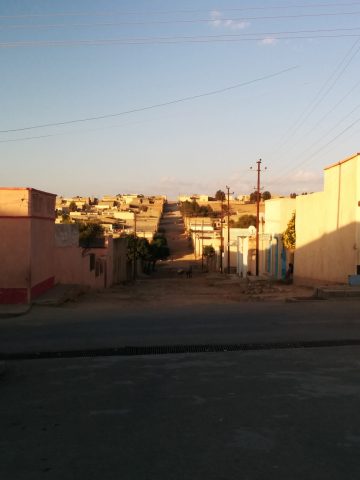
The area around the mosque has grown up over time, a small neighborhood of narrow lanes and single-story homes built from the same stone as the mosque itself. There are no wide boulevards or modern buildings here, just the worn surfaces of old walls and small shops selling spices, cloth, and household goods. In the mornings, the scent of fresh bread and coffee drifts through the air; in the evenings, the sound of children playing carries from the courtyards. The mosque stands at the center of it all, not as a grand landmark, but as the quiet heart of the neighborhood.
For those who do make the journey to Addi Keyh, the mosque offers something rare: a moment of stillness in a place untouched by tourism. There are no souvenir stalls, no crowds, no guides urging you to hurry. Just the quiet weight of stone, the play of light on walls, and the sense that time here moves differently. You can sit in the courtyard, watching as people come and go, or climb one of the minarets for a view of the town. From above, the scene is unremarkable in the best way—reddish rooftops, patches of green, the distant outline of mountains. It’s the kind of view that lingers in memory long after you’ve left.
Al-Huda Mosque isn’t a monument in the usual sense. It doesn’t demand attention with grand gestures or sweeping statements. Instead, it offers something quieter but just as powerful: a sense of continuity, of lives lived in the same place for generations. It’s a reminder that history isn’t always written in grand events or famous names—sometimes, it’s in the steady presence of a building that has seen a town change and yet remains unchanged itself. That’s why people keep coming back, not as tourists, but as part of something older and deeper than themselves.