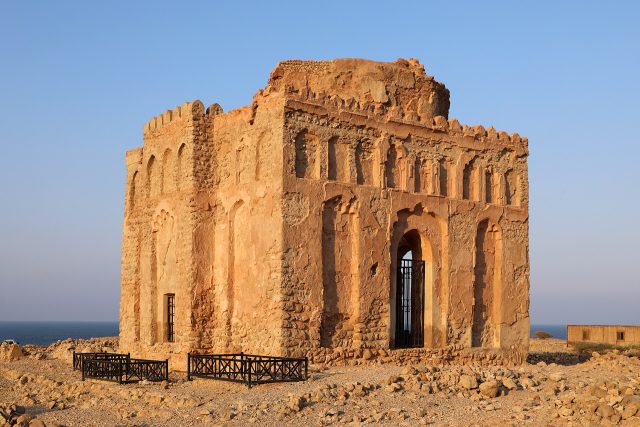
The ruins of Al-Baleed Mosque in Qalhat mark a city that once thrived at the crossroads of trade routes. Qalhat was a port on Oman’s coast where merchants from Arabia, India, and East Africa exchanged spices, textiles, and precious goods. The mosque, built in the 13th century, stood at the city’s center. It served as a place of worship and a gathering point for travelers, traders, and locals.
The mosque’s walls, weathered by time, still hold traces of the voices that once filled them—people who shaped the region’s history.
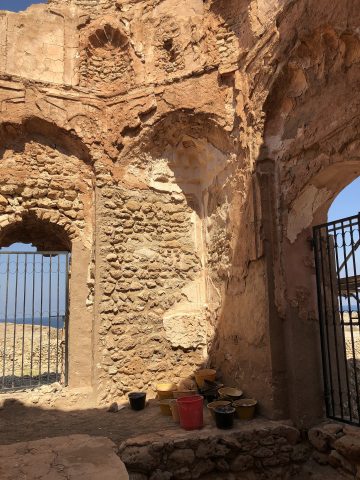
The architecture of Al-Baleed Mosque reflects Oman’s cultural influences during its golden age. Built from local stone and clay, the structure blends into the arid landscape. Inside, the prayer hall accommodated large congregations. A mihrab, an ornate niche pointing toward Mecca, was adorned with geometric patterns. Though much of the structure has crumbled, the remaining columns and walls show its original form. The ancient water system once supplied the mosque and nearby buildings with fresh water.
Qalhat was a city of significance, mentioned in Marco Polo’s travelogues. In the 13th century, it was ruled by local sultans and known for its markets, where goods from across the Indian Ocean changed hands. The mosque was part of this life, where people of different backgrounds came together.
Today, the ruins of Al-Baleed Mosque and the surrounding city are a UNESCO World Heritage site. Walking through the ancient streets, you can imagine merchants haggling or the call to prayer echoing across the rooftops. The sound of waves crashing against the shore reminds you of the sea that once brought prosperity here.
Al-Baleed Mosque stands as a symbol of resilience. The city was devastated by an earthquake in the 15th century and later abandoned. Yet, its legacy endures. Archaeological work uncovers details about life in Qalhat, and the mosque remains a reminder of that era. It offers a connection to the past, a way to step into the world of medieval traders.
A visit to the mosque works best with a walk through the broader archaeological site of Qalhat. Here, you can see the remnants of the city’s walls, ancient wells, and fragments of residential neighborhoods. The view from the ruins includes the Arabian Sea, which once carried ships laden with goods to Qalhat’s shores. At sunset, the stones of the mosque glow, casting shadows that seem to hold stories.
Qalhat and its mosque are not places for quick visits. There are no crowds, no guided tours, no souvenir stalls. Instead, there is silence, broken only by the wind and the waves. It’s a place where history feels present. For those who seek more than a scenic view, Al-Baleed Mosque offers a chance to stand where others have stood before, to feel time in the quiet breeze. The past lingers in the light on its stones, in the scent of salt and earth, in the way the ruins endure.