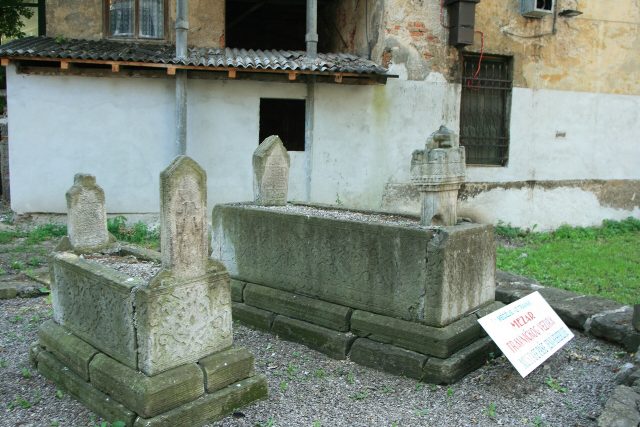
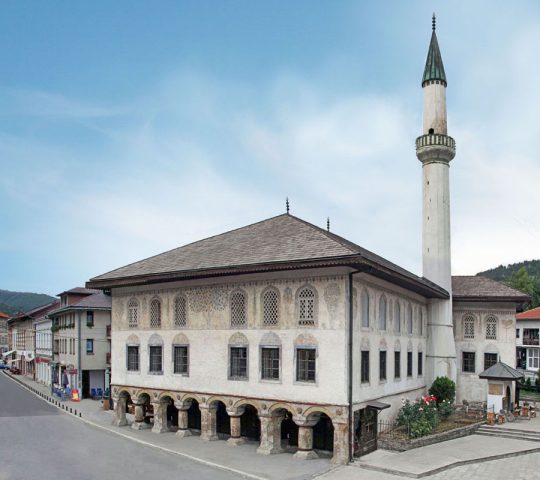
The mausoleum of Ivo Andrić in Travnik is one of those quiet places where the past lingers in the air, unspoken but impossible to ignore. It’s not a grand monument, nor does it demand attention—just a modest structure of white stone, half-hidden among the hills that once filled the pages of Andrić’s novels. There’s no pomp here, no elaborate decoration, only the quiet dignity of a place built to remember a man whose words gave voice to Bosnia’s layered history. The simplicity of the mausoleum feels deliberate, as if to say that what matters most isn’t the stone itself, but the stories it carries.
Travnik was more than just Andrić’s childhood home—it was a living character in his work, a place where the weight of history pressed into every street and shadow. Born in the nearby village of Dolac, he spent his early years in this Ottoman-era town, where narrow alleys twisted between mosques, markets, and coffeehouses, and where the echoes of different faiths and cultures blended into something uniquely Bosnian. That world found its way into his writing, especially in *The Days of the Consuls*, where Travnik becomes a microcosm of the Balkans’ tangled past. The mausoleum, tucked away on the edge of town, feels like a quiet acknowledgment of that connection—a place where the writer’s presence lingers, even if his body is gone.
The building itself is unassuming, designed in a style that nods to Ottoman traditions: a low roof, a simple arched entrance, and walls of local stone that have weathered into soft, muted tones. Inside, the space is open and airy, with Andrić’s marble tomb at its center, marked only by his name and a few lines from his work. There are no ornate carvings or grand inscriptions, just the essentials—a choice that reflects the writer’s own understated approach to storytelling. Outside, the garden is planted with roses and cypress trees, the kind of plants you’d find in any Bosnian cemetery, their scent mixing with the earthy smell of the hills. Visitors are rare, and those who come don’t do so for the architecture, but for the chance to sit in the stillness and let the place speak for itself.
Andrić won the Nobel Prize in Literature in 1961 for *The Bridge on the Drina*, but his bond with Travnik was deeply personal. In his memoirs, he wrote about the town as a crossroads of East and West, where Catholics, Muslims, and Orthodox Christians had lived side by side for centuries, each leaving their mark on the landscape. For him, Travnik wasn’t just a dot on a map—it was proof of how history shapes people, how the past seeps into the present. The mausoleum, in its quiet way, stands as a monument to that idea, a reminder of the complex, often contradictory world he described.
Today, the mausoleum isn’t a major tourist attraction, but it draws those who seek something more than a quick photo opportunity. Locals come to pay their respects, students visit on school trips, and readers of Andrić’s work make pilgrimages to stand by his grave. Sometimes, you’ll see a group of schoolchildren gathered around the tomb, their teacher reading aloud from *The Days of the Consuls*, the words hanging in the air like a shared secret. The town around it has changed—new buildings, wider roads, modern cafes—but the mausoleum remains a pocket of stillness, where time moves at its own pace. It’s easy to imagine Andrić himself sitting on one of the benches, watching the light shift across the stones, lost in thought.
Travnik has always been a town of contrasts. During the Ottoman era, it was the seat of Bosnian viziers, a place of political power where the local bazaar was famous across the empire. Later, under Austro-Hungarian rule, it became an administrative hub, with new buildings rising in European styles. Yet even then, the town never lost its Eastern soul. The mausoleum of Ivo Andrić embodies that duality—it stands at the intersection of old and new, East and West, much like the characters in his novels. It’s a place where history isn’t just remembered; it’s felt.
Visiting the mausoleum isn’t like touring a museum. There are no guided tours, no explanatory plaques, no audio guides—just you, the stone, and the silence. The hills around it are thick with forest, and the old houses with their tiled roofs look much as they did in Andrić’s time. Sometimes, the wind carries the scent of coffee from a nearby café, and for a moment, it’s as if the years have folded in on themselves. There’s no rush here, no agenda, just the quiet invitation to sit, to think, or to simply be.
That might be why the mausoleum rarely makes it onto tourist itineraries. There’s nothing flashy about it, no dramatic backstory or Instagram-worthy views. It’s a place for reflection, for those who understand that some of the most powerful experiences come not from seeing, but from feeling. Andrić once wrote that a writer’s job is to capture the soul of a place, and in that sense, the mausoleum does the same—it holds the essence of Travnik, of Bosnia, of all the lives that have passed through here. If you ever find yourself in this part of the country, it’s worth stopping by, if only to stand in that quiet garden and let the weight of history settle around you.