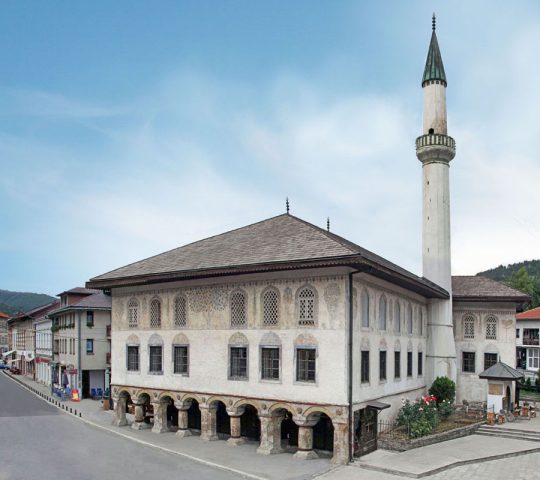
Perched on a hillside above Travnik, the Church of the Dormition of the Mother of God stays with you long after you leave. Below, the town sprawls in narrow streets lined with Ottoman-era houses, their terracotta roofs glowing under the sun. Minarets rise against the skyline, and the Lašva River cuts through the valley. Travnik’s history is palpable here—layers of time and culture woven together—and this church is one of its quiet threads.
The church was built in the mid-19th century, a time when the Ottoman Empire still ruled Bosnia. Relations between Muslims and Christians were often tense, yet Orthodox churches began appearing more frequently, sometimes with local approval. The Serbian community in Travnik, long part of the town’s fabric, pooled their resources to build it. Construction was slow, shaped by modest means and a deep respect for tradition.
The architecture is simple, designed for a small community rather than grand displays. It follows a neo-Byzantine style, with echoes of medieval Serbian design in its proportions. The exterior is light stone, weathered over decades into a soft, golden hue. The bell tower, added in the 20th century, stands slightly apart but doesn’t disrupt the building’s harmony. Inside, the space is intimate—low vaulted ceilings, a wooden iconostasis, and rows of pews. Small windows filter the light, casting a warm glow over the icons.
For the Serbian community, the church was never just a place of worship. In the 19th century, Travnik was an administrative center, home to the Bosnian Eyalet’s vizier. Serbs and Croats lived alongside Muslims, maintaining their traditions despite political shifts. The church became a symbol of resilience, a gathering place for celebrations and refuge in turbulent times. Its priests offered guidance when needed.
Today, the church remains active, though the Serbian community in Travnik is smaller. Services follow the Orthodox calendar, and on major feast days, worshippers fill the church. The Feast of the Dormition of the Mother of God draws crowds—people arrive early to secure a spot inside. Outside, vendors sell candles, icons, and homemade pastries. The scent of incense and coffee lingers in the air.
Travnik’s history is always close to the surface, and this church is one of its quieter landmarks. Unlike the town’s famous mosques or the medieval fortress, it doesn’t attract tourists. That’s part of its appeal. Visitors who find it often linger in the courtyard, taking in the view of red roofs, green hills, and slender minarets. On clear days, distant mountains frame the scene.
Travnik is drawing more travelers now, and those who wander into the church usually come out of curiosity. Locals don’t mind—they see it as part of daily life and share its story if asked. Sometimes a priest is around, pointing out old photographs or explaining the significance of icons. Even without a guide, the church speaks for itself. The worn stone, flickering candlelight, and quiet hum of the town below tell a story of endurance.
The hillside around the church offers one of the best views of Travnik. In summer, leaves rustle in the breeze. In winter, snow dusts the scene. It’s a place to sit away from the noise and simply be.
The Church of the Dormition of the Mother of God is more than a monument. It’s a living part of Travnik, a reminder of how cultures and faiths have coexisted here—sometimes in tension, sometimes in harmony. It has witnessed wars, power shifts, and daily life, yet it endures. Today, it still serves its community, a quiet witness to time and resilience.