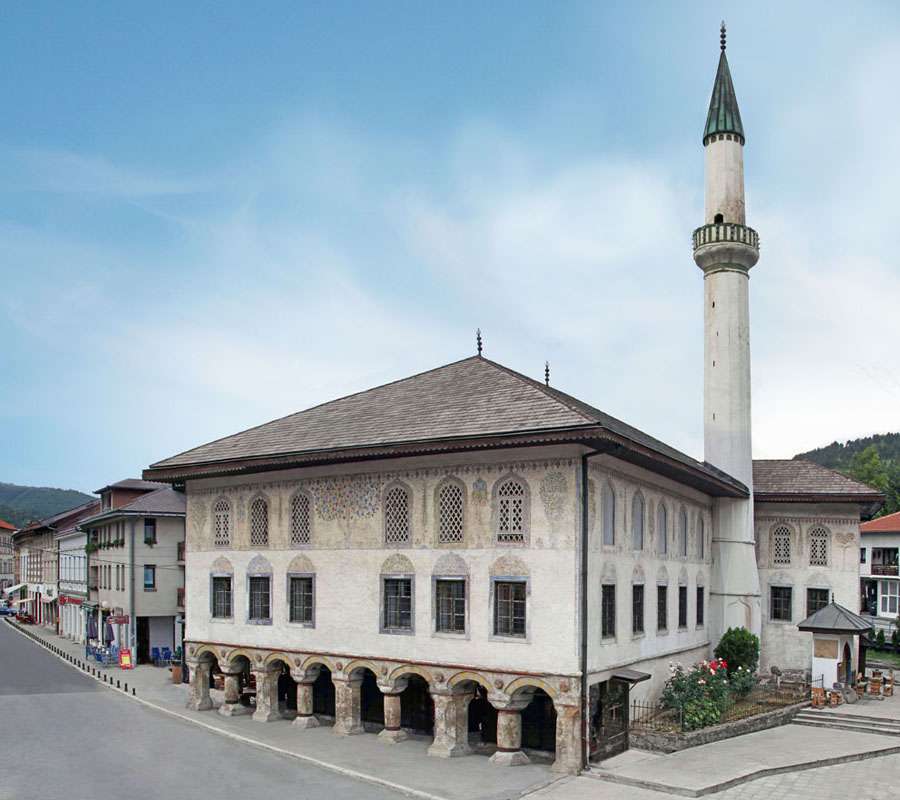
Perched on a hill overlooking Travnik, the Suleymanija Mosque feels like a quiet guardian of the past. Built in the early 1700s, it stands where the town once pulsed with the energy of the Ottoman Empire—back when Travnik was the capital of the Bosnian Eyalet, a key administrative hub. The mosque was commissioned by Sultan Suleiman II, though locals have long called it simply Suleymanija, a name that carries the weight of history without ceremony. It wasn’t just a place of worship; it was a statement of power, a landmark that anchored the town’s identity during its most influential years.
The architecture is classic Ottoman, but with a character shaped by the land itself. The mosque is built from local stone, which glows warmly in the sunlight, shifting from pale gold to deep amber as the day progresses. The minaret rises slender and tall, cutting through the skyline like a needle, its presence so familiar to the town that it feels less like a structure and more like a natural part of the landscape. Inside, the space is uncluttered—whitewashed walls, a wooden minbar, and a carved mihrab pointing toward Mecca. The floors are covered in rugs, and light filters through narrow arched windows, casting soft, shifting patterns that make the air feel still and timeless.
Travnik earned its nickname as the "city of viziers" for good reason. In the 18th and 19th centuries, it was the seat of Bosnian governors, and the Suleymanija Mosque was at the heart of that world. Around it, a complex of buildings once thrived—a madrasa, a library, public baths, and markets—forming a self-contained universe where politics, faith, and daily life intertwined. Today, much of that has faded, but the mosque remains, a tangible link to an era when the town was a crossroads of culture and authority.
The surrounding neighborhood is a maze of narrow streets, where stone houses with wooden eaves lean into each other as if sharing secrets. This is the old Muslim quarter, where life moves at its own pace. The scent of fresh bread drifts from a nearby bakery, the sound of water trickling from a courtyard fountain mixes with the creak of old gates, and under the shade of trees, elderly men play backgammon or sip coffee just as their ancestors did. For them, the mosque isn’t a relic; it’s a living space, a place to pray, to chat with neighbors, or simply to sit in quiet reflection.
Unlike tourist hotspots that dazzle with grandeur, Travnik offers something quieter: authenticity. The Suleymanija Mosque hasn’t been polished into perfection. Its walls bear the marks of time—cracks, worn edges, patches where plaster has chipped away. Yet these imperfections give it a rare kind of beauty, as if the building itself is whispering stories of the past. Stand close enough, and you might almost hear the echo of footsteps from centuries ago, the rustle of robes, the distant call to prayer that has sounded here for generations.
The best time to visit is at dusk, when the setting sun turns the minaret a soft pink and stretches the shadows long across the courtyard. That’s when the mosque feels most alive. Locals gather in the yard, the call to prayer rings out, and for a moment, the town pauses, caught in a ritual that has repeated itself for hundreds of years. There’s no performance here, no attempt to impress—just the simple, enduring rhythm of life.
Travnik is a place of contrasts, where Ottoman history brushes up against Austro-Hungarian architecture, and where mosques, churches, and synagogues coexist within a few blocks of each other. The Suleymanija Mosque sits at the intersection of these worlds, a silent witness to the layers of time. Nearby, a Catholic cathedral stands tall, while a short walk away, an Orthodox church completes the picture. There’s no tension in this proximity, only a quiet understanding, a reminder of how different traditions can share the same space without erasing one another.
Visiting the mosque isn’t just about seeing a historic building; it’s about stepping into a way of life. There are no crowds, no souvenir stalls, no guides rushing you along. Just the quiet hum of the town, the weight of centuries in the stone beneath your feet, and the people for whom this place is home. That’s what makes the Suleymanija Mosque so striking—it doesn’t try to impress. It simply is, and in its unassuming presence, it leaves a mark deeper than any grand monument could.