Ravenna’s Mausoleum of Galla Placidia feels like a place where time has paused, preserving a fragment of late antiquity in quiet defiance of the centuries. Built in the first half of the fifth century, this small brick structure was never intended as a tomb for Galla Placidia herself, the daughter of Emperor Theodosius the Great. Historians still debate its original purpose—perhaps a chapel connected to the Basilica of the Holy Cross, or a memorial linked to her brother, Emperor Honorius. Whatever its beginnings, the mausoleum became Galla Placidia’s final resting place after her death in 450, though her remains were later moved to Rome.
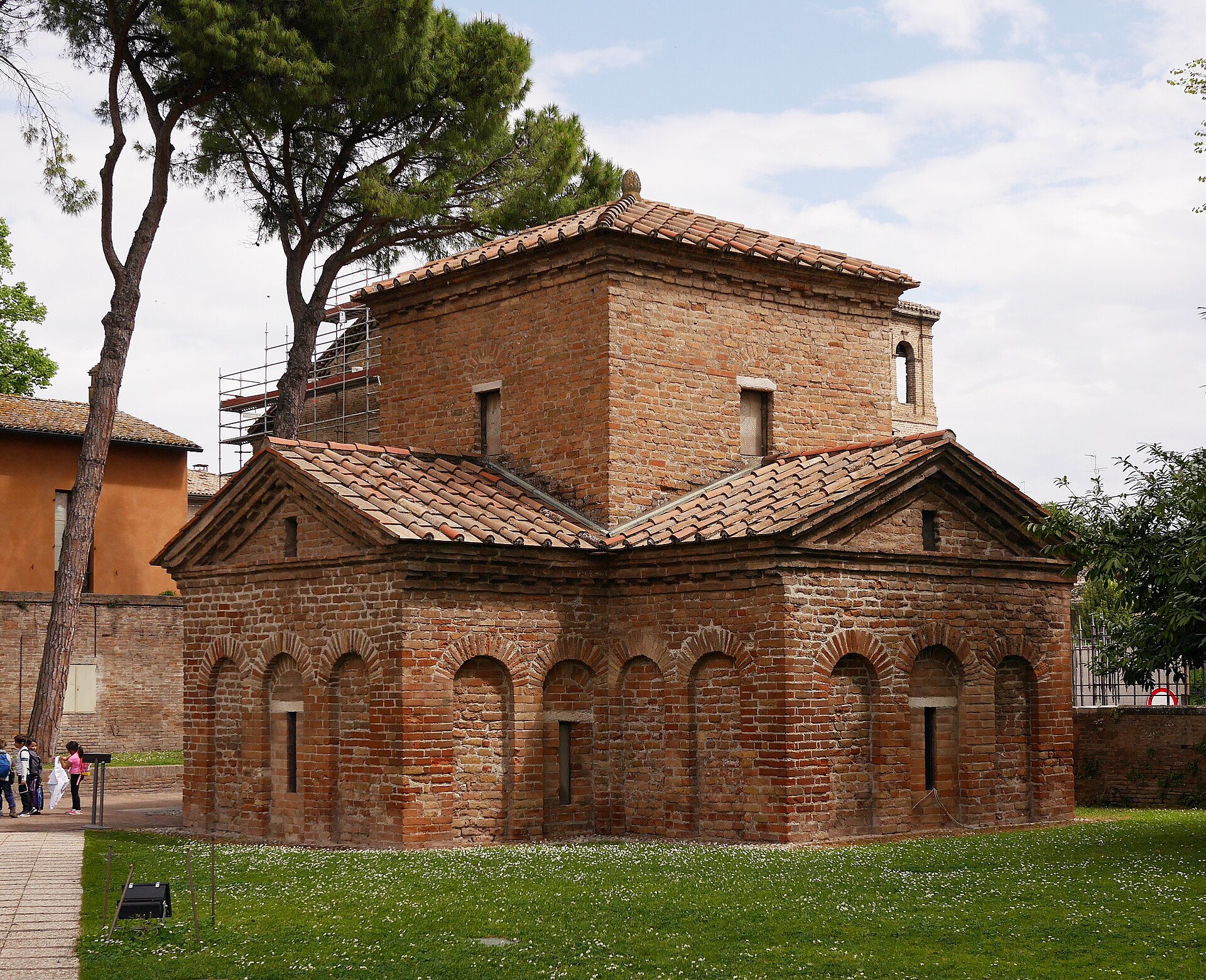
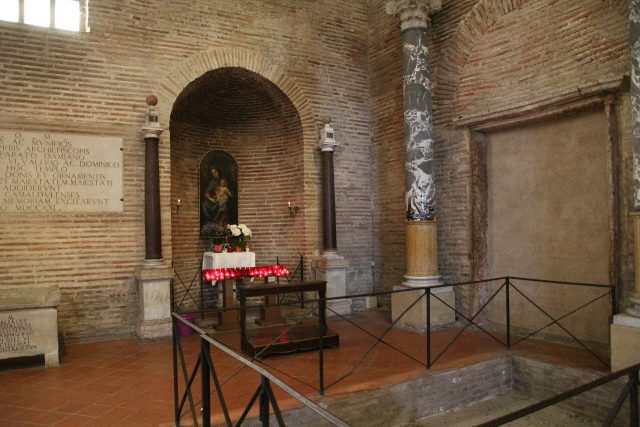
From the outside, the building is unassuming—a modest cruciform structure of plain brick, its only ornamentation the thin marble cornices and small arched windows. Yet stepping inside reveals a different world entirely. The interior is a study in contrasts: low vaults, narrow windows that admit only slivers of light, and then the sudden, dazzling brilliance of mosaics covering every surface. These mosaics, crafted in the early Christian style, are among the finest examples of Byzantine art in Italy, their gold and deep blues still vibrant after fifteen hundred years.
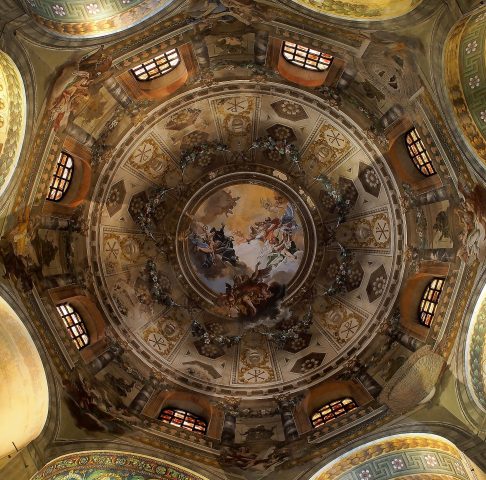
The central dome is a masterpiece in itself, depicting a star-studded night sky with a cross at its heart. The design is more than decorative; it embodies the Christian promise of salvation and eternal life. Around the arches, lunettes depict scenes from the lives of saints, while niches hold figures of apostles, their elongated forms and solemn expressions typical of the period. One of the most striking images is that of the Good Shepherd—a youthful Christ surrounded by sheep, a scene of serene grace that has become one of the most recognizable in Christian iconography.
The mausoleum’s interior creates an oddly intimate yet monumental effect. The low ceilings evoke a sense of warmth, almost like a private chamber, but the shimmering mosaics and deep hues remind you that this space was never meant for the ordinary. Light plays a crucial role here, filtering through the narrow windows to highlight the depth of the colors and the three-dimensionality of the figures. On overcast days, the mosaics seem to glow from within, lending the space an almost mystical quality.
This small building is more than just an architectural relic; it’s a testament to a pivotal moment in history. In the fifth century, Ravenna was the capital of the Western Roman Empire, later becoming the seat of Ostrogothic kings and Byzantine governors. The city was a crossroads where classical traditions met Christian ideals, where Roman order blended with new influences. The mausoleum reflects this transition—its forms still carry the simplicity of Roman design, but its mosaics introduce the richness and symbolism of Byzantine art. Unlike later Byzantine works, however, these mosaics retain a certain softness, even a touch of naivety, characteristic of the era’s shifting artistic sensibilities.
Today, the mausoleum is part of Ravenna’s UNESCO-listed early Christian monuments, often overshadowed by the city’s grander basilicas like San Vitale or Sant’Apollinare Nuovo. Yet it’s here, in this modest space, that the spirit of the past feels most tangible. Unlike in larger churches, where mosaics can feel distant, here every detail is within reach. Visitors linger over the intricate patterns, studying the faces of saints, imagining the hands that crafted them so long ago.
A visit to the mausoleum is less about sightseeing and more about stepping into another time. There are no crowds, no rush—just silence and the dim glow of ancient art. Occasionally, someone pauses to examine a mosaic more closely, or sits on one of the benches, lost in thought. The mausoleum doesn’t shout its history; it whispers, leaving room for contemplation.
Remarkably, the mausoleum has survived the centuries with minimal alteration. While it has undergone restoration—strengthening its foundations, cleaning its mosaics—its original character remains intact. This is rare for a monument of its age, especially in a city that has seen its share of upheavals, from barbarian invasions to wars and earthquakes. Perhaps its survival is due in part to its quiet seclusion, as if the building itself has guarded its tranquility through the ages.
The mausoleum is open to visitors, and entry is often included with tickets to Ravenna’s other monuments. Even if you arrive by chance, it leaves an impression. It doesn’t overwhelm with size or opulence, but that’s its strength—it invites you to pause, to reflect, to find beauty in simplicity. There’s nothing superfluous here, nothing that distracts from its core purpose: to remind us of what endures when all else fades.