Ravenna’s Basilica of Sant’Apollinare in Classe sits quietly on the outskirts of the city, a short distance from the historic center. From the outside, it doesn’t demand attention—just a modest brick structure, its walls unadorned, almost austere. But step inside, and the space unfolds into something far greater than its humble exterior suggests. Built in the sixth century, when Ravenna was the capital of the Western Roman Empire and later a key outpost of Byzantine rule, the basilica was erected on the site of an ancient necropolis, dedicated to Saint Apollinaris, the city’s first bishop.
The interior is a study in contrasts: the soaring height of the nave, the cool marble columns imported from the East, the way light filters through the clerestory windows to soften the space. Yet the true marvel lies in the mosaics that cover the apse and parts of the walls. Unlike the naturalistic art of later periods, these works are steeped in symbolism, their flat, golden backgrounds and vibrant hues creating a world that feels both earthly and divine. At the center of the apse, Saint Apollinaris stands among twelve sheep, representing the apostles, while above him a cross gleams against a star-strewn sky. Flanking the scene are the prophets Moses and Elijah, their presence a bridge between the Old Testament and the early Christian era. These images weren’t mere decoration; they were part of the liturgy, a visual language meant to guide the faithful.
The basilica has weathered centuries of change. Earthquakes, invasions, and renovations have left their mark—most visibly in the medieval bell tower and the 18th-century facade. Yet the mosaics remain remarkably intact, a rarity for a monument of this age. Ravenna’s relative obscurity in later centuries may have spared it from the destruction that befell other ancient sites, while the local climate, though damp, proved less harsh on the mosaics than the conditions in Rome. Time has softened some details, but the overall effect is one of astonishing preservation, as if the sixth century had simply paused here.
Sant’Apollinare in Classe is more than an architectural relic; it’s a quiet witness to Ravenna’s transformation. Once a thriving imperial capital, the city gradually faded into provincial obscurity, leaving behind a handful of monuments that speak of its former glory. The basilica stands apart from the more frequented sites in Ravenna’s center, and that distance is part of its charm. There are no crowds here, no hurried footsteps—just the stillness of a place where history lingers in the air.
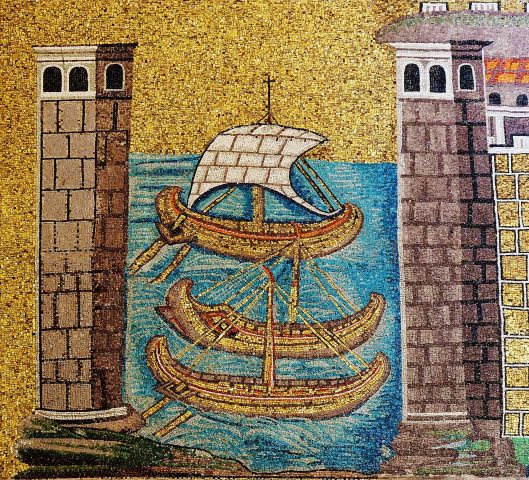
The surrounding landscape adds to the sense of timelessness. Fields stretch out around the basilica, and nearby lie the ruins of Classe, once a bustling port that connected Ravenna to the Mediterranean trade routes. Today, the docks are gone, and the wind rustles through the grass where ships once unloaded their cargo. The basilica seems to stand guard over this emptiness, a silent link between the city’s past and its present.
Visiting Sant’Apollinare in Classe feels less like a tour and more like a step into another era. There are no ornate Baroque altars or soaring Gothic arches here—just the clean lines of early Christian architecture and the weight of symbolism in every mosaic. The art doesn’t tell stories in the way Renaissance frescoes do; instead, it invites contemplation, a chance to glimpse how people saw the world fifteen hundred years ago. The figures in the mosaics are not lifelike, but their gestures and expressions carry a quiet intensity, as if they’re waiting for the viewer to decipher their meaning.
The basilica is open year-round, though it draws fewer visitors than Ravenna’s more famous sites. Those who come are often drawn by an interest in early Christian history or Byzantine art. Inside, the atmosphere is one of reverent quiet, broken only by the occasional murmur of a guide or the soft echo of footsteps. This isn’t a place to rush through. It’s worth taking a seat on one of the wooden benches, letting your eyes wander over the mosaics, and trying to unravel the layers of meaning embedded in their shimmering surfaces.
Yet Sant’Apollinare in Classe is more than a museum piece. It remains an active place of worship, and on feast days, the basilica comes alive in a different way. The flicker of candlelight, the sound of chanting, the scent of incense—these elements transform the space, reminding visitors that this is not just a monument to the past, but a living part of Ravenna’s spiritual life. Even for those who don’t share the faith, the experience is moving, a glimpse into how art and devotion have always been intertwined here. The basilica doesn’t just preserve history; it continues to shape it.