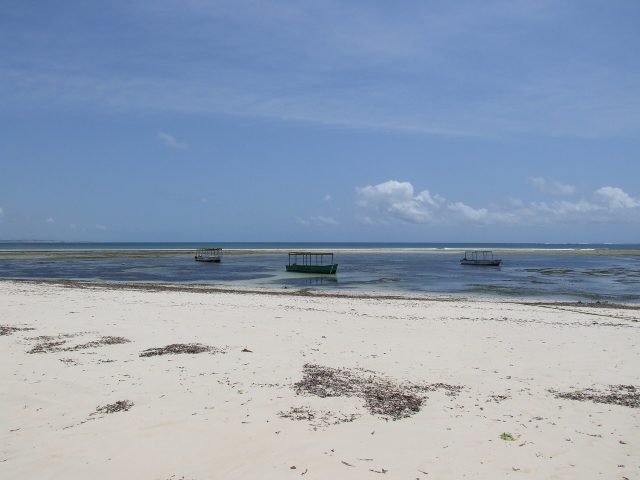
Malindi is a town where the past lingers in the salt-tinged breeze and the rustle of palm fronds. Perched on the edge of the Indian Ocean, it feels like a place where time has softened, where the weight of history is carried not in grand monuments but in the quiet details—the worn stones underfoot, the narrow lanes that twist toward the sea. The Malindi Museum is one of those rare places where you can step into that history, not as a spectator but as someone tracing the same paths walked by traders, explorers, and generations of locals who shaped this coast long before the first tourists arrived.
The museum itself is part of the story. It occupies a 16th-century Portuguese fort, one of the oldest European structures on the East African coast. Built when Malindi was a key stop on the trade route between Europe and India, the fort has served many roles over the centuries—military stronghold, administrative center, even a prison. Its coral-stone walls, pocked by time and the elements, still bear the marks of those who lived and worked within them. Inside, the high-ceilinged halls, once filled with soldiers and supplies, now house exhibits that unfold like chapters in a book. The building doesn’t just contain history; it is history, its very structure a testament to the layers of influence that have defined this region.
One of the most compelling sections of the museum focuses on the Age of Exploration. It was here, in 1498, that Vasco da Gama made landfall on his way to India, seeking a sea route to the riches of the East. The local sultan welcomed him, providing a navigator who guided the Portuguese fleet to Calicut. The museum preserves fragments of that encounter—replicas of 15th-century maps, excerpts from ship logs, and everyday objects that hint at the lives of sailors who risked everything on voyages that could last years. A meticulously crafted model of a Portuguese caravel, based on historical records, offers a glimpse of the vessels that braved the open ocean, their hulls straining against storms and unknown currents. Standing beside it, you can almost hear the creak of timber and the snap of sails in the wind.
But the story of Malindi begins long before the Portuguese arrived. For centuries, the town was part of the Swahili Coast, a network of city-states that stretched from Somalia to Mozambique, linked by trade and a shared culture shaped by Arab, Persian, and African influences. The museum’s exhibits on this era include pottery unearthed from ancient settlements, coins minted in distant lands, and intricate jewelry made from gold and silver. Among the most striking pieces are fragments of Chinese porcelain, dating back to the 14th and 15th centuries. These delicate bowls and plates, found in local excavations, are a reminder that Africa’s connections to the wider world are far older than the colonial era. They speak of a time when merchants from China, India, and the Middle East converged here, exchanging goods, ideas, and stories that would leave an indelible mark on the region.
Another section of the museum turns its attention to the people who have called this coast home. The displays here are less about grand historical narratives and more about the rhythms of daily life—the tools of fishermen, the looms of weavers, the instruments of musicians. Traditional Swahili wedding attire, with its vibrant fabrics and intricate beadwork, offers a glimpse into the customs that have endured for generations. Wooden masks and figurines, used in rituals and celebrations, reveal the skill of local artisans, their craftsmanship still vivid despite the passage of time. These objects aren’t relics of a vanished culture; they’re part of a living tradition, one that has adapted and evolved but never disappeared.
The museum isn’t confined to its walls. The fort’s courtyard holds its own quiet stories. Rusting cannons, once used to defend the town from pirates and rival fleets, now point silently toward the ocean. Nearby, weathered gravestones with Arabic inscriptions lie scattered, their carvings worn smooth by centuries of wind and rain. Some are ornate, their surfaces covered in intricate patterns, while others are simple, bearing only names and dates. Together, they form a kind of open-air archive, a record of the lives that have unfolded here over hundreds of years. It’s a humbling reminder that history isn’t just about the famous or the powerful—it’s also about the ordinary people who lived, worked, and died in places like this.
Visiting the museum is as much about the town itself as it is about the exhibits. Malindi doesn’t have the polished sheen of Kenya’s more famous coastal destinations. There are no crowded beaches or high-rise hotels here, just a quiet, unhurried pace that feels closer to the way things have always been. After wandering through the fort’s cool, dimly lit halls, it’s worth taking a walk along the waterfront, where fishermen mend their nets and vendors sell fresh octopus and crab from rickety stalls. The air smells of salt and woodsmoke, and the sound of the waves blends with the murmur of voices in Swahili and Italian—lingering traces of the town’s long history as a crossroads of cultures.
What makes the Malindi Museum special isn’t its size or its fame. It’s the sense of intimacy, the way the past feels tangible here in a way it rarely does in larger, more impersonal institutions. The exhibits aren’t roped off or hidden behind glass; they’re meant to be examined up close, to be touched with the eyes if not the hands. There’s no rush, no crowds, just the quiet hum of the building itself, its walls holding centuries of stories. For anyone curious about how East Africa’s history unfolded—how trade routes connected distant lands, how cultures collided and blended, how ordinary people lived through it all—this is a place to linger.
And perhaps that’s the real draw of Malindi. It’s a town that doesn’t try too hard to impress, where history isn’t packaged for tourists but exists in the spaces between the present and the past. The museum is just one piece of that, a place where you can step out of the sun and into the shadows of the fort, where the echoes of the past are still audible if you listen closely. It’s not the kind of place you visit once and forget. It’s the kind of place that stays with you, a quiet reminder of how much of the world’s story has been written in places like this.