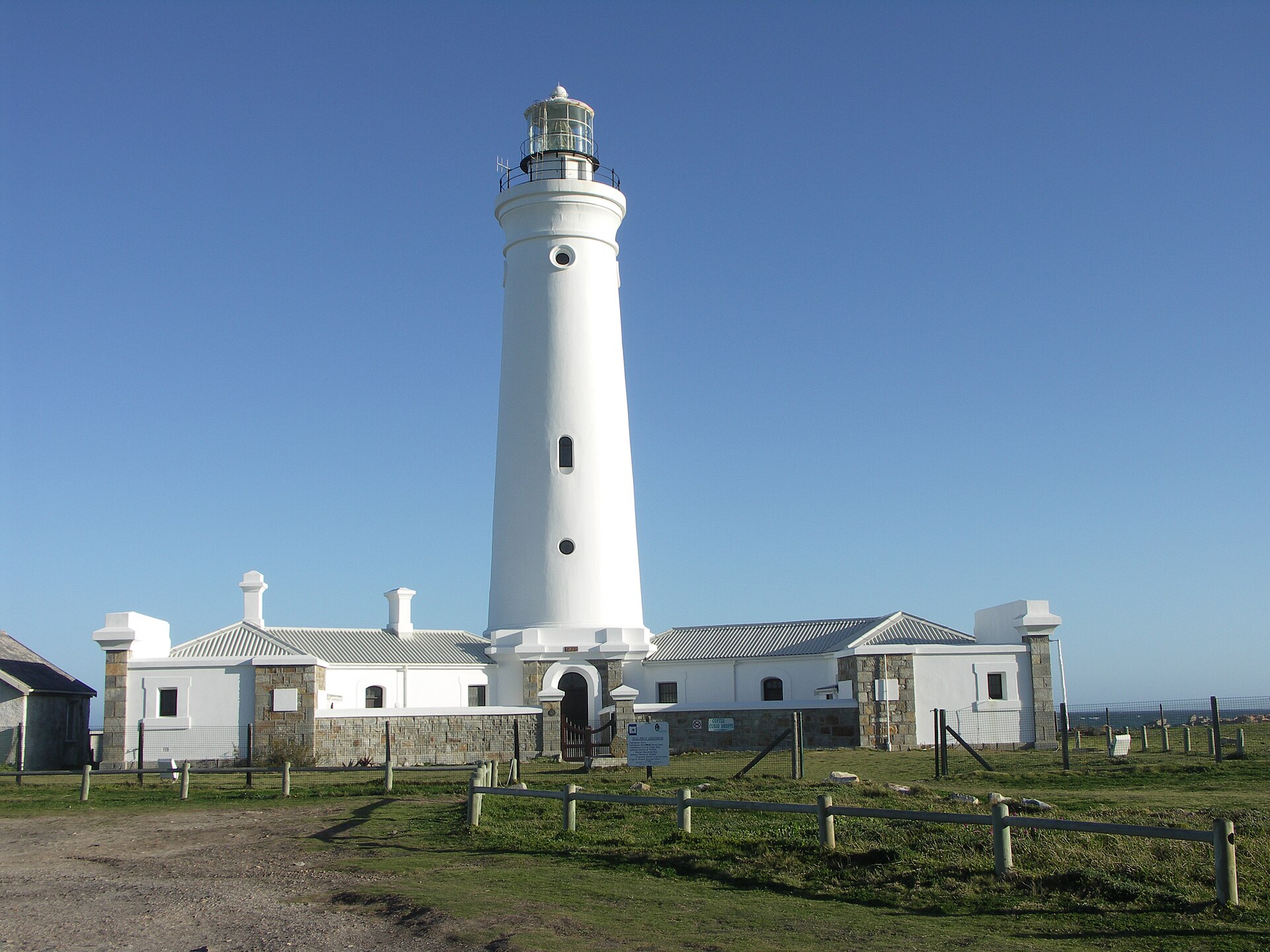
The lighthouse stands where the Indian Ocean meets the continent’s edge, a solitary tower on a windswept headland. It’s not for those who want crowded beaches or resorts—here, the draw is space, silence, and the raw meeting of land and sea. The structure is modest, but its silhouette against the horizon defines this stretch of coastline, especially at dusk when its beam scatters across the water.
In the mid-1800s, shipping routes around the Cape of Good Hope grew busier. Storms and hidden reefs claimed vessels, and lighthouses like this one were the only warning sailors had in the dark or fog. Built in 1878, Cape St Francis Lighthouse has guided ships for nearly 150 years. Though GPS and radar have reduced its practical role, its light still burns each night, a quiet tribute to the mariners who once relied on it.
The tower is built for endurance. The whitewashed structure, roughly fifteen meters tall, is made from local stone, tapering toward the top where the Fresnel lens sits. Inside, a narrow spiral staircase leads to the lantern room, offering a view that stretches to the horizon. The keeper’s cottage and outbuildings, now abandoned, stand nearby. Their weathered walls hold echoes of lives spent in isolation. The wind rattles the doors, and salt air has long since erased any trace of domesticity.
The landscape is untamed: jagged rocks, shifting dunes, and hardy shrubs clinging to the earth. Waves crash against the shore, sending spray high enough to reach the tower in a storm. The ocean here is unpredictable, its currents and swells a challenge even for experienced surfers. When the weather turns, the headland becomes a place of raw power, where the only sound is the roar of the sea.
Seals often bask on the rocks below. Seabirds wheel overhead, scanning the water for fish. In winter, migrating whales sometimes pass close to shore, their dark shapes breaking the surface before vanishing. You might see them without crowds or tour boats—just the open ocean and the cry of gulls.
The lighthouse is more than a navigational aid. It’s a piece of the region’s history, a reminder of when the sea was the only highway between continents. Local stories speak of a ghostly keeper near the tower, though the tales are likely just that. Still, when the wind howls through the empty buildings at night, it’s easy to imagine something unseen moving in the shadows.
Reaching the lighthouse takes effort. The road winds along the coast, narrow and uneven. Port Elizabeth is hours away. There are no gift shops or cafes—just the ocean, the wind, and the quiet. That isolation is part of what makes the place special. It offers a chance to step outside the usual rush, to stand where the land ends and the sea begins.
The light still serves its purpose. On clear nights, its beam cuts through the dark; in fog, it diffuses into a soft glow. Photographers and artists come here, drawn by the way the light plays across the water and the stark beauty of the landscape. There’s nothing superfluous—just the sea, the sky, and a light that refuses to go out.