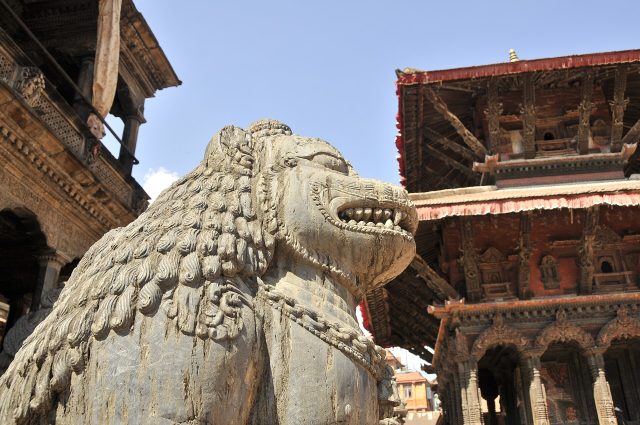
Machhendranath Mandir sits in the old city’s core, where daily life and history merge without hurry. Locals walk past it on their way to work, stop to light a lamp, or sit on its steps to talk. Tourists rarely crowd here—just a few who wander in from the nearby square, curious about the quiet.
The temple honors Machhendranath, a deity claimed by both Hindus and Buddhists. Hindus pray to him for rain; Buddhists see him as a figure of compassion. This shared reverence isn’t unusual in Nepal—faiths here have borrowed from each other for centuries. The temple’s courtyard, where marigolds and rice grains are scattered on the ground, shows how little separates the two.
The building is Newari: a three-tiered pagoda with wooden windows carved in geometric patterns. The roof sags slightly in one corner, and the stone statues at the entrance are worn smooth by hands touching them over generations. Inside, the air is cool and dim, the only light coming from small openings near the ceiling. A brass bell hangs in the corner, its surface darkened by years of use.
Legends say the temple dates back to the 7th century, when Patan was already a city of craftsmen and traders. One story tells of a drought so severe that people carried Machhendranath’s statue from Assam to end it. Every spring, the Rato Machhendranath festival reenacts this journey—men pull a towering chariot through the streets while musicians play and crowds cheer. The chariot’s wheels creak under its weight, a sound that has echoed through Patan for centuries.
What stays with you isn’t the architecture or the history, but the way the temple feels alive. In the morning, women in saris sweep the courtyard with brooms made of twigs. A monk in maroon robes chants while arranging copper bowls on the altar. Children run past, their laughter mixing with the clatter of tea cups from a stall across the lane. You don’t need to understand the rituals to feel part of it—just sit on the steps and watch.
Patan’s artisans have always worked near the temple. The metalworkers in the alley behind it still hammer out statues of gods, their rhythm steady as they shape brass into faces. The woodcarvers next door craft masks for festivals, their tools the same ones their grandfathers used. Some of the temple’s beams and statues bear their marks—initials scratched into the wood or tiny flaws in the metal that only they would notice.
The temple changes with the day. At dawn, the first light catches the dew on the marigolds. By noon, the courtyard is quiet, the only sound the drip of water from an old stone spout. As night falls, oil lamps flicker, casting long shadows on the walls. The scent of incense lingers, sweet and heavy.
You won’t find a gift shop or a sign explaining what to do. No one will ask for your donation or tell you where to stand. Just the temple, the people who use it, and the sense that some things don’t need to be explained. Maybe that’s why, after you leave, you remember the quiet more than anything else.