Luxor Temple stands where the past feels almost tangible, its stones holding the weight of millennia. Built on the eastern bank of the Nile in ancient Thebes, it was never meant to be a monument to death like the tombs across the river. Instead, it was a place of life—where pharaohs renewed their divine authority, gods met mortal rulers, and the rhythms of religion and power shaped the destiny of a civilization. The temple wasn’t just a structure; it was a stage for the grand theater of Egyptian statecraft, where every ritual and inscription reinforced the idea that the pharaoh’s rule was ordained by the gods themselves.
Construction began under Amenhotep III in the 14th century BCE, but the temple evolved over centuries, each ruler leaving his mark. Ramses II expanded it with colossal statues and obelisks, while later Ptolemaic pharaohs and even Roman emperors added their own touches. Unlike static ruins, Luxor Temple grew organically, absorbing new influences while staying true to its original purpose: a threshold between the earthly and the divine. This layering of history makes it unique—here, you can trace how ideas of power, beauty, and sacred space shifted across dynasties, all within the same walls.
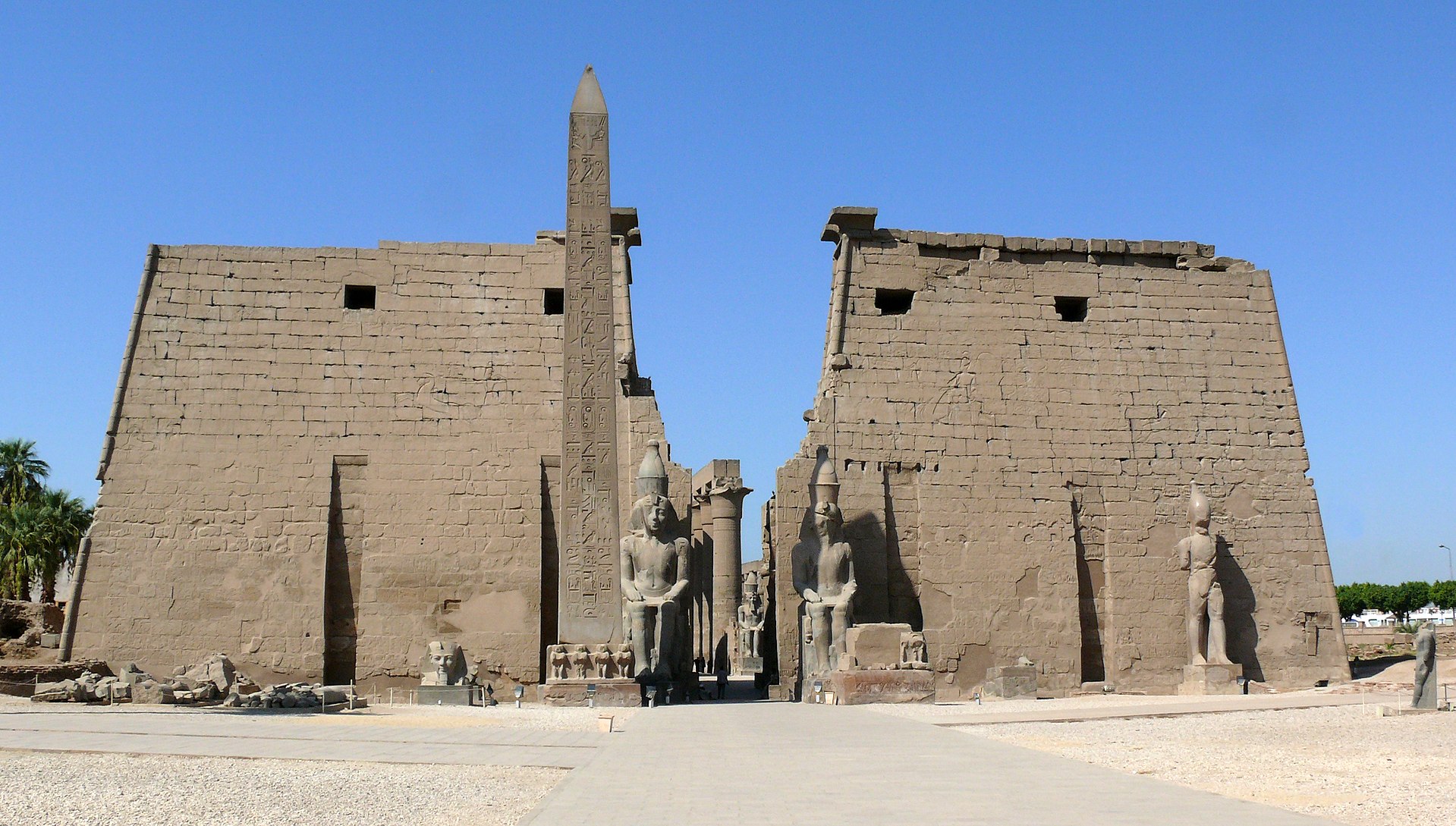
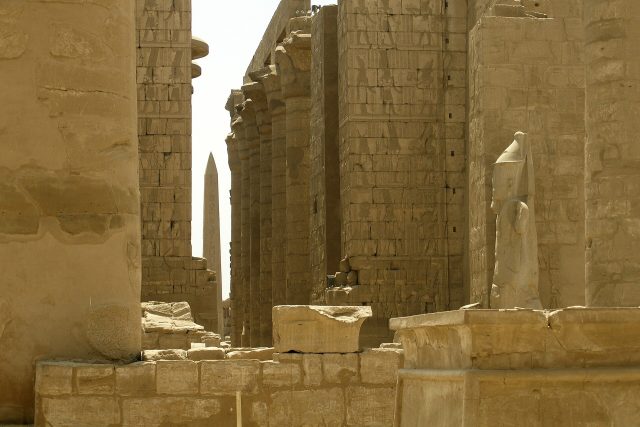
The entrance is flanked by two massive pylons built by Ramses II, their surfaces carved with scenes of his military triumphs. Beyond them lies a vast courtyard, once filled with crowds during festivals. The columns here aren’t just structural—they rise like the trunks of a sacred grove, their papyrus-bud capitals symbolizing rebirth and fertility. Deeper inside, the hypostyle hall of Amenhotep III plays with light and shadow, its towering columns creating an almost mystical atmosphere. At its center once stood a statue of Amun-Ra, the chief god of Thebes, drawing pilgrims from across Egypt to pay homage.
One of the temple’s most sacred spaces was the sanctuary of the barque, where the ceremonial boat of Amun was kept. During the annual Opet Festival, the boat was carried in procession to Karnak Temple, symbolizing the union of Amun and Mut, the divine couple of Thebes. This wasn’t just a religious event—it was a political spectacle, reinforcing the pharaoh’s legitimacy. Today, the barque is gone, but the sanctuary still feels charged with meaning, as if the boundary between the human and the divine lingers in the air.
Luxor Temple hasn’t always looked as it does now. In the early Christian era, it became a church, and later, parts of it were swallowed by medieval buildings. It wasn’t until the 19th century that archaeologists began peeling away these layers, revealing the temple’s original form. Even now, remnants of a Coptic basilica and the 13th-century Mosque of Abu al-Haggag stand alongside the ancient columns, a quiet testament to the site’s many lives. This coexistence of eras and faiths makes Luxor Temple more than just an open-air museum—it’s a place where history refuses to be neatly categorized.
At dusk, the temple transforms. Soft lighting picks out details that daylight obscures—the delicate carvings, the worn edges of stone, the way shadows pool between columns. The crowds thin, and for a moment, it’s possible to imagine the temple as it once was: the murmur of priests, the rustle of papyrus, the distant hum of the Nile. The river, still flowing nearby, was the lifeblood of ancient Thebes, and the temple was its spiritual heart. Today, as it has for thousands of years, Luxor Temple bridges the gap between past and present, each stone a silent witness to the passage of time.