High in the Swiss Alps, where the air is thin and the silence deeper than anywhere else, there’s a place where ice becomes art, and time seems to stand still. The Glacier Palace in Zermatt isn’t just a tourist attraction—it’s a quiet revelation, a hidden world carved into the heart of the Gorner Glacier. Here, at over three thousand meters above sea level, the rules of ordinary architecture don’t apply. Walls, floors, even furniture and sculptures are all made of ice, their surfaces catching the light in ways that make the space feel both ancient and ever-changing. The cold is sharp but not unwelcoming, as if the glacier itself is sharing its clarity with those who venture inside.
The palace began as a simple idea in the mid-20th century, when local mountain guides wanted to show visitors something beyond the usual alpine sights. They took their ice axes and saws—tools more familiar to climbers than artists—and began shaping the glacier from within. What started as a few rough chambers grew over the years into a labyrinth of halls, each one unique. New sculptures were added, then ice chandeliers, and eventually a small café where visitors could warm up with a hot drink. The work was slow, done by hand, and the results were never permanent. Ice melts, shifts, and reforms, so the palace is always evolving, always slightly different from one season to the next.
There’s nothing rigid or geometric about the Glacier Palace. The walls curve and flow like frozen rivers, their surfaces etched with patterns that resemble frost on a winter window. Light filters through the ice in unpredictable ways, casting blue and green hues that make the space feel alive. In some rooms, colored lamps illuminate the sculptures, turning them into otherworldly figures—dragons, eagles, abstract shapes that seem to emerge from the ice itself. The most striking chamber is the one with towering ice columns, where the walls refract light like a giant crystal. It’s easy to forget you’re inside a glacier until you hear the distant creak of shifting ice, a reminder that this place is still very much in motion.
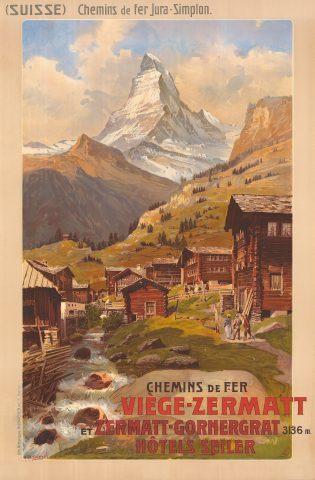
Reaching the palace is part of the experience. The journey begins with a ride on the Gornergrat Railway, a scenic ascent that takes about half an hour. As the train climbs, the landscape unfolds in layers—snow-covered peaks, jagged ridges, and the iconic pyramid of the Matterhorn, its sharp silhouette unmistakable against the sky. When you arrive at the glacier, the entrance to the palace is a tunnel leading downward, its steps slick with ice. Visitors are given spiked overshoes to prevent slipping, a small but necessary precaution. Inside, the temperature hovers just below freezing, so even in summer, a warm jacket is essential.
The Gorner Glacier, which houses the palace, is one of the largest in the Alps, stretching nearly fourteen kilometers and reaching depths of several hundred meters in places. It moves slowly, just a few centimeters each year, but that movement is enough to reshape the palace over time. Old chambers close up as the ice shifts, and new ones are carved elsewhere, ensuring that no two visits are exactly the same. This impermanence is part of the palace’s charm—it’s a place that can’t be preserved, only experienced in the moment.
Beyond the sculptures, the palace offers a glimpse into the glacier’s history and its relationship with the people of Zermatt. A small exhibit includes photographs showing how the landscape has changed over the decades. In the early 1900s, the glacier’s tongue extended much closer to the village, a stark contrast to its current retreat. It’s a quiet reminder of how fragile these natural wonders are, and how quickly they’re disappearing. In one corner, a thermometer shows the ice temperature, usually around minus two degrees Celsius—a relatively warm reading for a glacier, but still a world away from the comfort of the valley below.
The atmosphere inside the palace is unlike anywhere else. It’s a tourist attraction, yes, but it doesn’t feel crowded or rushed. Visitors wander through the chambers at their own pace, some stopping to admire the sculptures, others simply standing in silence, listening to the occasional crack of ice echoing through the tunnels. There’s a sense of discovery here, as if you’ve stumbled upon something secret, even though hundreds of people pass through each day. The cold, the light, the way sound travels through the ice—it all combines to create a feeling of being somewhere outside of time.
There’s a melancholy beauty to the Glacier Palace, too. The Alps’ glaciers are shrinking, and scientists warn that many may vanish within decades. Visiting a place like this is a chance to witness something that might not exist in the future. It’s a bittersweet experience, knowing that the ice you’re walking through is slowly melting, that the sculptures will eventually disappear. But that impermanence is also what makes the palace so special. It’s a reminder that some things can’t be captured in a photograph or preserved in a museum—they have to be seen, felt, and remembered in the moment.
When you return to Zermatt after visiting the palace, the village feels different. The snow-capped peaks that surround it seem more fragile, the air crisper, as if the glacier’s presence lingers in your senses. The people who live here have always understood this—they’re not just hosts to tourists but stewards of a landscape that’s constantly changing. The Glacier Palace isn’t just a place to take pictures or marvel at ice sculptures. It’s a quiet invitation to think about the natural world differently, to see it not as a backdrop for our travels but as something alive, something worth protecting. And perhaps that’s why it stays with you long after you’ve left.