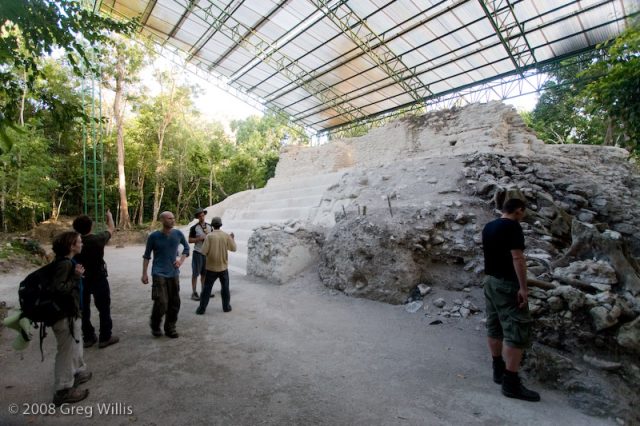
La Amelia is one of those quiet, unassuming places that feels like a secret tucked away in the jungles of northern Guatemala. Unlike the more famous Maya sites like Tikal or Yaxha, it doesn’t draw crowds, and that’s precisely what makes it special. Here, you can wander among ancient structures without the hum of tour groups, the stillness broken only by the rustle of leaves and the distant calls of howler monkeys. The ruins lie off the beaten path near Santa Elena de la Cruz, accessible only by winding roads that cut through rural landscapes where life moves at its own unhurried pace.
The city flourished during the Classic Maya period, roughly between the 6th and 9th centuries, under the influence of the powerful Mutul kingdom centered in Tikal. La Amelia was never a major political hub, but it played a crucial role as a trading post and religious center. The remnants of palaces, temples, and a ball court hint at a small yet prosperous settlement connected to neighboring cities by the Maya’s network of *sacbeob*—raised stone causeways that once crisscrossed the region. These roads were more than just thoroughfares; they were lifelines, linking communities and facilitating the exchange of goods, ideas, and culture.
The architecture here is classic Petén style: sturdy stone platforms, stepped pyramids, and narrow staircases leading to temple summits. The most striking structure is known simply as Structure 1—a modest pyramid with fragments of carved stone blocks that once bore hieroglyphic inscriptions. Time has worn away much of the detail, but even the faint outlines suggest the craftsmanship and significance of these buildings in their prime. Nearby, the ball court remains in surprisingly good condition, one of the few in the area where you can still trace the contours of the game that held deep ritual meaning for the Maya.
The surrounding jungle is as much a part of the experience as the ruins themselves. Dense foliage envelops the site, the air thick with the scent of damp earth and the occasional cry of a toucan. It’s easy to imagine the city as it once was, alive with the sounds of daily life—merchants haggling, priests chanting, children playing in the plazas. Unlike more developed archaeological zones, La Amelia has no modern amenities. There are no cafes, no souvenir stalls, no neatly labeled signs. What you find instead is raw history, untouched and unpolished, where the past feels almost tangible.
Getting here is part of the journey. The road winds through villages where life has changed little over the centuries. Farmers tend to fields of corn, beans, and coffee, while women in traditional embroidered *huipiles* balance baskets of fruit on their heads. Tourists are a rare sight, and the locals greet visitors with a mix of curiosity and warmth. The contrast between the ancient ruins and the living culture around them is striking—one moment you’re standing in a temple built over a thousand years ago, the next you’re passing a wooden house where a family gathers around a fire for the evening meal.
La Amelia may not have the grandeur of Tikal or the dramatic vistas of El Mirador, but that’s not the point. Its charm lies in its authenticity. There are no reconstructions here, no attempts to sanitize the past for modern audiences. The stones are worn, the edges softened by time and vegetation, and the silence is profound. It’s a place that invites reflection, not just on the Maya civilization but on the nature of history itself. The great cities like Tikal were the exception, not the rule. Most Maya lived in smaller settlements like this one, where life was shaped by the rhythms of the land and the cycles of the seasons.
If you decide to visit, come prepared. The roads can be rough, especially during the rainy season when dirt paths turn to mud. Bring water, snacks, and insect repellent—essentials for any jungle excursion. Local guides from Santa Elena or Flores can help arrange a trip, though it’s best to arrange things in advance since not everyone knows the site well. Even without a guide, the ruins are open to explore, though a little local knowledge can help piece together the fragments of history scattered among the trees.
What makes La Amelia worth the effort isn’t just the ruins themselves, but the sense of discovery that comes with them. It’s a reminder that history isn’t always about monumental achievements or famous names. Sometimes, it’s about the quiet places, the ones that don’t make it into the guidebooks but still have stories to tell. Here, among the crumbling stones and the whispering jungle, you can almost hear the echoes of a world that once was—and in some ways, still is.