Photo: David Stanley from Nanaimo, Canada, CC BY 2.0
Sigiriya Fortress
out of 5 0 ratingsSigiriya is one of those rare places where nature and history collide in a way that feels almost deliberate, as if the landscape itself conspired to preserve a story. Rising abruptly from the flat plains of central Sri Lanka, this massive rock formation doesn’t just dominate the horizon—it commands attention, its sheer walls and jagged outline hinting at something far more complex than a simple geological feature. For centuries, it was forgotten, swallowed by the relentless growth of the surrounding jungle, until the modern world rediscovered what had once been one of the most extraordinary feats of ancient engineering: a royal citadel carved into the living rock.
The man behind Sigiriya’s creation was King Kashyapa, a ruler whose life reads like a tragic drama. In the 5th century, he seized power from his father in a coup, only to live in constant fear of retribution from his exiled brother. Desperate for security, he chose this imposing monolith as the site for his new capital, believing its natural defenses—sheer cliffs, surrounding marshlands, and dense forest—would make it impregnable. Over seventeen years, he transformed the rock into a fortress, its summit crowned with a palace that was as much a display of power as it was a refuge. Gardens, pools, and intricate water systems were built to impress, while the famous frescoes of the Sigiriya maidens—mysterious, graceful figures painted high on the western face—added an air of divine legitimacy to his rule. Yet for all his ambition, Kashyapa’s reign ended in betrayal. His brother returned with an army, and rather than face capture, the king is said to have taken his own life on the battlefield, leaving his dream city to fade into legend.
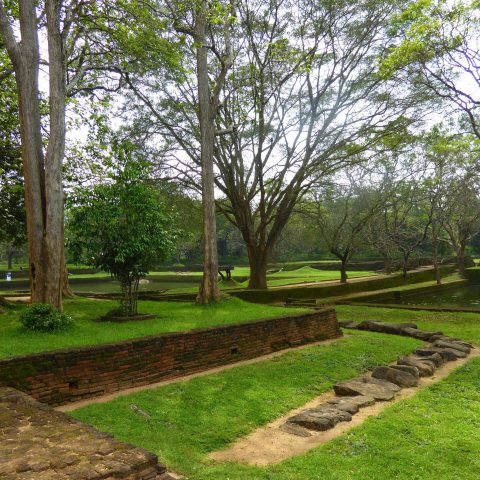
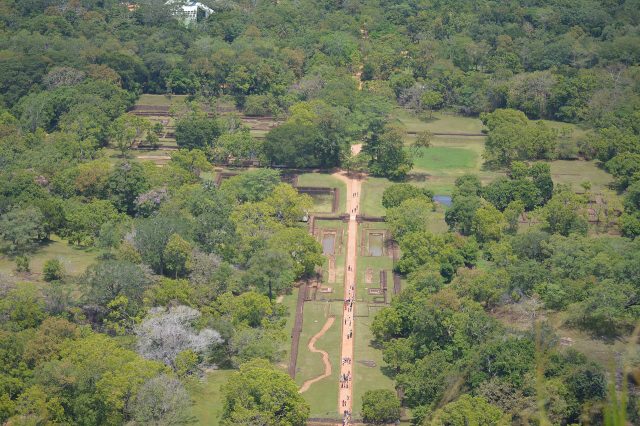
The ascent to the top begins not with the rock itself, but with the remnants of what was once one of the world’s oldest landscaped gardens. Even in ruin, the symmetry and precision of the design are striking. Water channels, still faintly visible, once carried streams through terraced gardens, while stone-lined pools and islands created a sense of controlled beauty. The gardens were divided into three distinct sections: the water gardens, with their reflective pools and stepping stones; the boulder gardens, where massive rocks were incorporated into the design; and the terraced gardens, built into the slope of the rock with retaining walls that still stand today. What’s remarkable is how little has changed in the intervening centuries. The same principles of harmony and balance that guided their creation are still evident, and on a quiet morning, it’s easy to imagine the gardens as they once were—alive with the sound of flowing water and the murmur of courtiers strolling beneath the shade of ancient trees.
The most famous—and debated—feature of Sigiriya is the gallery of frescoes halfway up the rock face. Painted directly onto the stone, the images depict twenty-one women, their bodies adorned in jewels, their expressions serene yet enigmatic. Known as the Sigiriya damsels, their identities remain a mystery. Were they celestial beings, royal consorts, or symbolic figures representing fertility and abundance? The colors, remarkably preserved, still glow with a vibrancy that defies the passage of time. To reach them, visitors must walk along a narrow ledge, once part of the fortress’s outer wall. Today, metal railings offer some reassurance, but the drop is still dizzying, especially when you consider that in Kashyapa’s time, this path would have been even more precarious. The frescoes themselves are a marvel of ancient artistry, their delicate brushwork and lifelike details suggesting a level of sophistication that belies the era in which they were created.
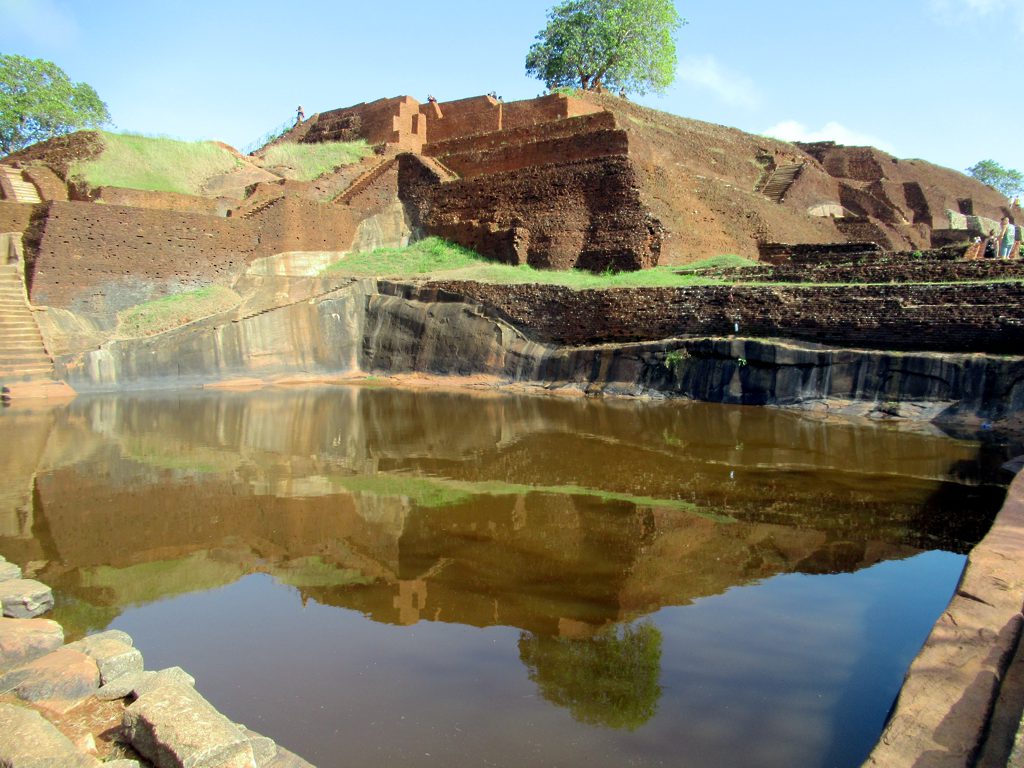
The climb to the summit is a physical challenge, but it’s also a journey through layers of history. The steps, cut directly into the rock, wind past the remains of storerooms, barracks, and cisterns that once supplied the palace with water. About halfway up, the path leads to the Lion’s Platform, where the final ascent was once guarded by a massive stone lion. Only the paws remain today, but their scale is still imposing, a reminder of the grandeur that once stood here. The lion’s mouth served as the gateway to the upper palace, and though the statue is long gone, the symbolism endures. At the top, the reward is a view that stretches for miles—the emerald expanse of the jungle, the distant hills, and below, the sprawling ruins of Kashyapa’s kingdom, now reclaimed in part by the forest.
The summit itself is a vast, windswept plateau, where the foundations of the royal palace still trace the outlines of what was once a lavish residence. The remains of the throne room, bathing pools, and even an early form of plumbing hint at the sophistication of the design. It’s difficult to comprehend how such a complex was built without modern tools, relying instead on human labor and ingenuity. The stone underfoot is worn smooth in places, polished by centuries of footsteps, while the wind carries the distant calls of monkeys—now the true rulers of this domain. The silence up here is profound, broken only by the rustle of leaves and the occasional cry of a bird, as if the rock itself is holding its breath, waiting for the past to speak.
After Kashyapa’s death, Sigiriya’s fate was sealed. The capital was abandoned, and for a time, the site was repurposed as a Buddhist monastery, its caves and terraces serving as places of meditation. But even that chapter eventually ended, and the jungle reclaimed what was left, burying the rock in layers of vegetation until it was all but forgotten. It wasn’t until the 19th century that British archaeologists rediscovered Sigiriya, peeling back the vines and centuries of neglect to reveal the ruins beneath. Since then, it has become one of Sri Lanka’s most iconic landmarks, drawing visitors from around the world. For some, it’s a historical curiosity; for others, a spiritual site. Buddhists still consider it sacred, and there are those who believe the spirits of its ancient inhabitants linger in the shadows of the rock.
What makes Sigiriya so compelling isn’t just its history, but the way it exists in the present. The jungle is slowly, inexorably reclaiming it—roots crack the ancient stone, vines creep over walls, and monkeys scamper through the ruins with the confidence of owners. There’s a sense of impermanence here, a reminder that even the most ambitious human endeavors are temporary. The rock stands as a monument to both ingenuity and hubris, a place where nature and civilization are locked in an eternal dance. One doesn’t conquer the other; they simply coexist, each shaping the other in ways that are both visible and unseen.
Visiting Sigiriya is less about ticking off a tourist attraction and more about stepping into a different time. The best moments here are the quiet ones—the early morning, when the first light touches the rock and the mist still clings to the trees; the late afternoon, when the heat of the day gives way to a cooler breeze and the shadows lengthen. It’s a place that demands patience, a willingness to look beyond the obvious and imagine the lives that once unfolded here. If you listen closely, you might catch the faintest echo of the past—the murmur of voices, the splash of water in long-dry fountains, the distant sound of a king’s footsteps as he walked these same stones, dreaming of a kingdom that would outlast him. But time, as always, has the final word.
Day around this place
Where else to go on the same day
Building the day…
Where it is
7.95666, 80.75993