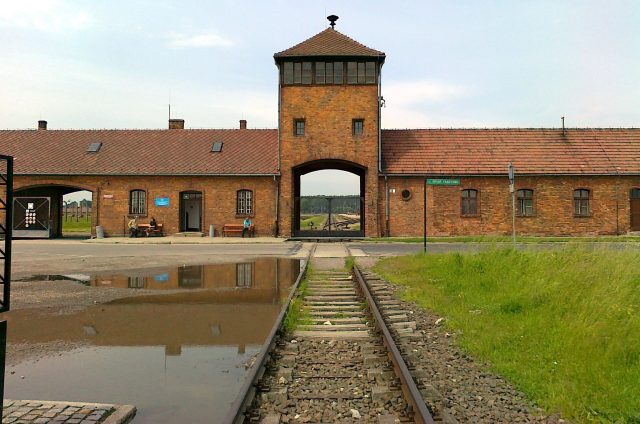
Terezín is a place that defies simple description. Today, it’s a quiet Czech town with neat streets and small cafés, a place where life moves at an unhurried pace. But beneath this peaceful surface lies a history that is anything but ordinary. During World War II, Terezín—known then as Theresienstadt—was one of the most infamous Nazi concentration camps. Established in 1941 within the walls of an 18th-century Austrian fortress, it served as a transit point for Jews bound for extermination camps in the east. Yet Theresienstadt was more than just a waystation; it was a carefully constructed illusion, a tool of Nazi propaganda designed to obscure the horrors of the Holocaust.
The crematorium in Terezín stands as a stark reminder of that deception. Built in 1942, it was a response to the rising number of deaths in the camp, which had overwhelmed the local cemetery. The structure itself is unassuming—a small brick building with a single furnace, tucked away beyond the fortress walls on the edge of town. It was here that the bodies of those who succumbed to disease, starvation, or execution were burned. The building has been preserved almost exactly as it was, its grim purpose unchanged by time. Walking through its low-ceilinged rooms, where the original furnace still stands, is an experience that lingers long after you leave.
The architecture of the crematorium is as functional as it is chilling. There is no ornamentation, no attempt at aesthetics—just thick walls and narrow spaces designed to contain the unspeakable. Inside, the air feels heavy, as if the weight of history has settled into the very bricks. Outside, the surrounding cemetery stretches in neat rows of unmarked graves, each marked only by simple concrete slabs. There are no grand monuments here, no elaborate tributes—just silence, broken only by the occasional rustle of wind through the trees.
Theresienstadt was unlike other camps in one crucial way: the Nazis presented it as a model Jewish settlement, a place where prisoners supposedly lived in relative comfort. In 1944, a Red Cross delegation was even brought in to witness this carefully staged performance. They saw theaters, concerts, and children’s drawings—all part of a propaganda film that showed prisoners smiling, playing music, and going about their lives as if nothing were amiss. But behind this facade lay a brutal reality. Disease, malnutrition, and the constant threat of deportation to Auschwitz or Treblinka were the true conditions of life in Theresienstadt. The crematorium, hidden from view, was the final stop for thousands who never made it out.
Today, Terezín is a memorial, a place of reflection for visitors from around the world. The museum here houses documents, photographs, and personal belongings of those who were imprisoned, offering a glimpse into both the suffering and the resilience of the camp’s inmates. There are records of underground resistance, of prisoners who wrote poetry, painted, and staged plays despite the horrors around them. Among the most moving exhibits are the drawings of children, many of whom did not survive the war. Their artwork is a testament to the human spirit’s ability to endure even in the darkest of times.
The crematorium is not just a historical site; it is a place of remembrance. There is no grandeur here, no dramatic memorial—just a quiet building where visitors often leave flowers or light candles at the entrance. Occasionally, memorial ceremonies are held, but for most of the year, the crematorium stands empty, a silent witness to the lives lost. For many, this is where the full weight of the Holocaust becomes real, where history ceases to be an abstract concept and becomes something tangible, something that demands to be remembered.
Terezín serves as a stark reminder of how thin the line between civilization and barbarism can be. The town itself, with its cobblestone streets and pastel buildings, looks deceptively ordinary. Yet it was here that unspeakable crimes took place, where the Nazis’ carefully constructed lies were exposed by the grim reality of the crematorium. Visiting this place is not easy, nor should it be. The discomfort it provokes is part of its purpose—to ensure that the past is never forgotten, and that the lessons it teaches are never ignored.
The crematorium, in its simplicity, speaks volumes. It is a place where the past feels immediate, where the absence of those who perished is almost palpable. There are no easy answers here, no comforting narratives—just the quiet insistence that we remember. And perhaps that is the most important thing of all.