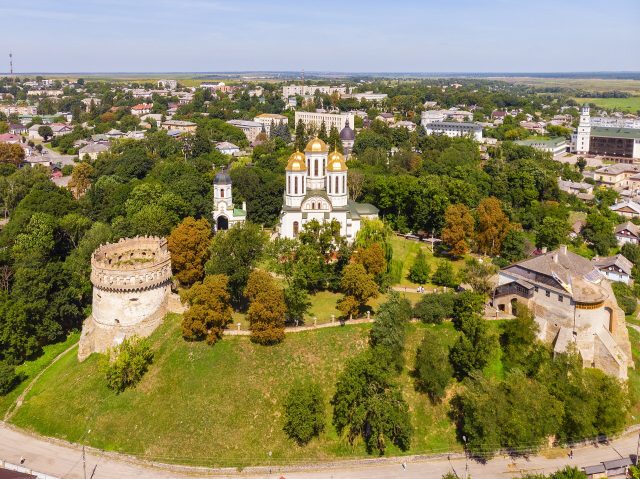
Ostroh is a town where time seems to have paused, leaving behind a quiet rhythm of history in every cobblestone and weathered wall. Among its low-roofed houses and remnants of ancient fortifications, the Church of St. Joseph stands as a quiet witness to the layers of culture and change that have shaped this place. Built in the early 17th century, it carries the weight of centuries within its walls, a silent observer of wars, shifting borders, and the slow passage of time.
The church was founded in 1607, when Ostroh was a thriving center of the Polish-Lithuanian Commonwealth. Back then, the town was more than just a fortress—it was a hub of learning and intellectual life, home to the Ostroh Academy, the first institution of higher education in what is now Ukraine. The Church of St. Joseph was part of this cultural landscape, blending Western European architectural traditions with local influences. Its construction reflected the town’s significance, a place where ideas and faith intersected.
Designed in the late Renaissance style with subtle Baroque touches, the church’s exterior is understated yet elegant. Pilasters frame the facade, while a modest pediment crowns the entrance, giving it a sense of quiet dignity. Inside, vaulted ceilings and arched windows create an atmosphere of solemnity and light. Unlike many churches of the era, it avoids excessive ornamentation, relying instead on proportion and craftsmanship. The massive columns supporting the choir loft and the high windows that filter soft daylight into the nave make the space feel both grand and intimate.
Over the centuries, the church has endured its share of hardships. After the partitions of Poland in the late 18th century, Ostroh came under Russian rule, and Catholic churches gradually lost their prominence. St. Joseph’s was closed, repurposed as a warehouse, and even used as a workshop. By the Soviet era, the building had fallen into disrepair. It wasn’t until the late 20th century that the church was returned to the faithful, and restoration efforts began to revive its faded glory.
Inside, traces of the past remain. Fragments of old frescoes and tombstones hint at the lives once lived here, while a carved wooden pulpit—adorned with intricate Baroque reliefs—stands as a rare survivor of the church’s original furnishings. Though the main altar has been altered over time, it still carries echoes of its former splendor. In the side niches, statues of saints offer a glimpse of the church’s once-rich interior, though much of it has been lost to history.
What makes the Church of St. Joseph special is the way it preserves the past not just as a relic, but as something almost tangible. Stepping inside, you can almost hear the murmurs of prayers, the distant notes of an organ, the footsteps of those who once filled its pews. There’s no modern hustle here, no crowds—just the quiet interplay of light and shadow through the stained glass. Outside, a small park surrounds the church, where old gravestones lie scattered, each one a silent story of the town’s long history.
Today, the church is one of Ostroh’s lesser-known landmarks, overshadowed by the more famous castle and academy. But that’s part of its charm. Without the usual tourist crowds, visitors can take their time, wandering through the nave or sitting in the park, imagining what life was like when the church was first built. It’s a place where history isn’t just recorded—it’s felt in the cool stone under your fingers and the hush of the empty pews.
If you find yourself in Ostroh, the Church of St. Joseph is worth a visit—not just for its architecture, but for the way it connects you to the past. There’s no grand narrative here, no dramatic tales of battles or kings. Instead, it offers something quieter: a sense of continuity, of lives lived and forgotten, of a town that has seen empires rise and fall yet remains. In a world that moves too fast, places like this remind you to slow down, to listen, and to look closely at the stories written in brick and mortar.