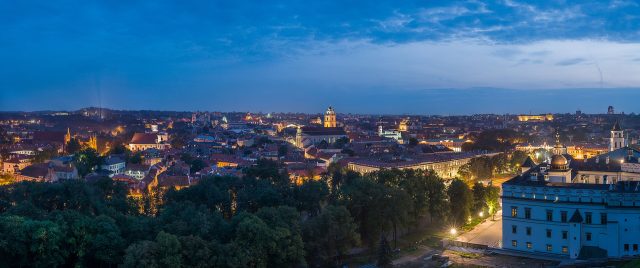
The Church of the Holy Trinity in Vilnius is one of those quiet places where time seems to stand still, carrying within its walls the echoes of different eras. Tucked away on Verkių Street, not far from the famous Gate of Dawn, its unassuming facade might not immediately catch the eye like some of Vilnius’ more flamboyant churches. Yet its history is as layered as the city itself, woven into the fabric of religious and cultural shifts that have shaped this part of Europe.
Built in the 17th century, the church was part of a monastic complex belonging to the Basilian Order, a community that played a significant role in Vilnius’ spiritual life. The Basilians followed the Byzantine rite but were in communion with Rome, reflecting the unique religious landscape of the Polish-Lithuanian Commonwealth. This duality is visible in the church’s architecture, where Baroque elements blend with the restraint of classicism—a common trait in Vilnius, where styles often overlapped and evolved. The exterior is simple, almost austere, but step inside, and the space unfolds with a sense of solemn grandeur. High vaulted ceilings, adorned with frescoes, rise above massive columns, while the gilded details of the altar catch the light filtering through the windows. The ceiling paintings, executed in grisaille, depict scenes from the lives of saints and are a rare sight in Lithuanian churches, adding to the building’s distinct character.
The church is deeply tied to the history of the Uniate Church, which emerged in the late 16th century as an attempt to bridge the divide between Catholicism and Orthodoxy. For the Basilians, the Church of the Holy Trinity became a spiritual hub, and in the 18th century, it housed the relics of Saint Josaphat Kuntsevych, a Uniate archbishop later canonized as a martyr. His veneration drew pilgrims from across the region, and even today, visitors come to pay their respects. The presence of his relics marked a period when the church was a focal point for those seeking unity between Eastern and Western Christian traditions.
Vilnius has always been a city of intersecting cultures, and the Church of the Holy Trinity stands as a testament to that complexity. In the 19th century, after the suppression of the Polish uprising and the dissolution of the Uniate Church within the Russian Empire, the building was transferred to Latin Rite Catholics. This was a time of upheaval, yet much of the church’s interior survived the transition. Today, services are held in both Lithuanian and Polish, a reflection of the city’s enduring multicultural identity. The church’s ability to adapt while preserving its heritage speaks to Vilnius’ broader story—a place where history is not just remembered but lived.
The surrounding area is just as intriguing. Verkių Street, where the church is located, leads toward the Gate of Dawn, one of Vilnius’ most iconic landmarks. The street itself is lined with old houses, some dating back to the Middle Ages, their facades bearing the marks of centuries. The church is set back from the road, enclosed by a small courtyard where the noise of the city fades into the background. It’s a quiet spot, even during peak tourist season, offering a respite from the crowds that gather at more famous sites like St. Anne’s Church or the Cathedral.
Inside, the church holds details that reward a closer look. The icons, for instance, blend Byzantine traditions with Western influences, a visual representation of the religious synthesis that once defined this region. One of the most revered is an image of the Virgin Hodegetria, considered miraculous by many. The wooden pews and confessionals, carved with care and worn by time, add to the sense of continuity. Everything here feels deliberate, as if each element has its place in a larger narrative.
What makes the Church of the Holy Trinity special is its lack of pretension. Unlike some of Vilnius’ more celebrated churches, it doesn’t demand attention with towering spires or ornate facades. Instead, it invites quiet reflection, a chance to step away from the rush of sightseeing and simply be present. There’s no grand spectacle here, just the quiet dignity of a place that has witnessed centuries of change. For those who appreciate history not as a series of dates but as something tangible, this church offers a rare kind of authenticity.
If you find yourself in Vilnius, it’s worth taking a detour to visit, even for a short while. You might not find the kind of dramatic beauty that fills postcards, but you’ll discover something just as valuable: a sense of stillness, a connection to the past, and the quiet rhythm of a place that has endured. The Church of the Holy Trinity isn’t just a building; it’s a living piece of the city’s soul, one that has quietly carried on for generations.