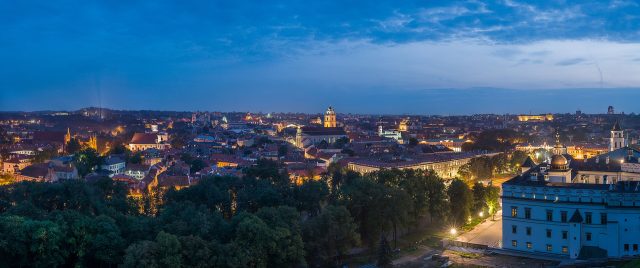
St. Anne’s Church stands quietly by the Vilnia River, a small but unmistakable landmark that has come to define Vilnius as much as the city’s winding streets and hidden courtyards. Built in the late fifteenth century, it is the most celebrated example of Gothic architecture in Lithuania, and one of the few structures in the country to have survived the centuries with its original facade nearly intact. Time has left its mark, but the church’s exterior remains remarkably unchanged—a rarity in a region where wars, fires, and reconstructions have erased so much of the past.
What makes St. Anne’s extraordinary is not its size, but the way it plays with perception. The facade is a masterpiece of brickwork, assembled from thirty-three different types of molded bricks—each shaped into pointed arches, twisted columns, rosettes, and delicate tracery. The effect is almost sculptural, as if the entire front of the church had been carved rather than built. Three slender towers frame the central arch, their tapering forms drawing the eye upward, making the modest structure appear far grander than it is. The craftsmanship is so precise that even after five hundred years, the details remain sharp, the lines clean.
Local legend claims that Napoleon, passing through Vilnius during his 1812 campaign, was so struck by the church that he wished he could carry it back to Paris in the palm of his hand. There’s no record to confirm the story, but it has endured, repeated so often that it feels almost true. Whether or not the French emperor ever uttered those words, the tale captures something essential about St. Anne’s—its ability to stop people in their tracks, to make them pause and look again.
Inside, the church is far simpler than its facade suggests. A single nave, a Baroque altar, and soft, filtered light create an atmosphere of quiet reverence. The contrast is striking: outside, the building is all drama and intricacy; within, it is restrained, almost austere. Most visitors come to admire the exterior, and it’s easy to see why. The real magic of St. Anne’s lies in its ability to transform ordinary materials—brick, mortar, clay—into something that feels almost weightless, as if it might dissolve into the sky.
Just steps away stands the much larger Church of St. Francis and St. Bernard, built from the same red brick. Together, the two form a harmonious ensemble, their Gothic lines complementing each other across the narrow street. The best views are from the bridge over the Vilnia or from the beginning of the street, where both churches appear side by side, their reflections shimmering in the river below. In the evening, when the facade is lit, the brickwork takes on a new depth, the shadows accentuating every curve and angle.
St. Anne’s remains an active place of worship, with services held in the mornings and evenings. The schedule is posted by the entrance, and visitors are welcome during the day, though access is limited during services. Winter hours are shorter, but even in the colder months, the church is worth a visit. Nearby, benches along the riverbank offer a place to sit and take in the full sweep of the facade, its reflection rippling in the water.
Beyond the church, the neighborhood of Užupis begins just a few minutes’ walk away. Once a bohemian enclave, it has become one of Vilnius’s most distinctive districts, known for its art galleries, cafes, and the playful Republic of Užupis, complete with its own constitution. But even here, St. Anne’s holds its own—a quiet counterpoint to the area’s creative energy, a reminder of the city’s deeper layers.
There’s something timeless about St. Anne’s, a sense that it has always been here and always will be. It doesn’t demand attention, yet it’s impossible to ignore. Whether you see it in the golden light of morning, the soft glow of evening, or the muted tones of a winter afternoon, the church has a way of making the past feel present, as if the hands that shaped its bricks are still at work.