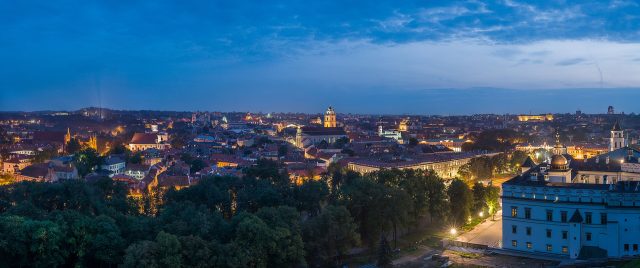
Gediminas Tower stands alone on a hill overlooking Vilnius, a solitary survivor of the Upper Castle that once commanded the city. Built in the fourteenth century under Grand Duke Vytautas, it replaced earlier wooden fortifications said to have been raised by Gediminas himself. Of the three original towers, only this one remains—the others were dismantled for bricks in the nineteenth century, leaving this round brick structure as the last witness to the castle’s former grandeur.
The hill rises nearly fifty meters above the surrounding streets, offering one of the best views in Vilnius. From the top, the old town unfolds in a patchwork of terracotta roofs, church spires piercing the skyline, and the slow curve of the Neris River. Across the water, the modern city rises in glass and steel, a contrast to the medieval streets below. On clear days, the horizon stretches far beyond the city limits, making the climb worthwhile even for those who have seen Vilnius from every angle.
Inside the tower, a small exhibition traces the history of the castle and the city. Models reconstruct the fortress as it once stood, while displays of weapons, armor, and old engravings give a sense of how the site evolved over centuries. The exhibits are modest but effective, grounding the visitor in the layers of time that have shaped Vilnius. The tower itself is narrow, with three levels connected by a tight spiral staircase, and the final ascent to the observation deck is through a small hatch—worth it for the breeze and the unobstructed view.
For Lithuanians, Gediminas Tower is more than a historical monument. In 1988, during the push for independence, the national tricolor was raised here for the first time in fifty years. That moment turned the tower into a symbol of resilience, a place where history and national identity intersect. Even now, it remains a focal point for gatherings, celebrations, and quiet reflection, its silhouette instantly recognizable against the Vilnius sky.
Reaching the tower is part of the experience. The most straightforward route is the paved road winding up the hillside, though it can be slippery after rain. A steeper staircase on the north side offers a quicker but more demanding climb. For those who prefer convenience, a funicular runs from the courtyard of the National Museum, whisking visitors to the top in under a minute. The funicular operates on a schedule and closes during bad weather, but the hill itself is always accessible, while entry to the tower requires a ticket.
At the base of the hill, Vilnius Cathedral and its bell tower anchor the square, their white facades gleaming in the sunlight. Nearby, the ruins of the Lower Castle and the reconstructed Palace of the Grand Dukes hint at the city’s medieval past. The area is a natural starting point for exploring the old town, with its cobblestone streets and hidden courtyards, though many visitors linger here before or after the climb, soaking in the atmosphere.
The tower’s upper platform is exposed to the elements, and even in summer, a strong wind can make it feel much colder than the streets below. It’s a reminder of the hill’s strategic importance—this was a place built for defense, not comfort. The view, however, is the reward. From here, Vilnius reveals itself in layers: the compact medieval core, the orderly grid of later centuries, and the sprawl of the modern city beyond. It’s a perspective that shifts with the light, the weather, and the time of year, making each visit feel slightly different.
There’s something quietly powerful about standing where generations of rulers, soldiers, and ordinary people once stood. The tower has seen sieges, fires, and reconstructions, yet it endures, a silent sentinel over the city. Whether you come for the history, the view, or the symbolism, Gediminas Tower leaves an impression that lingers long after the descent.