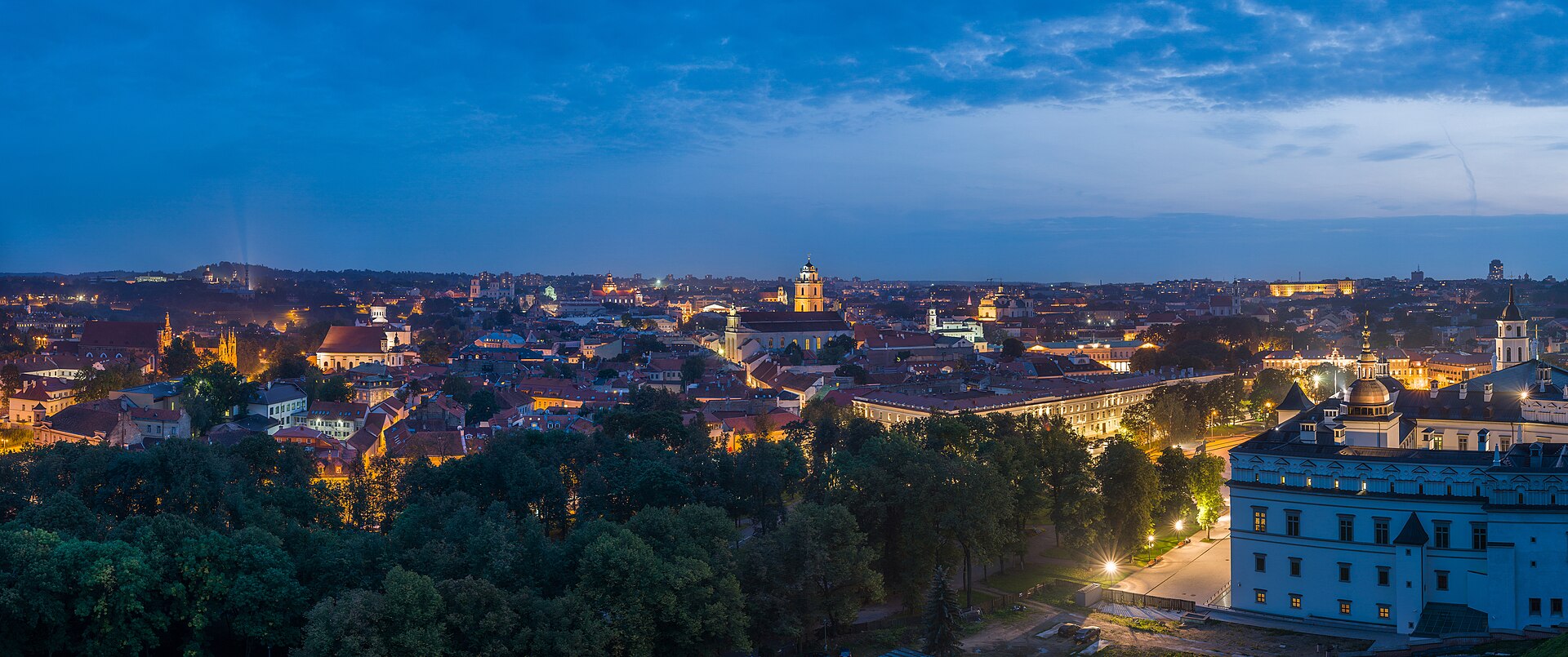
Vilnius Old Town is a place where time feels layered, not linear. Spread across nearly three and a half square kilometers, it’s one of the largest surviving medieval urban centers in Eastern Europe, its streets still following the same organic pattern laid down in the 14th and 15th centuries. From the Castle Hill at its heart, the roads fan out like the ribs of a leaf, twisting into dead ends, hidden courtyards, and arched passageways that stitch one block to the next. There’s no grand symmetry here—just the quiet logic of a city that grew slowly, adapting to the land and the needs of its people.
What makes the Old Town remarkable is how seamlessly different eras coexist. Gothic brick facades stand shoulder to shoulder with Renaissance doorways and Baroque churches, their whitewashed walls and tall, luminous towers giving the streets a bright, almost Mediterranean feel. Vilnius has always been a city of churches—over forty of them crowd the narrow lanes—and their presence is inescapable, whether it’s the soaring spires of St. Anne’s or the humble chapels tucked into back alleys. The Baroque style here isn’t the heavy, gilded opulence of Rome or Vienna; it’s lighter, more restrained, as if the northern light demanded something less ostentatious.
The spine of the Old Town is Pilies Street, a gentle slope running from the cathedral up toward the city gates. It’s the most tourist-heavy stretch, lined with amber shops, cafés, and street musicians, but even here, the past lingers. At the top stands the Gates of Dawn, the last surviving fragment of the city’s medieval fortifications. Above the archway, a small chapel houses a revered icon of the Virgin Mary, and whether you’re religious or not, it’s hard not to feel the weight of centuries when you see people pausing beneath it, removing their hats out of habit. Just off Pilies, the Vilnius University complex sprawls across thirteen interconnected courtyards, its mix of Renaissance, Baroque, and neoclassical buildings hiding an observatory, a library, and the Church of St. Johns, where the echoes of lectures and footsteps still seem to hang in the air.
One of the Old Town’s defining features is its courtyards. Nearly every building has an arched entrance leading to an inner world of galleries, staircases, and quiet corners. Some are grand, with ornate railings and potted plants; others are just narrow gaps between walls, barely wide enough to slip through. The university quarter is particularly rich in these hidden spaces, where students and locals move between lectures or stop for coffee in places that feel entirely removed from the bustle of the main streets. It’s easy to wander into one by accident and find yourself in a different century.
The entire Old Town is a UNESCO World Heritage site, and while maps exist, they’re often more confusing than helpful. The distances are small, but the layout is deliberately disorienting—what looks like a straight path on paper might dead-end into a flight of stairs or a sudden square. The best approach is to let curiosity lead the way. The main streets are where the souvenir shops and pricier cafés cluster, but step even a block away, and the prices drop, the crowds thin, and the city reveals itself in quieter ways. Cars are mostly banned from the center, so the streets belong to pedestrians, cyclists, and the occasional horse-drawn carriage that clatters over the uneven cobblestones.
For those who want a structured introduction, free walking tours leave from the Town Hall several times a day. They last about two hours and cover the highlights, though the real magic happens when you stray from the script. At night, the Old Town transforms. The crowds disperse, the streetlights cast long shadows over the cobblestones, and the illuminated facades take on a theatrical glow. It’s safe to walk even in the small hours, and the silence feels deliberate, as if the city is finally catching its breath after centuries of being lived in.
The one thing that never changes, day or night, is the cobblestones. They’re uneven, worn smooth in some places and jagged in others, and after a few hours of walking, even the most comfortable shoes start to feel like a poor choice. But that’s part of the experience—Vilnius doesn’t let you forget you’re in a place where history isn’t just preserved; it’s still being walked on.