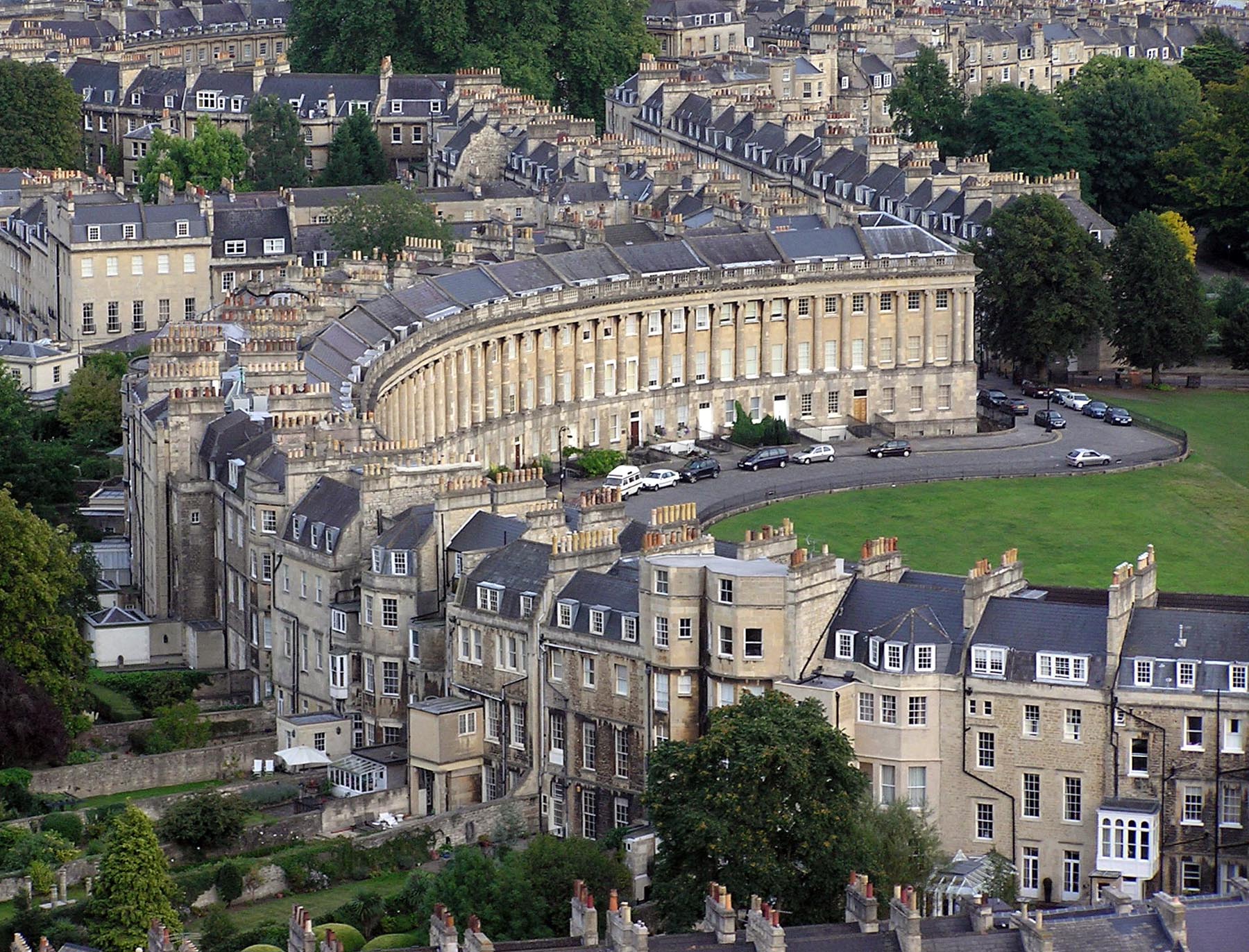
The Royal Crescent in Bath isn’t just a row of houses—it’s one of Britain’s most iconic architectural landmarks. Built in the mid-18th century, it embodies the ideals of the Enlightenment, a time when Bath was transforming into a fashionable retreat for the aristocracy. The crescent’s thirty-three houses curve gracefully along the hillside, their golden Bath stone facades appearing effortlessly elegant. Yet behind this simplicity lies a remarkable feat of engineering: each home has its own distinct layout, yet together they create the illusion of a single, seamless structure.
Designed by architect John Wood the Younger, the Royal Crescent wasn’t just meant to provide housing—it was a vision of urban harmony. Bath was flourishing as a spa town, and its architecture needed to reflect its newfound prestige. The crescent answered that call, blending the grandeur of private residences with a public space where visitors could stroll, socialize, and display their refinement. Today, it’s easy to imagine the chatter of 18th-century fashionables discussing the latest news from London or Paris as they promenaded along the lawn.
The Royal Crescent was part of a much larger ambition. John Wood the Elder, the architect’s father, had envisioned Bath as a perfect classical city, with grand geometric designs shaping its streets. The crescent was one of its centerpieces, complementing the nearby Circus—a circular ensemble of houses inspired by Roman amphitheaters. Together, they form a unique architectural landscape where every line and proportion follows a deliberate, harmonious order.
Though it appears as one grand building, the Royal Crescent is actually thirty-three individual homes, each with its own story. Some retain their original 18th-century interiors, complete with ornate plasterwork, fireplaces, and wood paneling, while others have been modernized. One house now operates as a museum, offering a glimpse into the lives of its past residents. There’s no grand spectacle here—just the quiet charm of a place where time seems to stand still, as if a lady in a crinoline or a gentleman with a cane might round the corner at any moment.
The crescent’s setting is just as striking as its design. The sweeping lawn in front frames views of the Avon Valley, while the curve of the buildings mirrors the natural slope of the land. In the 18th century, this was a prime spot for the elite to see and be seen—not just for the fresh air, but for the social performance of it all. Today, the atmosphere remains peaceful, though visitors from around the world come to photograph the famous facades.
The Royal Crescent is deeply tied to Bath’s history as a spa town. When mineral waters were believed to cure ailments, Bath became a destination for those seeking health and leisure. The crescent, built at the height of the town’s popularity, became a symbol of that era. Famous figures, from writers to royalty, stayed here, and though many names have faded, the spirit of the age lingers in the stone and space.
Architecturally, the Royal Crescent is a masterpiece of Palladian style, which enjoyed a revival in 18th-century England. John Wood the Younger drew inspiration from Andrea Palladio, the Renaissance architect, but adapted his ideas to suit English tastes. The facades feature columns and pilasters, with the central section slightly more ornate, giving the ensemble a sense of grandeur without heaviness. The warm hue of the stone and the graceful lines create an inviting, almost intimate feel, despite the scale.
What makes the Royal Crescent special today is that it remains a living place. Unlike many historic sites, it hasn’t been turned into an open-air museum—people still live here, which keeps it authentic. Tourists visit daily, but step into one of the side alleys, and you might find a quiet courtyard where time moves slower. It’s a rare quality for such a famous landmark: it doesn’t shut out visitors, but it doesn’t become a mere backdrop either.
Perhaps the crescent’s greatest appeal is its unassuming presence. It doesn’t try to impress—it simply exists, a quiet witness to history, a place where past and present coexist naturally. There are no flashy signs or loud announcements, just the stillness, the golden stone, and the sky above. That’s why it continues to draw those who seek not just a sight, but a sense of place.