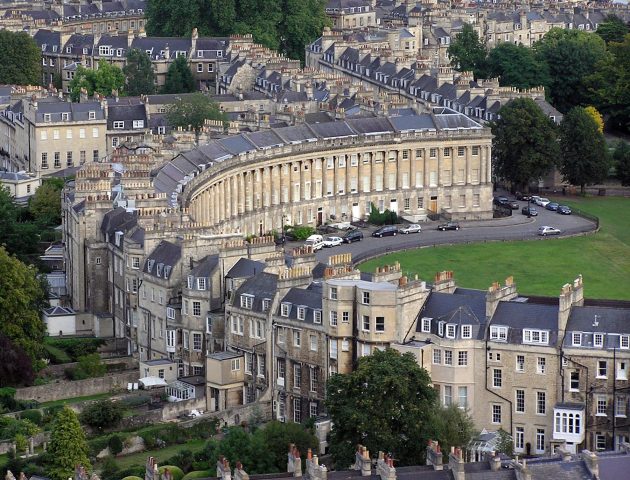
The Circus in Bath is one of those rare places that makes you pause, not just to admire its beauty, but to marvel at the ambition and skill of the people who built it. Completed in the mid-18th century, it was designed by John Wood the Elder as part of a grand vision to transform Bath into a modern-day Rome. Wood wasn’t just constructing a row of houses—he was creating a stage for Georgian society, a perfect circle where symmetry and proportion would dictate the rhythm of life. The result is an architectural masterpiece that feels both timeless and deeply rooted in its era.
What strikes you first about the Circus is its effortless harmony. Three curved terraces form a continuous ring, their facades clad in the warm, honey-coloured Bath stone that glows under sunlight. The design is a deliberate nod to classical architecture, with each level adorned with a different order of columns: Doric on the ground floor, Ionic above, and Corinthian at the top. This progression wasn’t just decorative—it was symbolic, reflecting the evolution of ancient Greek and Roman styles. The effect is one of quiet grandeur, as if the buildings themselves are performing a slow, dignified dance around the central green.
Wood’s original plans for the Circus were even more ambitious than what stands today. He envisioned it as part of a larger ritualistic landscape, inspired by Druidic traditions and cosmic symbolism. The three streets leading to the Circus were meant to represent the sun, moon, and earth, while the circular layout itself was intended as a gathering place for ceremonies. Though these ideas never fully materialised, traces of Wood’s mystical influences remain. Look closely at the friezes and cornices, and you’ll spot Masonic symbols—squares, compasses, and solar discs—subtle reminders of Wood’s involvement in the Freemasons. Even the slight curvature of the walls, which avoids any sharp angles, was a deliberate choice, creating a sense of movement within the stillness.
In the 18th century, Bath was the place to see and be seen. The city’s thermal springs had made it a fashionable retreat for the wealthy, and the Circus quickly became one of its most desirable addresses. Writers, politicians, and socialites flocked here, filling the houses with the hum of conversation and the rustle of silk gowns. Beau Brummell, the arbiter of men’s fashion, is said to have lived in one of the terraces, while Charles Dickens later wandered these streets, capturing their essence in his novels. Today, the Circus still feels like a stage, though the actors have changed. Instead of powdered wigs and breeches, you’ll see tourists with cameras and locals walking their dogs, but the sense of occasion lingers.
Unlike many historic sites, the Circus hasn’t been frozen in time. It’s still very much alive. Some of the houses remain private homes, their interiors hidden behind elegant Georgian doors, while others have been converted into boutique hotels or offices. The ground floors are occupied by cafés and small shops, where you can sit with a coffee and watch the world go by. In summer, the central green becomes a spot for picnics and lazy afternoons; in winter, it’s lit up with festive decorations. This blend of past and present gives the Circus a rare authenticity—it’s not a relic, but a living part of the city.
Approaching the Circus from Brock Street, the contrast is immediate. The straight lines of the surrounding buildings give way to the gentle curve of the terraces, as if you’re stepping into a different dimension. Inside the circle, the noise of the city fades, replaced by a hush that feels almost deliberate. The space seems to absorb sound, leaving only the soft murmur of voices and the occasional clatter of a cup in a nearby café. It’s the kind of place where you instinctively slow down, where the architecture encourages you to pause and take it all in.
What makes the Circus so enduring is its simplicity. There’s no excess here, no attempt to dazzle with opulence or scale. Instead, it relies on proportion, balance, and the quiet confidence of its design. In an age where architecture often chases novelty, the Circus feels refreshingly unapologetic about its classical roots. It doesn’t need to be trendy—it’s already timeless. That’s why it still resonates, why people still stop in their tracks when they see it. It’s a reminder that beauty doesn’t have to shout to be heard.
Bath has no shortage of stunning landmarks, but the Circus stands apart. It doesn’t dominate the skyline or demand attention. Instead, it invites you to look closer, to notice the way the light catches the stone at different times of day, or how the curve of the buildings frames the sky. It’s a place that rewards patience, where the longer you linger, the more you see. And perhaps that’s the secret of its appeal—it doesn’t just exist in the city; it becomes part of those who visit, leaving an impression that lingers long after they’ve walked away.