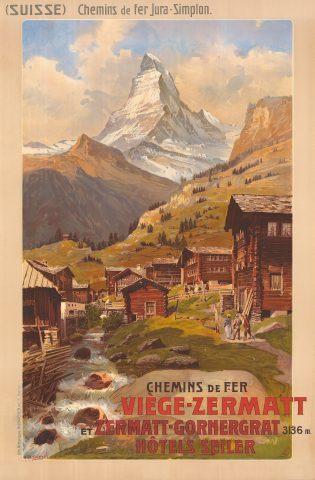
The cemetery sits on a hillside above the village. Below, the Matterhorn rises, its jagged peak framed by dark stone markers scattered across the slope. This is where those who never returned from the mountains lie—not as victims, but as part of a story tied to the peaks. The graves are simple, each holding a life spent chasing the climb.
The first burials happened in the late 1800s. Zermatt was still a remote village then, and the Matterhorn was a challenge few dared. Climbing gear was basic, mistakes were costly. Many who tried the ascent vanished, their bodies lost in the ice. Over time, the cemetery grew, not just as a place for the dead, but as a record of an era when exploration was raw and untested.
Walk among the graves, and you’ll see names carved into stone. Dates, routes, brief inscriptions—some in English, others in German, French, Italian. The mix reflects the people who came here, drawn by the same mountain. A few names stand out: Walter Bonatti, the Italian alpinist, or those from the first Matterhorn expeditions. Others are unknown, their stories kept by those who remember them.
The graves are uniform. Dark slabs of stone, letters engraved, sometimes a small cross or a mountain symbol. No grand monuments, just evergreen plants tended by family and friends. The wind moves through the trees, the only sound besides the distant chime of church bells from the village below. It’s a place that asks you to stop, to think—not just about loss, but about why people keep climbing.
The cemetery isn’t a tourist spot. No tours, no stands selling souvenirs, no crowds. People come for their own reasons—some to honor the dead, others to gather themselves before their own climb. Climbers often pause at a grave, leaving a pebble or a flag, a quiet gesture of respect. These moments are private, a way of acknowledging the risks that come with the mountains.
In the 19th century, Zermatt was a village of chalets and herders. That changed when the first climbers arrived, lured by the Matterhorn. The mountain was thought unclimbable until 1865, when the first ascent ended with four deaths on the descent. Their burials marked the start of the cemetery’s role as a resting place for those who pushed too far. Since then, it has stood as a reminder: the mountains demand respect.
Zermatt is a resort town now, with hotels and restaurants. But the cemetery remains unchanged, a place where time moves differently. It contrasts with the town’s bustle, a quiet reminder that the mountains are not just scenery. Here, the focus shifts from the climb to what it costs.
The cemetery isn’t on most maps. You might walk past it without noticing. But those who find it stay. Some stand silently at the graves. Others take photos. A few sit on the benches, looking up at the Matterhorn. There’s no right way to be here—no rules, no script. The only certainty is that the place stays with you.
The cemetery doesn’t glamourize climbing. It doesn’t hide the losses. It simply offers a space to recognize both the passion and the price. For many, it becomes a starting point—a place to pause before their own climb, to ask why they’re drawn to the mountains and what they’re willing to risk. In that way, it’s not just for the dead. It’s for the living, too.