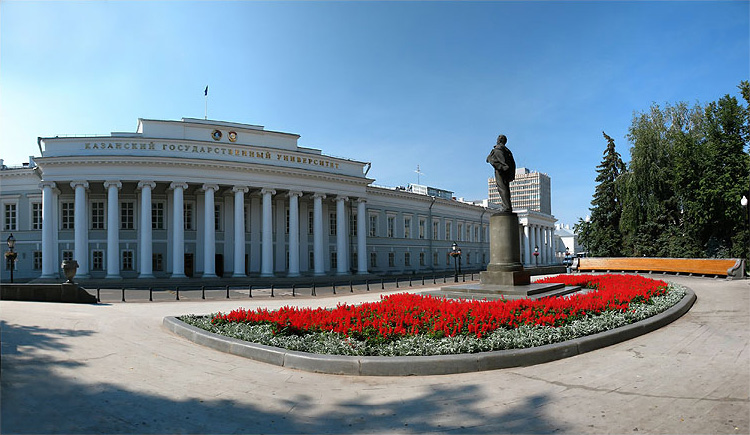
Kazan Federal University is one of those rare places where history isn’t confined to textbooks or archives but lingers in the very fabric of its walls, courtyards, and even the air. Founded in 1804, it stands as Russia’s second-oldest university, a living testament to the country’s intellectual and cultural evolution. Over the centuries, it has shaped not just the region of Tatarstan but the nation itself, nurturing minds that would leave an indelible mark on science, literature, and thought. Names like Nikolai Lobachevsky, the mathematician who redefined geometry, the chemist Nikolai Zinin, and even Leo Tolstoy, who briefly studied here, are woven into its legacy. The university isn’t merely an institution; it’s a world where eras, ideas, and destinies intersect in quiet, unassuming ways.
The architecture of the university tells its own story, a chronicle etched in brick and stone. The main building, constructed in the early 19th century, embodies the restrained elegance of neoclassical design—its symmetrical facades and stately columns immediately signal its academic purpose. Yet step beyond the central courtyard, and the campus reveals layers of history. There are older wings with intricately carved window frames, hidden courtyards where students once debated lectures and now take breaks between classes, and the university observatory, built in the 1830s, one of Russia’s oldest. Its dome still rises above the city, a silent reminder that here, science has always reached for the skies.
Beyond lecture halls and laboratories, the university is a cultural hub in its own right. The Museum of Kazan University’s History, one of Russia’s oldest, houses a trove of scientific instruments, manuscripts, and personal artifacts belonging to its most celebrated figures. The university library safeguards rare editions, including incunabula and early printed books, while the grand auditorium, adorned with plaster moldings and crystal chandeliers, continues to host concerts, lectures, and ceremonies. Even for visitors, the atmosphere is palpable—a sense of being part of something enduring, a tradition that has unfolded over centuries.
The university’s botanical garden, established in 1806, is more than just a green space. It’s a living laboratory where rare plants from around the world have been cultivated for over two centuries. Walking its paths, you might pass trees planted in the 19th century or step into greenhouses where tropical blooms thrive. The garden feels like a world apart, a place where time slows and nature quietly underscores the connection between beauty and discovery.
Kazan University has always been a crucible of ideas. It was here that Lobachevsky developed his non-Euclidean geometry, challenging centuries of mathematical orthodoxy. Alexander Butlerov, a pioneer of organic chemistry, worked within these walls, while in the Soviet era, the university became a training ground for specialists across entire industries. Today, students from Russia and abroad fill its halls, and its laboratories remain at the forefront of research. Yet what endures is the spirit of inquiry—the unshakable belief that knowledge isn’t just about answers but about asking the right questions.
Wandering the university’s corridors feels like stepping through time. Portraits of rectors and distinguished alumni line the walls, display cases showcase scientific milestones from different eras, and the quiet hum of lecture halls seems to echo with voices from the past. There’s no rush here, no modern campus frenzy—just a measured pace and a deep respect for tradition. Even students hurrying to class often pause to glance at an antique clock or run their fingers over the carved banisters, as if trying to touch the history beneath them.
The university and the city of Kazan are inseparable. The institution has shaped the city’s growth, its streets and squares evolving alongside academic life. Over the years, it has been a place of debate, dissent, and progress—whether in the revolutionary circles of the 19th century, the Soviet industrial boom, or today’s role as a leading educational center. Yet its core remains unchanged: a place where people pursue knowledge not for degrees or careers but for the sake of understanding itself.
Life at the university today is as vibrant as ever. International conferences, scientific festivals, and cultural events fill its calendar, while students organize theater productions, sports competitions, and volunteer projects. Yet the academic aura that drew the great minds of the past still lingers. Perhaps that’s why alumni often return—not just to reminisce but to reconnect with the sense of purpose that once defined their time here.
Kazan Federal University is more than a collection of buildings or an educational institution. It’s a place where past and future converge, where science becomes a way of life, and where tradition and innovation coexist. You might spend an hour strolling through the botanical garden, a day exploring the museum’s exhibits, or just a few minutes sitting on a bench, watching students rush to lectures. You might even stop by the university canteen, where recipes from another era are still served. But no matter how long you stay, the university leaves its mark—not just in memory but in the way you see the world.