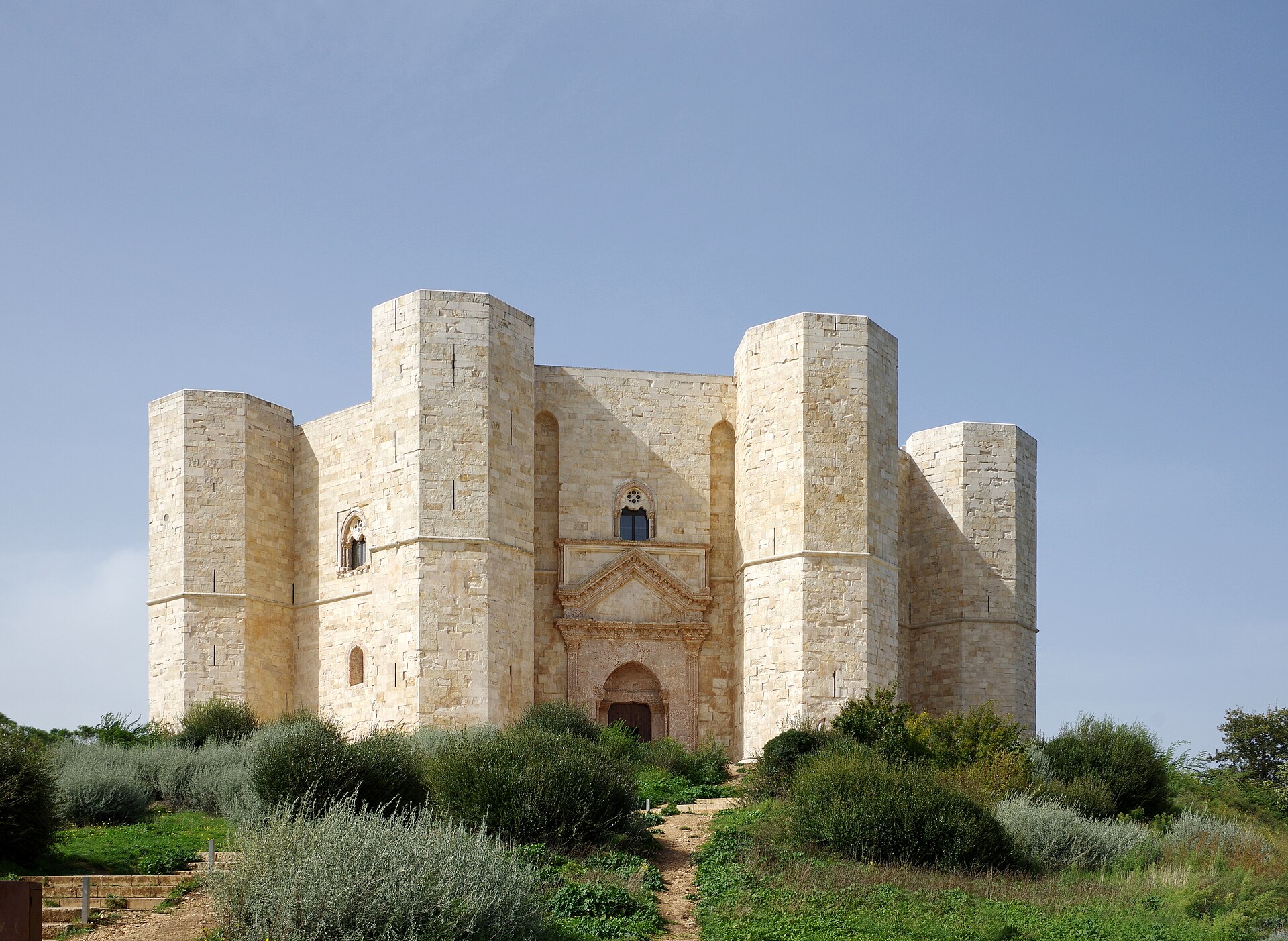
On a hill in Puglia, Castel del Monte rises with an eight-sided silhouette and eight angular towers. It’s a shape you won’t forget, yet the castle stays away from tourist crowds, surrounded by vineyards and olive groves. Emperor Frederick II ordered its construction in the 13th century, a time when the Christian West and Islamic East exchanged knowledge, art, and science. Frederick spoke multiple languages, supported scholars, wrote poetry, and studied falconry and mathematics. No one knows if he meant this place as a hunting lodge or something more, but its architecture suggests an obsession with order—almost mystical in its precision.
Medieval castles were built for war, with thick walls and moats. Castel del Monte has none of that. Its eight towers, set at the corners of an octagon, don’t defend anything. Inside, two floors connect via a spiral staircase, and an octagonal courtyard lets light through tall, narrow windows. The limestone walls glow gold in sunlight and turn pink at dusk. Traces of marble columns, mosaics, and faded frescoes remain, but what stands out is the proportion—deliberate, enigmatic.
Why was it built? Some say a hunting retreat. Others, an observatory for stargazing. A few think it was Frederick’s way of showing power, a monument to his vision of bridging cultures. The octagon might symbolize the Holy Grail, resurrection, or medieval numerology. Islamic architecture could have influenced it, or maybe classical traditions. Frederick worked with scholars of different faiths, translating Aristotle and advancing astronomy and medicine. Maybe the castle was where those ideas took shape.
Fewer visitors come here than to Rome or Florence. The landscape is quiet—vineyards stretch to the horizon, and the air smells of dry grass and sea. Inside, the castle is still, with only the wind and the occasional guide’s voice breaking the silence. From the upper floors, you see rolling hills, olive trees, and winding roads. At night, lights outline the castle, making it seem like a relic from another time.
It’s not like other Italian castles. No grand frescoes like in Florence, no fortress walls like in Siena. Instead, it feels like a mathematical equation in stone—a puzzle, not a palace. That’s why it stays in your mind.
Frederick II died in 1250. Over time, the castle became a prison, a refuge during plagues, and by the 19th century, it was abandoned. Restoration in the 20th century brought it back, and now it stands as it has for eight centuries—a silent witness to a time when Europe was still shaping itself.
Puglia isn’t the Italy most travelers imagine. No marble palaces, no canals, no crowds. Instead, there’s space, silence, and a slower rhythm. Castel del Monte fits here. It doesn’t ask for admiration or offer answers. You can stand in the courtyard, watching light move across the stone, or climb a tower and wonder about life in Frederick’s time. Or just sit on a bench at the hill’s base and think about all who’ve passed through its gates.
The castle doesn’t explain itself. No plaques or audio guides reveal its secrets. Maybe that’s the point. Its walls hold centuries of quiet, and its shape invites you to think—about perfection, mystery, and things not meant to be fully understood. In a world where everything demands attention, Castel del Monte stays unassuming, just like the man who built it.