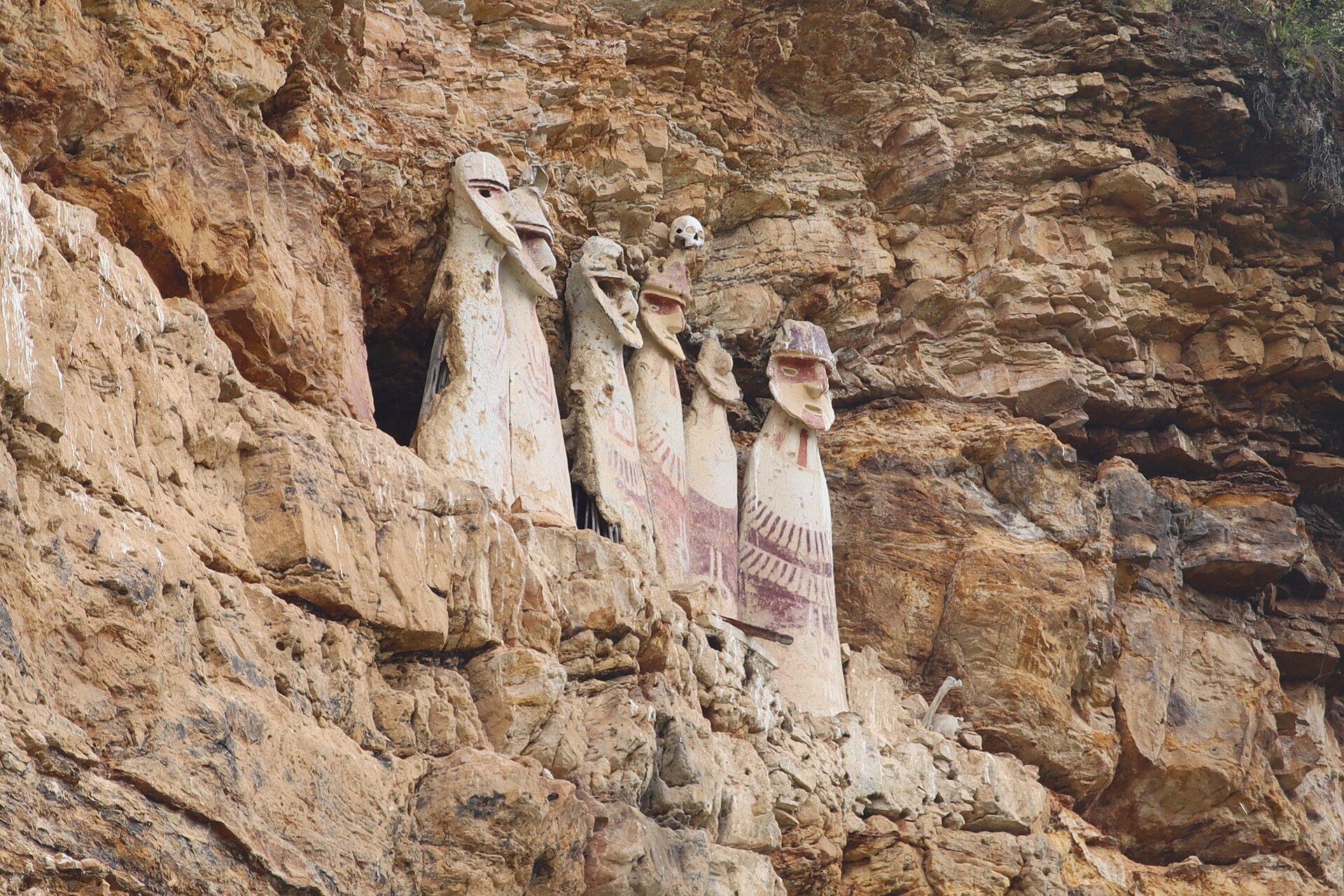
Perched on a sheer cliffside in the misty highlands near Chachapoyas, the ancient site of Karajía feels like a place where time has quietly slipped away. Here, a row of towering clay sarcophagi cling to the rock face, their human-like forms standing sentinel over the valley below. Unlike the grand pyramids or sprawling temple complexes of other pre-Columbian cultures, these burial figures were never meant to impress with scale or opulence. Instead, they were crafted with purpose—each one a vessel for the dead, placed high above the earth where the living could not easily reach.
The sarcophagi were the work of the Chachapoya, a civilization that thrived in these cloud-covered mountains long before the Inca Empire rose to power. Flourishing between the 9th and 15th centuries, the Chachapoya were masters of adapting to their rugged environment, building their settlements and sacred sites in places that seemed almost impossible to access. Karajía is one of their most striking achievements, a testament to their skill in blending architecture with the natural world. The figures themselves, some standing over two meters tall, were molded from clay and straw, their elongated heads and slightly bent knees giving them an eerie, almost lifelike presence. Inside, the remains of high-ranking individuals were laid to rest, wrapped in textiles and accompanied by offerings—perhaps tools, pottery, or food for the journey beyond.
What makes Karajía particularly fascinating is its isolation. The site was deliberately chosen for its inaccessibility, a strategic decision that has helped preserve it through the centuries. The cliff’s sheer walls and narrow ledges made it nearly impossible for outsiders to disturb the tombs, even after the Chachapoya themselves vanished. When the Inca conquered the region in the 15th century, they left the sarcophagi untouched, and later, Spanish colonizers never managed to reach them. Today, the journey to Karajía remains a challenge. From Chachapoyas, the road winds through dense forests and across high plateaus, where the air grows thin and the landscape shifts from cultivated fields to untamed wilderness. The final stretch is a hike along narrow paths, where the only sounds are the rustle of leaves and the distant call of birds. It’s a journey that feels like stepping into another era.
Standing at the base of the cliff, the sarcophagi loom overhead, their weathered surfaces bearing the marks of centuries. The Chachapoya positioned them to face east, toward the rising sun, a detail that hints at their beliefs about the afterlife. Some researchers suggest this orientation was symbolic, a way to guide the spirits of the dead toward renewal and light. Others see it as a practical choice—east-facing tombs would have been warmed by the morning sun, perhaps helping to preserve the contents within. Whatever the reason, the effect is striking. The figures seem to emerge from the rock itself, as if they’ve always been part of the landscape.
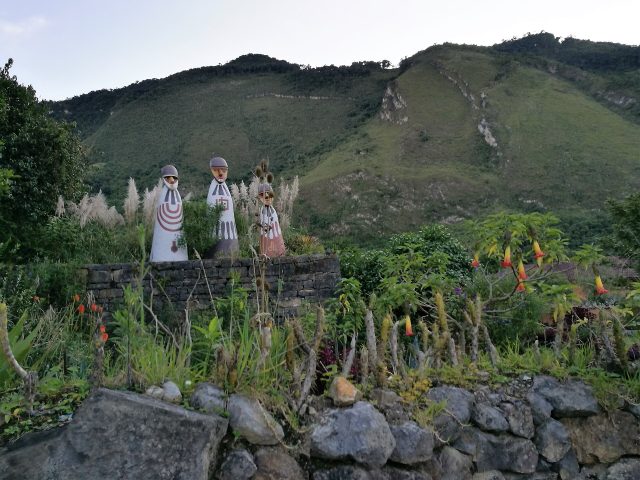
Unlike many archaeological sites, Karajía has escaped the trappings of mass tourism. There are no souvenir stalls, no guided tours with loudspeakers, just the quiet hum of the wind and the occasional cry of a hawk circling overhead. On clear days, the view from the cliff stretches across the Utcubamba Valley, where terraced hills give way to the vast, untamed expanse of the Amazon rainforest. It’s a place that invites reflection, not just on the people who built it, but on the fleeting nature of human achievement. The Chachapoya left no written records, and much of their culture remains shrouded in mystery. Yet in Karajía, their presence lingers, tangible and unmistakable.
The sarcophagi themselves are a puzzle. Why did the Chachapoya choose this particular cliff? How were the figures transported and placed on such precarious ledges? And what did these tombs mean to the people who built them? Some theories suggest the site was reserved for elite members of society—warriors, leaders, or shamans—while others propose it was a communal burial ground for a specific lineage. The truth is, no one knows for certain. What is clear is that Karajía was never meant to be a public monument. It was a private, sacred space, a bridge between the living and the dead.
For modern visitors, the experience of standing before the sarcophagi is one of quiet awe. There’s a sense of connection here, not just to the past, but to something deeper—the enduring human impulse to honor the dead, to seek meaning in the unknown. Local communities still regard the site with reverence, often referring to the figures as *los antiguos*, the ancients. Some believe the spirits of the Chachapoya linger in the cliffs, watching over the valley as they have for centuries. Whether or not that’s true, there’s no denying the power of the place. It’s a reminder that history isn’t just something we read about; sometimes, it’s something we can feel, standing in the shadow of those who came before us.
Karajía isn’t just an archaeological site—it’s a fragment of a lost world, one that refuses to be forgotten. The Chachapoya may have faded into history, but their legacy endures in these silent figures, perched high above the earth. For those willing to make the journey, it offers a rare chance to step away from the familiar and into a place where the past still breathes.