Jozani Chwaka Bay National Park is Zanzibar’s only national park, a place where the island’s wild heart still beats on its own terms. Tucked between the Indian Ocean’s coastline and the mangrove-lined waters of Chwaka Bay, the park feels like a world apart from the Tanzania most travelers know. There are no vast savannas or herds of elephants here—just dense, sun-dappled forests where the air hums with the calls of birds and the rustle of leaves underfoot. The humidity wraps around you the moment you step inside, a reminder that this is a place that moves to its own rhythm, untouched by the rush of the outside world.
The forest at Jozani is one of the last remaining patches of Zanzibar’s original wilderness, a refuge for plants and animals that have vanished elsewhere on the island. Towering trees, their trunks draped in vines, form a canopy overhead, while rare orchids and ferns thrive in the damp shade below. During the rainy season, the trails turn slick and streams swell into rushing torrents, but the park only grows more alive, its edges blurring into something wilder and less predictable. Even in the dry months, the air carries the scent of damp earth and green growth, a quiet insistence that this place has always been here, long before visitors arrived.
The park’s most famous residents are the red colobus monkeys, a species found nowhere else in the world. With their fiery coats and long, bushy tails, they’ve become the unofficial mascots of Jozani. Unlike their shy counterparts in other forests, these monkeys are remarkably at ease around humans, often descending from the trees to forage or simply watch the people passing below. They move in large, chattering troops, their calls weaving through the forest like a melody. The best place to see them is along the trail leading to the mangrove swamps, where they gather in the early morning or late afternoon, their bright fur standing out against the green.
Beyond the colobus, Jozani is home to a quieter cast of creatures, though spotting them takes patience. Small duikers, no bigger than house cats, dart between the undergrowth, while civets slink through the shadows. Birdwatchers will find plenty to keep them occupied—sunbirds flit between flowers, their iridescent feathers catching the light, and kingfishers perch motionless over the water, waiting for the perfect moment to dive. At night, the forest transforms. The air fills with the rustling of bats and the occasional chirp of a bushbaby, their eyes glowing like tiny lanterns in the beam of a flashlight. Most visitors stick to daylight hours, when the sun filters through the leaves, painting the forest floor in shifting patterns of light and shadow.
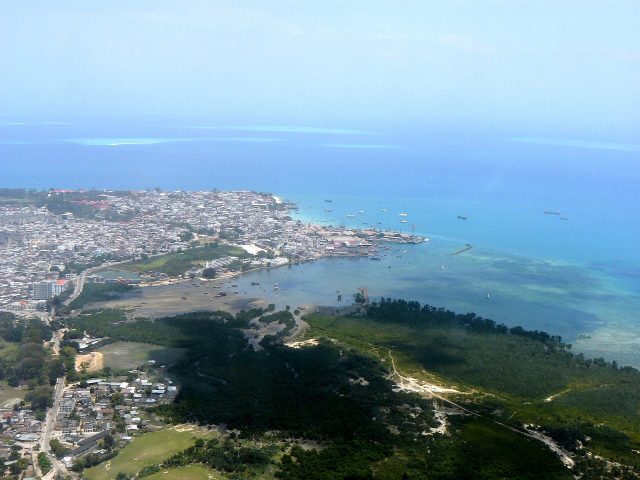
Chwaka Bay, where the park meets the sea, is a landscape of constant change. Here, freshwater streams mingle with the saltwater tides, and mangrove roots twist into the mud like gnarled fingers. A network of wooden walkways winds through the swamps, offering a glimpse into this liminal world where land and water blur. At low tide, the roots stand exposed, their tangled maze a playground for ghost crabs that scuttle away at the slightest disturbance. When the tide returns, the water rises, swallowing the walkways and turning the bay into a mirror of the sky. It’s a place where time feels fluid, where the only constant is the ebb and flow of the sea.
Jozani’s history is as layered as the forest itself. For centuries, the land was part of Zanzibar’s interior, a source of timber, medicine, and game for local communities. During the colonial era, it became a hunting ground for the sultan and later British officials, who saw it as little more than a resource to be exploited. By the mid-20th century, it was clear the forest couldn’t survive without protection. In the 1960s, conservation efforts began, and by 2004, Jozani was officially designated a national park. Today, it’s not just a sanctuary for wildlife but a living laboratory where researchers study the island’s fragile ecosystems. The park’s creation was a rare victory in a place where development often comes at the expense of nature.
Exploring Jozani doesn’t require much—just sturdy shoes, a bottle of water, and a willingness to slow down. The trails are short but varied, each one offering something different. One path leads to a viewpoint overlooking the bay, where the mangroves stretch out like a green sea. Another winds past a small waterfall, its water trickling over moss-covered rocks. A third takes you to a clearing where the colobus monkeys have learned to expect treats from guides, their curiosity outweighing their caution. The local rangers know the forest intimately, and their stories often blur the line between fact and folklore. Some will tell you the spirits of ancestors still linger in the oldest trees, or that certain paths are best walked with respect, lest you disturb something unseen.
What makes Jozani special isn’t the promise of adventure or the chance to tick off a list of sights. It’s the quiet, the way the forest seems to breathe around you, the sense that you’ve stepped into a place that exists outside of time. There are no crowds here, no souvenir stalls or tour buses—just the rustle of leaves, the distant call of a monkey, and the occasional splash of a fish in the bay. It’s the kind of place that lingers in your memory long after you’ve left, not because of anything dramatic, but because it feels real in a way few places do. Zanzibar is often sold as a paradise of white sand and turquoise water, but Jozani offers something rarer: a glimpse of the island as it once was, before the world rushed in. Here, nature and people coexist, not in opposition, but in a delicate balance that feels almost fragile. And perhaps that’s why it stays with you.