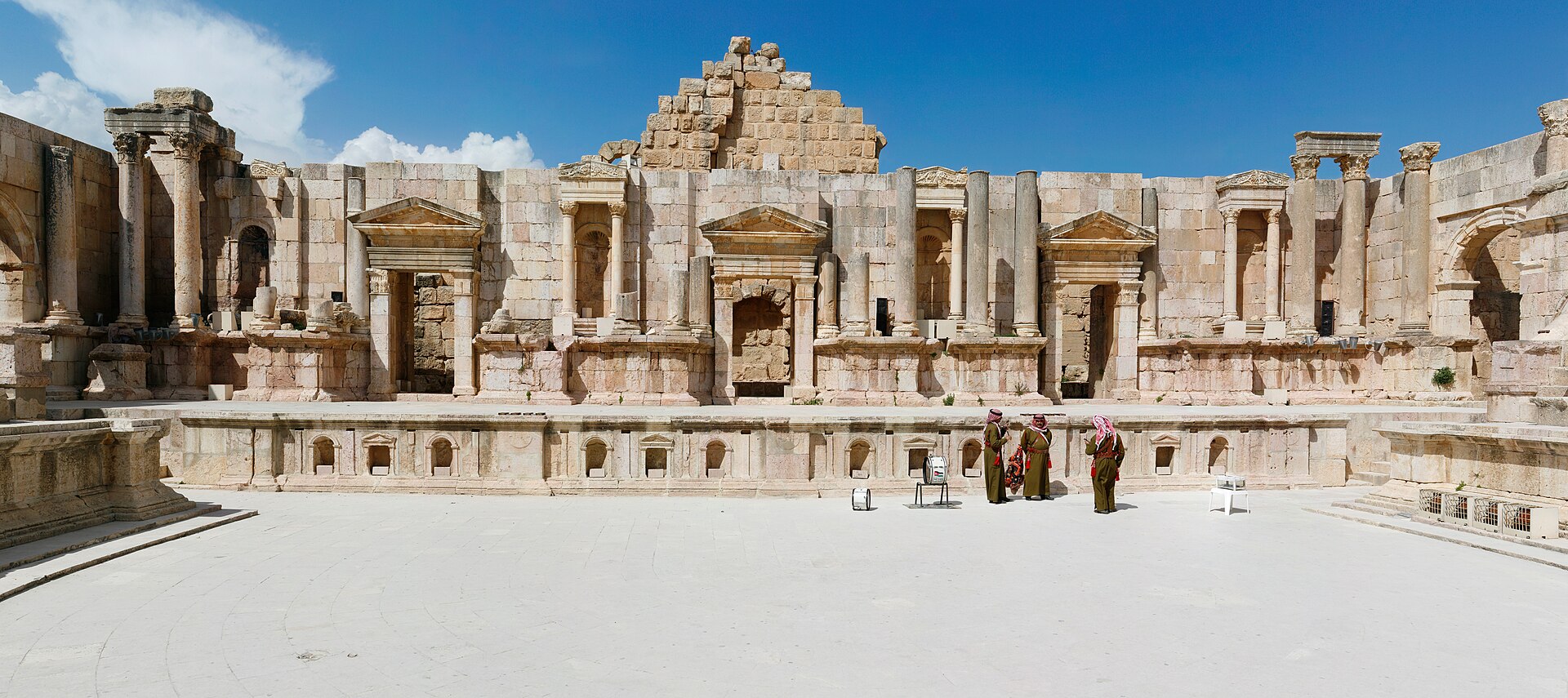
Jerash is a city where time seems to have paused, leaving behind a landscape of stones that whisper stories of the Roman Empire. Among its ancient streets, temples, and colonnades, the Southern Theatre stands as a place where history feels alive, where the echoes of voices from nearly two thousand years ago still linger in the air.
Built in the second century AD, when Jerash—then known as Gerasa—was at its peak, the theatre was more than just a venue for performances. It was a hub of public life, hosting not only plays but also political debates, civic gatherings, and even gladiatorial contests. With a capacity of around three thousand spectators, it was one of the largest and most important cultural spaces in the Decapolis, a league of ten Roman cities in the region. The theatre’s design reflects both Roman architectural traditions and local influences, with its semicircular orchestra and tiers of stone seats rising in a gentle arc.
The acoustics of the Southern Theatre are remarkable. Even today, a whisper spoken on the stage carries clearly to the uppermost rows, a testament to the precision of ancient engineering. The shape of the amphitheatre and the stone surfaces work together to amplify sound naturally, a feature that still impresses visitors. In the summer months, the theatre occasionally comes back to life with concerts and festivals, filling the air with music and voices once again.
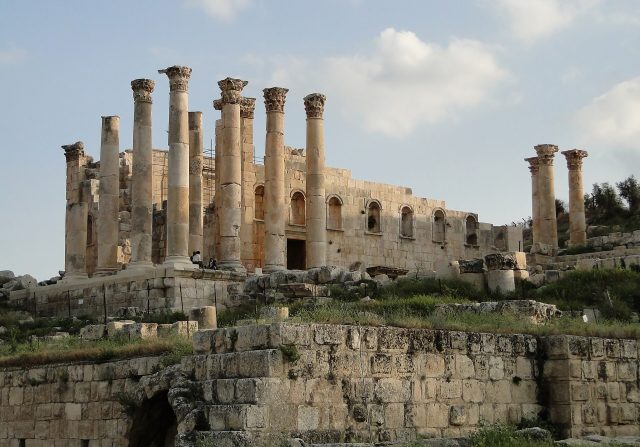
Approaching the theatre from the south, you walk along the same ancient colonnaded street that once led to the Temple of Artemis. The view offers a glimpse of how the city must have looked in its prime—bustling with merchants, processions, and crowds hurrying to performances. Though the street is quiet now, the worn stones beneath your feet still bear the marks of chariots and sandals that passed this way centuries ago.
Like much of Jerash, the Southern Theatre fell into disrepair over time. Earthquakes, invasions, and neglect took their toll. During the Byzantine era, parts of it were repurposed, and later, in the early Islamic period, the structure was used as a quarry. It wasn’t until the 20th century that restoration efforts began, slowly bringing the theatre back to something resembling its former glory. Today, it stands not just as an open-air museum but as a reminder of how architecture and art can endure across the ages.
There’s a certain weight to walking through the Southern Theatre, knowing how many lives have passed through this space. People laughed, argued, and made decisions here that shaped the fate of entire cities. The theatre doesn’t demand admiration—it simply offers a chance to step into history, to feel connected to something far larger than the present moment.
Jerash is often called the Pompeii of the East, and the Southern Theatre is one reason why. Unlike many ancient ruins, which feel like relics of a distant past, Jerash retains a sense of its original spirit. The stones here aren’t just remnants; they carry the atmosphere of the city as it once was. Wander through the theatre, touch the worn surfaces, and you might just catch a fleeting sense of the past, as if the centuries between then and now have momentarily dissolved. It’s not just a landmark—it’s a doorway to another time, waiting for those who are willing to look.