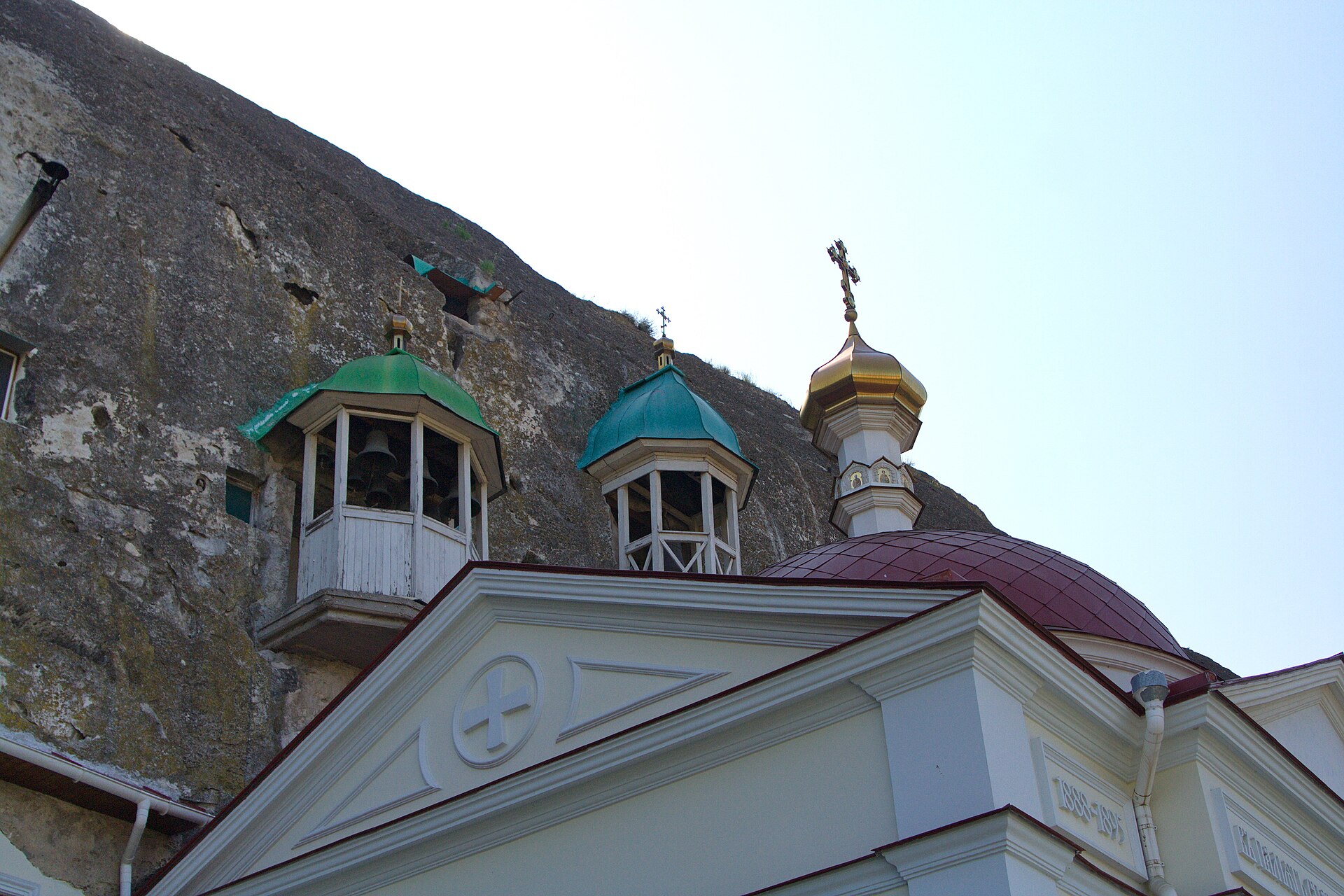
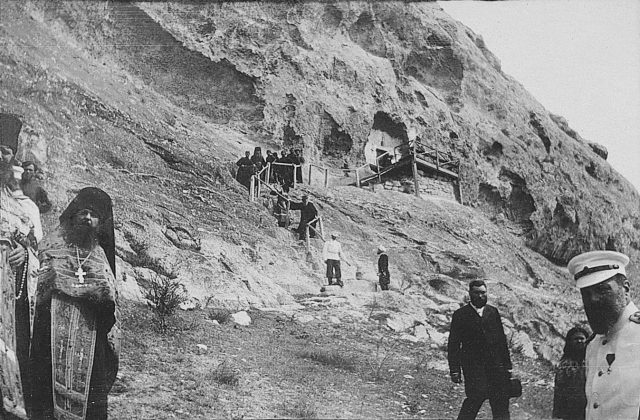
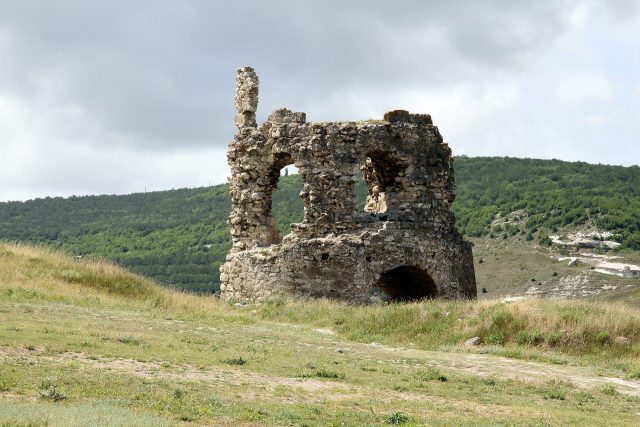
Perched on the rocky cliffs above the Black Sea, the Inkerman Monastery feels like a place where time has paused. The white stone walls and domes rise abruptly from the steep slopes of the Inkerman Valley, blending into the rugged landscape as if they’ve always been part of it. The monastery’s location isn’t accidental—this stretch of Crimea has long been a crossroads of cultures, and the cliffs here are riddled with caves that have sheltered people for centuries. Some say monks first settled in these natural grottos as early as the 8th or 9th century, though the first written records of a monastic community here date back to the 15th century, when the Genoese controlled the region. Back then, the monastery was dedicated to Saint Clement, a 1st-century pope who, according to legend, was martyred in Crimea and whose relics were said to have been discovered nearby.
The monastery we see today took shape much later, in the 19th century, when Crimea became a favored retreat for Russian nobility and the Orthodox Church sought to restore its presence in the region. The main cathedral, with its pale yellow facade and five golden domes, was built in the 1850s in a style that blends Byzantine traditions with the more ornate tastes of the Russian Empire. Inside, the walls are covered in frescoes depicting scenes from the life of Saint Clement, though much of the original artwork was lost during the Soviet era, when the monastery was closed and repurposed—first as a military warehouse, then as a prison. The restoration that began in the 1990s has brought back some of the building’s former grandeur, though the scars of neglect are still visible in the faded paint and uneven floors.
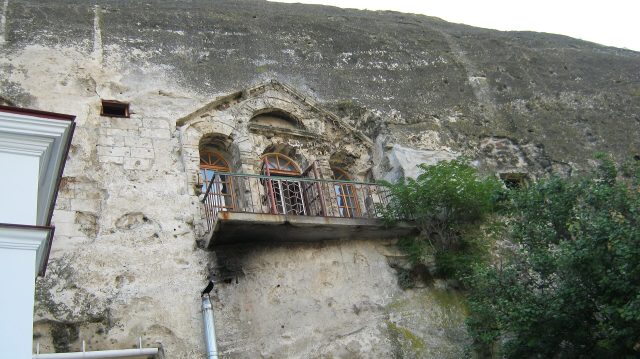
What makes Inkerman unique is its relationship with the caves. The monastery isn’t just built near them—it’s literally carved into them. The lower levels of the complex are a labyrinth of tunnels and chambers, some of which were expanded by monks over the centuries, while others remain in their natural state. The most famous of these is the Cave Church of Saint Clement, a small, dimly lit space with a low ceiling and rough stone walls. The air here is cool and damp, and the only light comes from a handful of flickering candles and the narrow windows cut into the rock. It’s easy to imagine how this place would have felt to medieval monks—a refuge from the world, where the silence was broken only by the sound of waves crashing against the shore far below.
The monastery’s history is as layered as the cliffs it stands on. After the Crimean War in the 1850s, the area became a symbol of Russian resilience, and the monastery was expanded to include a hospital for wounded soldiers. Later, during World War II, the caves were used as a shelter by locals hiding from German occupation. The Soviets, who saw religion as a relic of the past, turned the monastery into a storage facility, and the caves were sealed off. When the monastery was reopened in the 1990s, it was in a state of disrepair, with collapsed tunnels and overgrown vegetation. The restoration has been slow, but the place has regained some of its quiet dignity, though it’s still far less visited than the more famous monasteries of Crimea, like the one in Balaklava.
Today, Inkerman feels like a hidden corner of the peninsula. The road leading to it winds through industrial outskirts, past shipyards and half-abandoned factories, before suddenly opening up to reveal the monastery’s white walls against the blue of the sea. There’s no grand entrance or tourist infrastructure—just a small parking lot and a path that leads up the hill. The monks who live here now are few, and the place has an air of gentle decay, as if it’s still recovering from its past. The main cathedral is usually open, though services are infrequent, and visitors are free to wander the grounds, which include a small cemetery with weathered gravestones and a spring said to have healing properties.
The caves are the real draw, though exploring them requires a bit of effort. Some of the tunnels are narrow and uneven, and the lighting is minimal, so it’s easy to lose your bearings. The deeper you go, the more the outside world fades away—the noise of the wind, the distant hum of the port, even the sunlight filtering through the trees. What remains is the cool, still air and the sense of being in a place that has witnessed centuries of human struggle and faith. The monks who once lived here must have felt the same isolation, though for them it was a choice. Today, the caves are empty, but the echoes of their presence linger in the quiet.
Inkerman isn’t a place that reveals itself quickly. There are no grand narratives or dramatic stories here—just the slow accumulation of history, etched into the stone. The monastery’s significance lies in its persistence, in the way it has endured despite wars, neglect, and changing ideologies. It’s a reminder that some places are more than just buildings or landmarks; they’re living connections to the past. For those who make the effort to visit, Inkerman offers a rare kind of quiet, the kind that makes you pause and listen to the silence. The sea is always there, a constant presence in the background, but up here, on the cliffs, it feels distant, as if the monastery exists in its own time.