Holy Trinity Cathedral in Port-au-Prince is one of those rare places where history isn’t just remembered—it’s felt in the weight of the stones, the vibrancy of the colors, and the quiet resilience of a building that has witnessed a nation’s struggles and triumphs. Built in the mid-20th century, the cathedral was never meant to be just a house of worship. It became something far greater: a symbol of cultural endurance in a country where every structure seems to carry the echoes of revolution, hardship, and renewal. Haiti’s history is written in its architecture, and this cathedral is one of its most vivid chapters.
From the outside, the cathedral appears unassuming—simple lines, pale stone, a lack of ornate flourishes. But step inside, and the space transforms. The walls are alive with murals that stretch from floor to ceiling, a riot of color and movement that tells the story of Haiti in a way words never could. These aren’t just religious paintings; they’re a visual chronicle of the nation’s soul, blending biblical scenes with the rhythms of everyday life. Farmers till the soil under a Caribbean sun, musicians play traditional *rara* drums, children chase each other through dusty streets. Even the saints and angels wear the faces of ordinary Haitians, their stories intertwined with the land itself.
Among the most striking murals are those depicting Haiti’s fight for independence. Jean-Jacques Dessalines, the revolutionary leader who declared the nation free in 1804, is rendered with the reverence usually reserved for saints. His image, surrounded by fellow rebels, feels almost sacred—a reminder that for many Haitians, the cathedral is as much a monument to national pride as it is a place of worship. The murals were painted over decades, each layer reflecting the spirit of its time. Some were created under the Duvalier dictatorship, when art often served as a quiet act of defiance. Others emerged after the devastating 2010 earthquake, when the cathedral, though badly damaged, refused to fall.
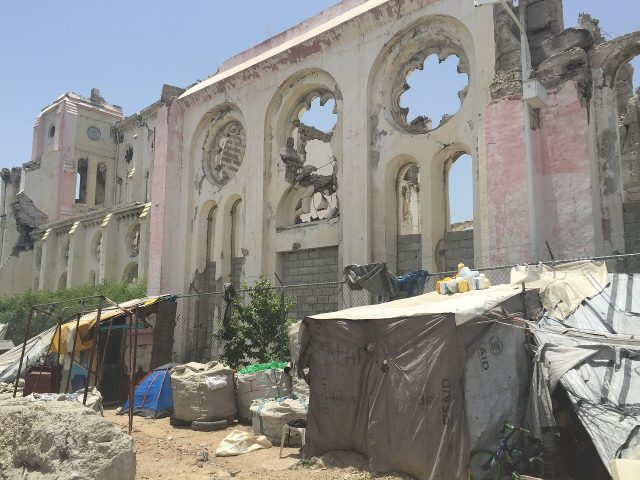
That earthquake was a brutal test for Holy Trinity. Walls collapsed, the roof caved in, and many of the murals were left in ruins. Yet even in its broken state, the cathedral remained a gathering place. Parishioners held services in the open air, and over time, they began to rebuild—slowly, painstakingly, with whatever materials they could find. Today, the scars of that disaster are still visible: cracks in the plaster, patches where murals were restored, temporary supports holding up weakened sections. But these imperfections don’t diminish the cathedral’s power. If anything, they make it more human, a testament to the idea that beauty and meaning can survive even the deepest fractures.
This is not a place of cold grandeur. Unlike the towering cathedrals of Europe, Holy Trinity feels lived-in, almost intimate. On any given day, the steps outside are crowded with vendors selling mangoes, fried plantains, and handmade crafts. Children dart between the columns, their laughter mixing with the murmur of prayers inside. Elderly men and women sit on benches, watching the city go by. The atmosphere is warm, communal—less like a museum and more like a family home where everyone is welcome. Services, weddings, and baptisms share the space with art exhibitions and impromptu concerts, blurring the line between the sacred and the everyday.
For many Haitians, the cathedral is a place of solace and strength. It’s where they come not just to pray, but to remember that their country is more than its struggles. The murals, with their vivid depictions of history and faith, serve as a reminder of all that Haiti has endured—and all it has created. They whisper of resilience, of a culture that has refused to be erased. Even now, with some of the artwork faded and the walls still bearing the marks of past disasters, the spirit of the place endures. It’s as if the cathedral itself is saying: look at what we’ve survived, look at what we’ve built, look at what we’re still becoming.
The artists who painted these murals are among Haiti’s most celebrated, their work a bridge between the sacred and the deeply personal. Names like Philomé Obin, Prefete Duffaut, and Cécile Fatiman are woven into the cathedral’s story, their brushstrokes capturing not just religious narratives, but the essence of Haitian identity. Their art is a dialogue between faith and history, between the universal and the intensely local. Every figure, every color choice, feels deliberate—a love letter to a homeland that has shaped them as much as they’ve shaped it.
Today, Holy Trinity Cathedral is still a work in progress. Some of the murals remain partially restored, their edges blurred by time and damage. The building itself bears the marks of its long life: peeling paint, uneven floors, the occasional makeshift repair. But that’s part of its charm. This isn’t a pristine monument frozen in time; it’s a living space that breathes with the city around it. There’s no attempt to hide its flaws, no pretense of perfection. Instead, there’s something deeply honest about it—a place where faith, art, and history coexist in all their messy, beautiful reality.
To visit Holy Trinity is to step into the heart of Haiti. It’s not just a cathedral; it’s a conversation between past and present, between struggle and hope. The murals don’t just decorate the walls—they tell a story, one that continues to unfold with every person who walks through its doors. And though the building may never be fully restored to its former glory, that doesn’t make it any less powerful. If anything, its imperfections make it more real, a reminder that history isn’t about perfection—it’s about survival, about the quiet strength of a people who refuse to be forgotten.