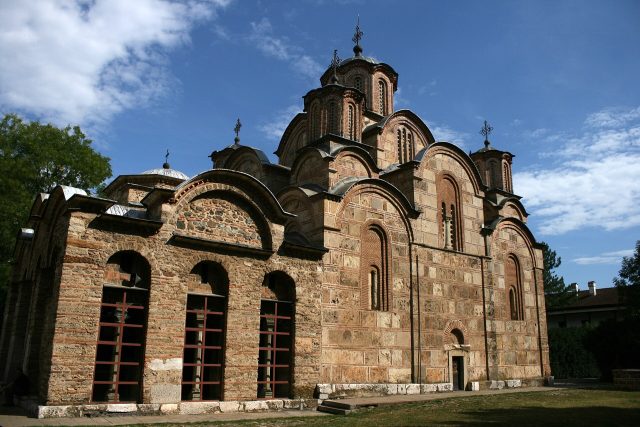
Gračanica is one of those rare places where the weight of centuries lingers in the air. The stones here remember the hands that laid them. Just outside Pristina, this monastery isn’t merely an old building—it’s a witness to empires, faiths, and people moving through the Balkans. Unlike many historical sites, Gračanica feels alive. Its walls hold the prayers of generations, the footsteps of pilgrims, and the silence of monks who kept its flame through wars and shifting borders.
The foundation and its purpose
King Stefan Milutin built the monastery in the early 1300s. He ruled medieval Serbia and chose this spot carefully. The location wasn’t random—it stood on the ruins of an older church, layering past and present. Milutin wanted Gračanica to be both a spiritual refuge and a political symbol. The architecture reflects this: Byzantine grandeur meets local craftsmanship. The result is a structure that feels both timeless and distinctly Balkan.
The design balances solidity with aspiration.
The frescoes
What stays with you are the frescoes. Painted by unknown masters, these murals cover the interior walls in vivid scenes. Figures from Christ’s life, saints, and biblical stories seem to move in the candlelight. One standout is the Tree of Jesse—Christ’s lineage intertwines with prophets and kings, their faces full of quiet intensity. These paintings weren’t just decoration. They were stories meant to teach and inspire. Centuries later, they still do.
Sacred geometry
The monastery’s design follows sacred geometry. A cross inscribed within a square, it rises in five domes—the central one for Christ, the others for the evangelists. The effect is both grounded and soaring. Heavy stone walls give way to an interior that feels light. Narrow windows were placed to guide the eye upward. Outside, the facade is simple, with alternating stone and brick. Inside, gold leaf glints against deep blues and reds, the frescoes glowing in the dimness.
Every detail serves a purpose.
Survival through centuries
Gračanica’s survival is remarkable. When the Ottomans took Kosovo in the 15th century, many Christian sites were destroyed. Yet this monastery endured. Perhaps its remote location spared it. Whatever the reason, it became a bastion of Orthodox Christianity in a region where Islam took root. Monks preserved the building and the faith it represented. In the 19th century, as nationalism rose in the Balkans, Gračanica gained new meaning. For Serbs, it symbolized resilience—a link to a past empires tried to erase. Restoration efforts revived it, and it became a pilgrimage site again.
A living monastery
Today, Gračanica is still active. A small community of nuns lives here, maintaining its daily rhythms. Services continue under the same domes that have heard them for centuries. On feast days, the church fills with worshippers, incense, and candlelight. Visitors are welcome, but there are rules: women cover their heads, no flash photography, and silence in certain areas. These aren’t restrictions—they’re reminders that this is a house of prayer.
You step into a different rhythm here. The outside world fades. No traffic, no political tensions, no rush. Just gravel underfoot, leaves rustling in the garden, and the murmur of prayers. The garden itself is tended by the sisters—herbs, flowers, and the quiet act of growing basil as devotion.
Part of a larger story
Gračanica isn’t just a destination. Nearby, the ruins of Ulpiana, an ancient Roman city, hint at Kosovo’s layered past. Other medieval churches dot the countryside. But you don’t need to see them all. A single visit here offers a glimpse into Balkan history—how faith, art, and identity were shaped by conquest and resistance.
There’s no tourist infrastructure. No souvenir stalls. Just the monastery, the hills, and the sense of something enduring.
Beyond religion
In recent years, Gračanica has expanded its role. Concerts of sacred music, exhibitions of iconography, and lectures on medieval art have turned it into a cultural hub. Yet it hasn’t lost its essence. The monastery isn’t trying to be a tourist attraction. It’s simply being itself—a place where history is alive, where the past is felt.
For some, it’s a spiritual retreat. For others, a lesson in art or architecture. For many, a reminder that beauty and faith endure.
A rare point of convergence
Kosovo’s history is marked by divisions. Yet this monastery has become a point of convergence. Serbs, Albanians, and others come here not just as visitors but as seekers. In a place where history is often weaponized, Gračanica offers a different narrative. One of shared heritage, of art that doesn’t belong to any one group. The frescoes on its walls tell stories for everyone who pauses to look.