Famagusta’s city walls stand as a quiet testament to centuries of shifting power, trade, and conflict on the eastern edge of the Mediterranean. Built during the Venetian rule in the 16th century, they were designed not just as fortifications but as a statement—an attempt to turn a prosperous port city into an impregnable stronghold. The walls stretch for nearly three and a half kilometers, encircling what was once one of the wealthiest cities in the region, a place where merchants from Venice, Genoa, and the Levant converged to trade silk, spices, and sugar. Today, their massive stone blocks, worn smooth by time and salt winds, tell a story of ambition, siege, and eventual abandonment.
The most striking feature of the walls is their sheer scale. Rising up to eighteen meters in places and reinforced with bastions named after Venetian saints—San Luca, San Domenico, and the imposing Martinengo—they were engineered to withstand artillery, a relatively new threat when construction began in 1540. The Venetians, ever pragmatic, used local limestone and incorporated elements of earlier Lusignan fortifications, blending medieval and Renaissance military architecture. Walking along the top of the walls, you can still trace the path where guards once patrolled, though the battlements now offer views not of approaching fleets but of the modern city and the shimmering sea beyond.
The walls were put to the test in 1571 when the Ottoman Empire laid siege to Famagusta. For nearly a year, the city held out under the command of Venetian general Marcantonio Bragadin, despite overwhelming odds. The Ottomans, determined to break the Venetian grip on Cyprus, bombarded the walls relentlessly, and though they eventually breached them, the defenders’ resistance became legendary. When the city finally fell, the aftermath was brutal. Bragadin was flayed alive, and his skin, stuffed with straw, was paraded as a trophy. The siege marked the end of Venetian rule in Cyprus and the beginning of nearly three centuries of Ottoman control, a period that left its own marks on the city’s character.
After the Ottomans took over, the walls lost much of their military significance. The new rulers adapted them to their needs, adding mosques and bathhouses within the city and allowing the fortifications to slowly decay. By the time the British arrived in the late 19th century, Famagusta was no longer a strategic prize but a sleepy port town, its walls more of a curiosity than a defense. The British, with their eye for preservation, began documenting and stabilizing the structures, though their efforts were limited. Today, parts of the walls are well-preserved, while others have crumbled into heaps of stone, overtaken by wildflowers and fig trees.
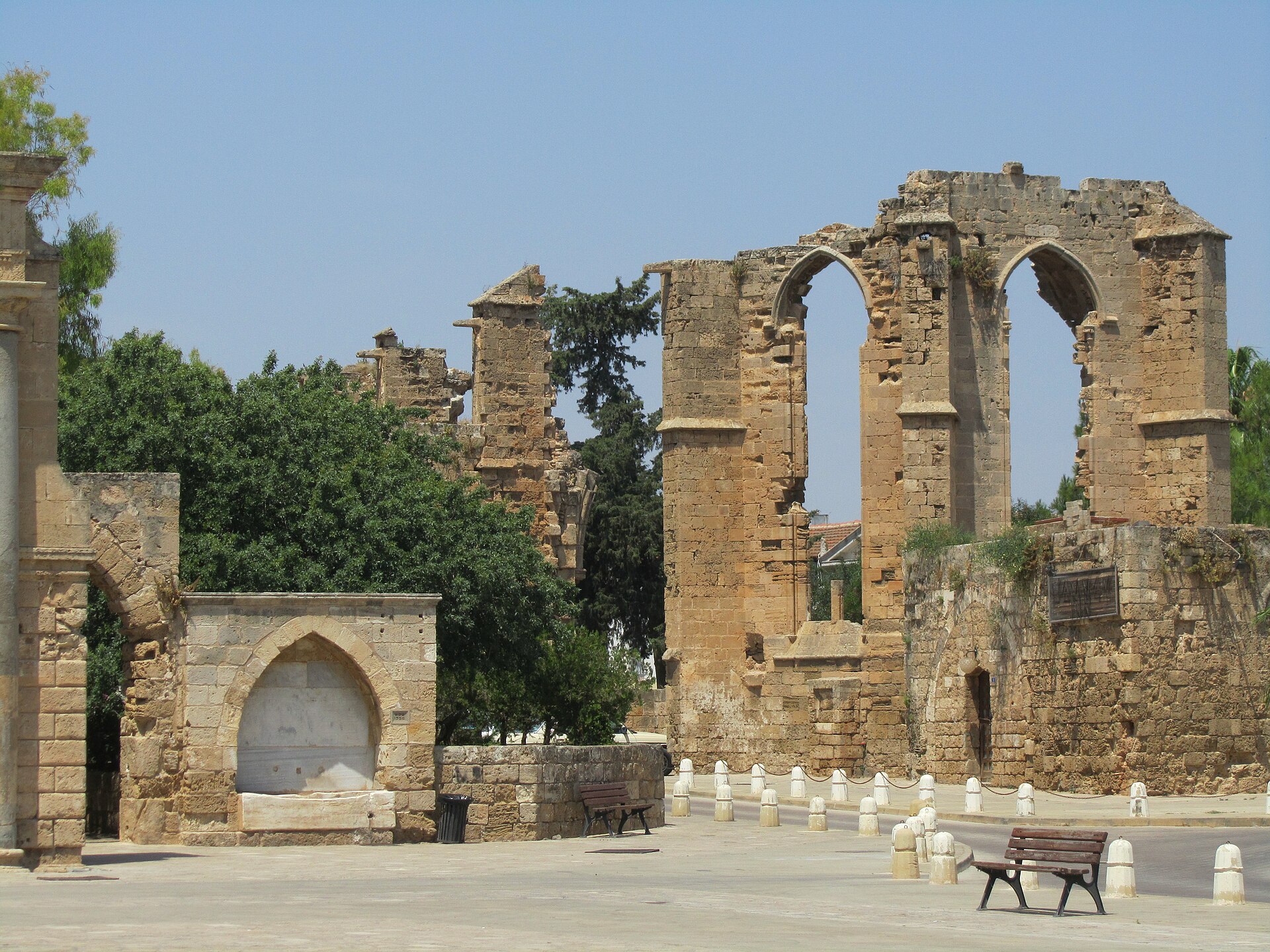
One of the most atmospheric sections is the Land Gate, the main entrance to the old city. Flanked by two sturdy towers, it was once the only way in or out for travelers and merchants. The gate itself is a mix of Venetian and Ottoman modifications, with a pointed arch that hints at its original design and later additions like the small guardhouse above. Passing through it feels like stepping into another era, where the narrow streets beyond are lined with the remnants of Gothic churches, Ottoman-era houses, and the occasional modern café. The contrast between the imposing stone of the walls and the intimate scale of the old city is striking.
The walls also frame the ghostly beauty of Varosha, the abandoned district just to the south. Once a glamorous resort area in the 1960s and 70s, it was fenced off after the Turkish invasion in 1974 and left to the elements. From the top of the fortifications, you can see the skeletal remains of hotels and apartment blocks, their windows empty, their facades bleached by the sun. The juxtaposition of the ancient walls and the modern ruins is unsettling, a reminder of how quickly fortunes can change. Varosha’s fate remains a sensitive topic, but its presence looms over Famagusta, adding a layer of melancholy to the city’s history.
Despite their age, the walls are far from a relic. They remain a living part of Famagusta, used by locals and visitors alike. In the cooler months, people walk along the ramparts in the evenings, watching the sunset over the Mediterranean. During festivals, the space near the Land Gate becomes a stage for music and performances. The walls have also become a symbol of the city’s resilience, a structure that has survived sieges, earthquakes, and political upheavals. They may no longer serve their original purpose, but they endure as a connection to the past, a tangible link to the generations who built, defended, and lived within them.
For those who take the time to explore, the walls offer more than just history. They provide a sense of scale—of how small human lives are against the weight of centuries, and yet how much those lives have shaped the world around them. The stones bear the marks of countless hands, from the Venetian masons who laid them to the Ottoman soldiers who scaled them, to the tourists who now run their fingers along the rough surfaces. In a city where the past is never far away, the walls of Famagusta stand as a reminder that history is not just something to be read about, but something that can be touched, walked upon, and felt.