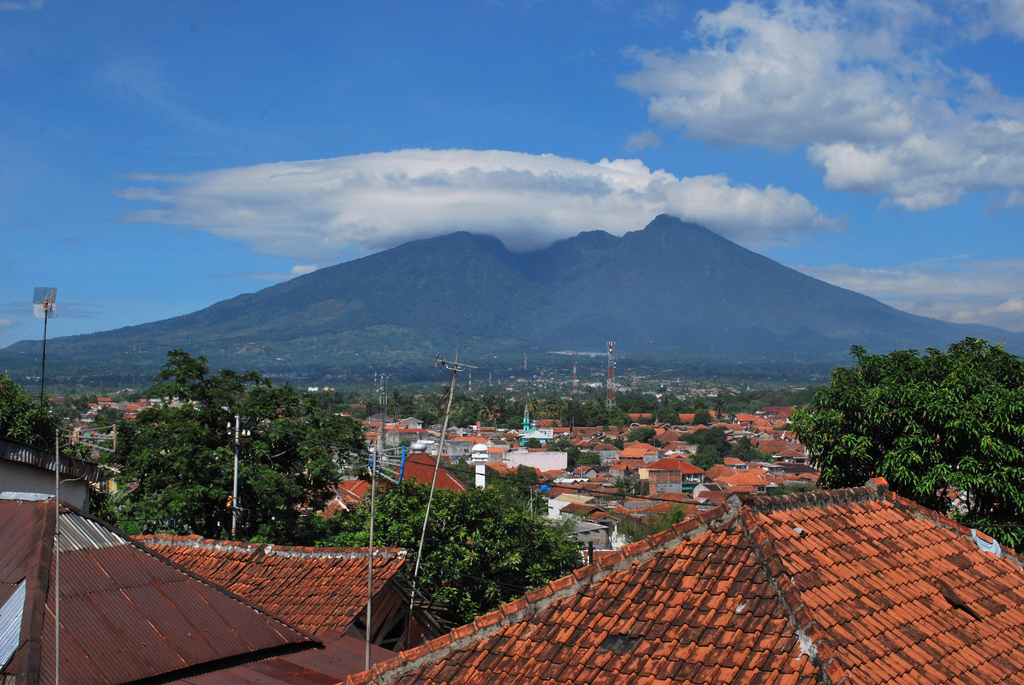
Mount Salak rises above the landscapes around Bogor like a silent guardian of Java’s ancient legends. Its jagged slopes, cloaked in dense forests, are visible from miles away, while the summit often vanishes into a veil of clouds, lending the mountain an air of mystery. For locals, Salak is more than just a natural landmark—it’s a place steeped in myth and history. The name itself is tied to the Javanese word for the salak fruit, its scaly skin said to resemble a dragon’s hide. According to local lore, the mountain was once home to spirits and supernatural beings, and in medieval times, it served as a refuge for those fleeing war and invasion.
Salak is an active volcano, one of many in Indonesia, though its activity is far less dramatic than that of better-known peaks like Merapi or Krakatoa. The last major eruption occurred in the early 19th century, and since then, the mountain has remained relatively quiet, occasionally reminding visitors of its presence with faint tremors. The volcanic soil has made the surrounding land fertile, supporting thriving agriculture on its slopes. Tea, coffee, rubber trees, and, of course, salak fruit—with its tart, pineapple-apple flavor—are grown here, shaping the region’s identity.
There are several routes to the summit, each offering a different perspective of the mountain. The most popular trail begins in the village of Cibinong, winding through dense tropical forest alive with birdsong and the rustle of leaves. Along the way, small waterfalls and mountain streams appear, and the air grows cooler and more humid. The landscape shifts as you climb—lush green valleys give way to rocky outcrops where vegetation thins. If the weather cooperates, the summit rewards hikers with sweeping views of the surrounding peaks and the Bogor valley below, stretched out like a map.
For many travelers, Salak is more than just a hiking destination—it’s a chance to experience the culture of West Java. The surrounding villages are home to the Sundanese people, who maintain traditional ways of life. Here, you can see farmers working the land by hand, artisans weaving batik, or families preparing local dishes like *nasi liwet*—rice cooked in coconut milk with spices. Small guesthouses and cafes dot the area, offering visitors a taste of Sundanese hospitality and cuisine.
What makes Salak special is its atmosphere—quiet, unhurried, and far removed from the bustle of Indonesia’s more tourist-heavy destinations. There are no crowds here, no souvenir stalls or guided tour groups, just the mountain and its rhythms. Mornings are particularly magical, with mist lingering between the trees as the sun begins to filter through the canopy. Evenings bring a different kind of stillness, broken only by the chirp of cicadas and the distant rush of waterfalls.
Salak is also part of the larger Gunung Halimun-Salak National Park, one of Java’s most significant protected areas. The park is a haven for biodiversity, home to rare species like the Javan gibbon and leopard. For scientists, it’s a living laboratory; for visitors, it’s a glimpse of nature in its rawest form. Well-marked trails allow for safe exploration, designed to minimize impact on the delicate ecosystem.
Despite its beauty, Salak demands respect. Its volcanic nature means conditions can change quickly—rain turns trails slippery, and fog can descend without warning. Local guides recommend sticking to marked paths, especially during the wet season when landslides are a risk. The mountain’s unpredictability is part of its charm, though. Every hike feels like a small adventure, with the landscape shifting underfoot and the weather keeping you on your toes.
For the people of Bogor and the surrounding villages, Salak is woven into daily life. Its slopes provide livelihoods—tea and coffee plantations, fruit orchards, and rice fields all thrive in its fertile soil. The forests offer timber and medicinal plants, while its waters feed the terraced paddies below. Yet the mountain is also a spiritual place. Small shrines dot its peaks, where locals come to honor ancestors and seek blessings. In this blend of the ordinary and the mystical, Salak reveals its true character—a place that is both grounded in reality and touched by something greater.